
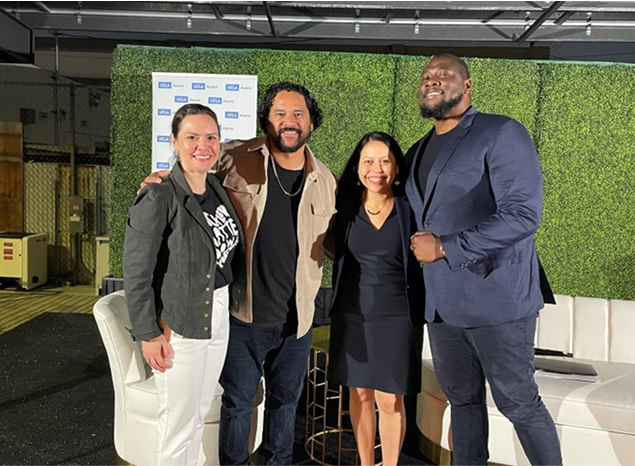
fighting spatial inequality
Ruby Bolaria Shifrin, Bruin story since, MURP ’14
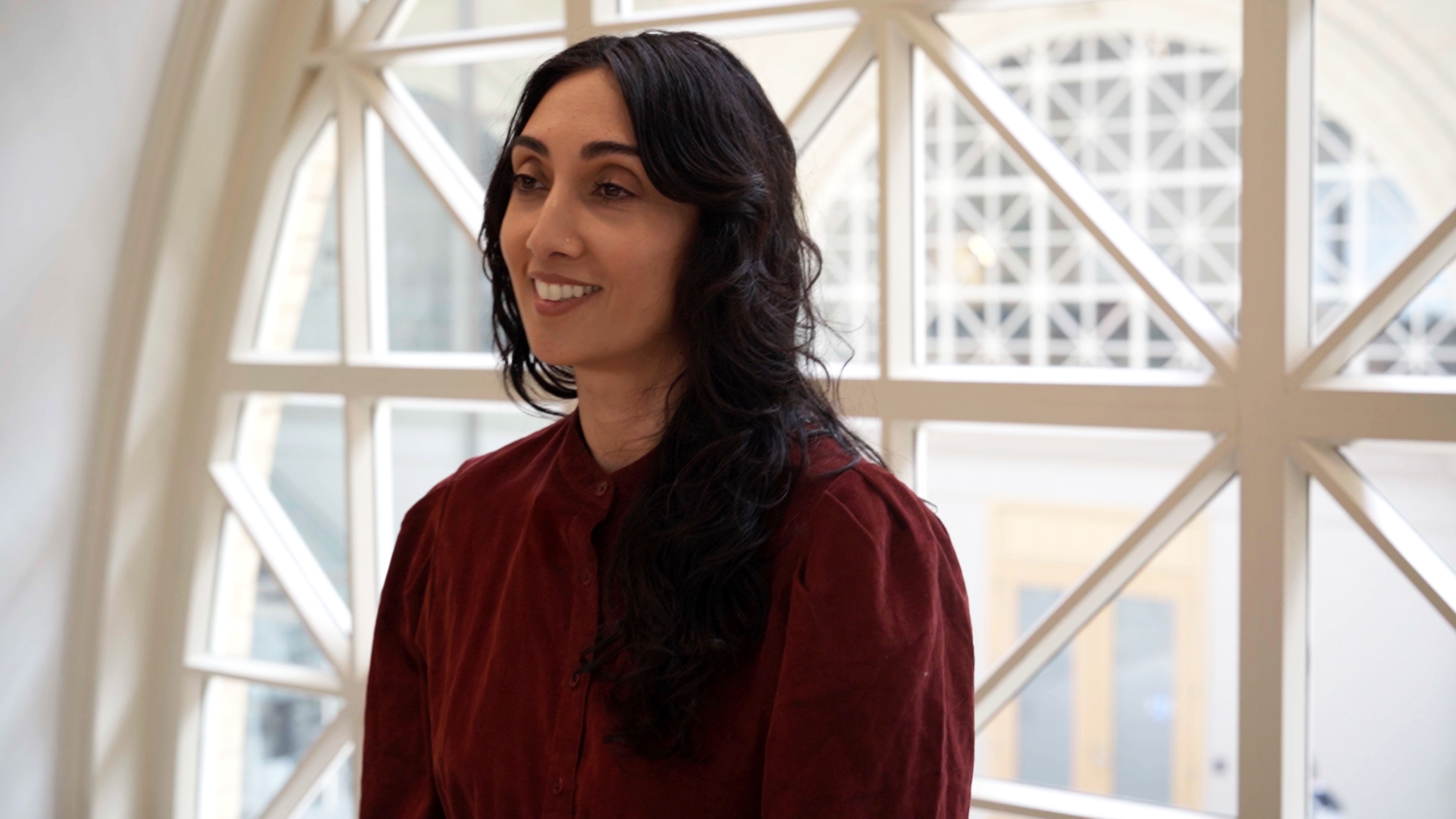
Ruby Bolaria Shifrin has called many places home. The daughter of immigrants, she grew up in Sacramento and San Mateo before attending UC Santa Cruz. She later lived in San Francisco, Boston, and New York City while working in environmental and social justice. In 2013, she returned to California to earn her master’s degree in Urban and Regional Planning at UCLA. Wherever she lived, Shifrin got around by public transit.
Navigating America’s largest metropolitan areas without a car made it painfully clear how the built environment reinforces racial and economic segregation. Who used transit throughout the day—not only during rush hour—and where they could go revealed stark disparities in communities’ access to jobs, healthy food, quality education, and other essential resources. While organizing in food justice alongside residents in Dorchester, a historically Black neighborhood in Boston, Shifrin met a local pastor working to create more opportunities for his community. The scale of the challenge quickly became clear: fast-food restaurants and liquor stores were plentiful, while the nearest grocery store was an hour away by bus. The experience reinforced for Shifrin that supporting healthy communities requires more than encouraging individual choices, it means working alongside residents to address the structural barriers that shape those choices in the first place.
Shifrin experienced those disparities in her own work as an organizer, which required her to travel across the city at all times of day, not just during rush hour. Infrequent service added significant time to even routine trips, making getting from point A to point B something she had to plan carefully. She also noticed that, outside peak commuting hours, most of her fellow passengers were women often with children. At UCLA, she later found the research behind what she had observed: women disproportionately shoulder caregiving responsibilities and often rely on transit for multiple connected trips, even though many systems are still designed primarily around peak-hour commutes.
Navigating those cities without a car. … It was really clear what parts of the city you have access to, what opportunities you have access to, where transit-poor neighborhoods are. You learned that that’s really by design, not by accident.
— Ruby Bolaria Shifrin

In Dorchester, Shifrin and her fellow organizers fought back by bringing weekly farmers markets into the neighborhood and successfully campaigning for a program allowing doctors to prescribe fruits and vegetables to low-income families. These victories, although inspiring, revealed to Shifrin the limits of grassroots advocacy. If city planning and zoning were ultimately responsible for resource inequality, then municipal reform could be the only permanent solution.
To change the rules of the game, Shifrin first needed to understand them. So, she applied to the UCLA Luskin School of Public Affairs, an institution she admired for blending a “social justice lens” with a “rigorous practitioner lens.” There, she learned exactly how regulations, capital incentives, and built environments shape people’s lives, while mastering technical skills like cleaning census data and compiling policy briefs. Shifrin applied these lessons outside the classroom, working with the graduate student union (UAW) to improve wages, hours, and childcare.
After completing her studies, Shifrin decided to enter the private sector to help better understand incentives and market forces that shape development., beginning in as a Market Analyst for the real estate agency JLL, before transitioning to the home construction company Lennar as a Development Manager in 2015. Armed with years of experience in creating financial models, securing city permits, and monitoring land use, Shifrin joined the Chan Zuckerberg Initiative (CZI) in 2018 to lead the new housing affordability program focused on California She built the team and oversaw its grantmaking and impact-investing portfolios, expanding both the program’s reach and its approach to creating change. As her leadership grew, so did her mandate: Shifrin ultimately became CZI’s Vice President and Head of Community, overseeing work across housing affordability, economic mobility and inclusion, and place-based giving.
It was during her seven-year tenure at CZI that Shifrin fully grasped the profound disparity between homeowners and renters. “Homeowners have the trifecta,” Shifrin observed. “They have cultural, economic, and political power.” Cultural power because homeownership remains a central component of the American Dream, economic power because homeownership builds wealth over time, and political power because homeownership is tied to a valuable and engaged constituency.
To pursue more innovative housing solutions, Shifrin pivoted once again, leaving her leadership position as Vice President and Head of Community at CZI to launch a new fund at Terner Labs dedicated to helping early-stage housing startups overcome the “scale gap”particular to housing: promising early-stage companies may have proven their ideas through pilots and initial customers, yet still lack the capital, policy expertise, and industry relationships needed to expand into new markets and attract further investment. The fund will pair values aligned capital with Terner Labs’ deep housing and regulatory expertise to help scale solutions that lower costs, accelerate production, and expand access to housing. Leveraging her background in organizing, real estate development, and philanthropy, Shifrin brings an interdisciplinary approach to the enduring battle against spatial inequality.
Of course, this is a massive undertaking, and Shifrin does not expect to fix the entire housing market by herself. “I think it’s hubristic to think that one effort, one person, one organization can solve all the problems,” reflected Shifrin. “The reality is that you need a coalition. You need a community.” For Shifrin, growing this collective is the next step in the journey.
I’ve always thought of it as a baton race. It’s my job to take the baton as far as I can and pass it to the next person.
— Ruby Bolaria Shifrin