
who we are
about us
“We hope to rekindle old memories and inspire new discussions of UCLA’s legacy.”
Marina Dundjerski ’94, author of UCLA: The First Century
Presented below are snapshots of our beloved institution from its humble beginnings to its current standing as one of the world’s most prestigious public research universities.
July 1, 1920 | ROTC Installed on Campus
On July 1, 1920, University of California President David Prescott Barrows’ request to implement a Reserve Officers’ Training Corps program at the Southern Branch of the University of California (as UCLA was first known) was officially granted. Having gained approval from the U.S. secretary of war, Newton Diehl Baker, the Southern Branch welcomed its first ROTC unit to the Vermont Avenue campus in fall 1920.
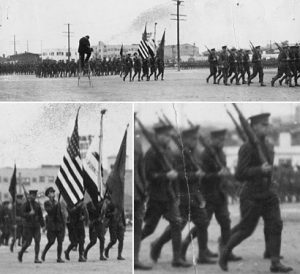
“The expressed object of the R.O.T.C. training is to create a reservoir of trained leaders classified as Reserve Officers, from which to draw in case of national emergency,” Col. Guy Palmer, instructor of military science, told the Daily Californian.
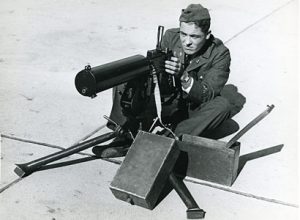
The campus provided a two-year program of compulsory military instruction and basic courses to all freshman and sophomore men. Initial enrollment totaled 516 cadets, who were required to dedicate at least three hours per week to military training and instruction during their first two academic years. At first, all instruction was limited to infantry training, but in 1934 a coast artillery course was added.
Students seeking advanced coursework were required to transfer to UC Berkeley. That changed in 1923, when curriculum leading to an officers’ commission was added. By 1940, more than 1,000 graduates of the program had been commissioned as second lieutenants in the U.S. Army Reserve.</p>
The Department of Naval Sciences followed the Army at UCLA in September 1938, when the secretary of the Navy authorized a program for those interested in pursuing a career with the Navy or the Marine Corps. The Department of Air Science and Studies was established on campus in 1949. In 1962, the UC Board of Regents made the initial two years of the ROTC program voluntary.
During the Vietnam War, opposition to the ROTC program at UCLA grew intense. But a resolution to abolish ROTC was defeated in the Academic Senate by a vote of 826 to 398.
Since its inception, more than 3,000 officers have been commissioned through UCLA’s ROTC. Today, there are 170 students enrolled in the campus’ Army, Navy and Air Force programs.
Top image: UCLA’s Army ROTC unit participates in a military procession on the Vermont Avenue campus in 1927. Early instruction was limited to infantry training.
Bottom image: Artillery instruction was added to the curriculum in 1934. In the photo above, a cadet learns to operate a machine gun. During World War II, ROTC training tapered off in favor of several special units to meet the needs of a country at war.
June 1, 1923 | The first UCLA graduates
On June 1, 1923, Director Ernest Carroll Moore conferred the first degrees awarded by the Southern Branch of the University of California (as UCLA was first known).
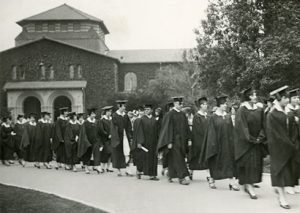
Twenty-eight students dressed in traditional black caps and gowns received bachelor of education degrees and listened to an address by Professor John Adams of the University of London. The ceremonies were held in ivy-covered Millspaugh Hall on the Vermont Avenue campus.
The first bachelor of arts degrees were awarded two years later.
Dec. 10, 1923 | A "twig" grows
On Dec. 10, 1923, the University of California Board of Regents approved a senior year of curriculum — to start the following September — at the Southern Branch (as UCLA was called then), offering students the opportunity of obtaining a Bachelor of Arts degree for the first time.
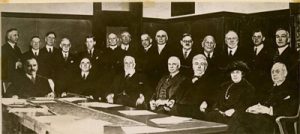
With this decision, 13 departments were authorized as major fields of study: chemistry, economics, English, French, history, Latin, mathematics, philosophy, physics, political science, psychology, Spanish and zoology. Charles H. Rieber was named dean of the College of Letters and Science.
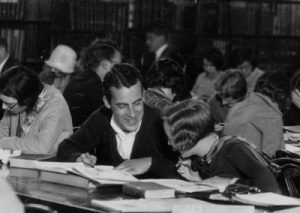
In his annual report for 1923, UCLA Provost Ernest Carroll Moore alluded to the struggle over the development of the Southern Branch:
“We are trying to discover whether or not a university can conduct its work in two localities [Berkeley and Los Angeles]. The experiment is significant, for, as the nation grows and the states increase in population, it is inevitable that the State University must either transform itself into a statewide system of higher education, under a single Board of Regents, or become one of several competing state colleges.”
The Southern Branch, or “twig” as some called it, was now a full-fledged, four-year university. And there was no going back.
Top image: In 1923, the University of California Board of Regents approved a fourth-year curriculum for the Southern Branch.
Bottom image: Students studying in the library of the Vermont Avenue campus.
May 5, 1925 | Rallying for Westwood
New media, record voter turnout and engaged young voters – these were the stories that riveted citizens on May 5, 1925. The biggest issue for Bruins was Proposition 2, a city bond measure that would raise about 70% of the funds needed to purchase a 200-acre parcel for the Southern Branch of the University of California.
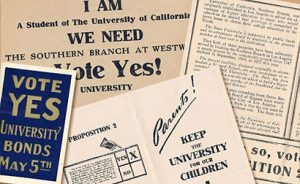
Students and young alumni joined together to conduct a colorful and noisy campaign. They knocked on doors, distributed literature on street corners and exploited new technology. Local theaters screened a 10-minute advocacy film, and students took the case directly to voters over the radio airwaves.
The Los Angeles proposition passed by a 3 to 1 margin, and victories soon followed in Santa Monica, Beverly Hills, Venice and statewide measures. A final grant from the Los Angeles County Board of Supervisors allowed the UC Board of Regents to purchase UCLA’s current Westwood location at no cost to the university. Originally known as the Beverly site, the area was selected over proposed locations in Burbank, Fullerton and Palos Verdes.
Image: Propaganda created by students and alumni helped convince voters to overwhelmingly approve funding in 1925 to purchase UCLA’s Westwood campus.
Oct. 22, 1926 | Hail, Bruin!
The mighty Buccaneers? The California Gorillas?
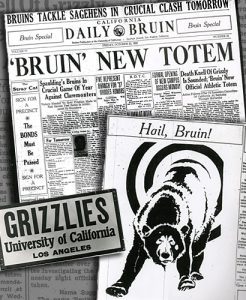
Those were just two of the possible answers to the crisis that arose in October 1926.
In the spring of 1924, students from the Southern Branch of the University of California (as UCLA was known then) had discarded Cubs — a moniker that symbolized the campus’ fledgling status — to the fiercer Grizzlies name instead. But the University of Montana (members of the Pacific Coast Conference, which UCLA hoped to enter) claimed precedence to the name. In several exchanges of correspondence, Montana had threatened legal action unless UCLA changed its team name.
By Oct. 4, 1926, students had submitted more than 100 new names for campus to consider, including Pirates, Panthers, Buccaneers and Gorillas. Approximately half were alternative references to bears, including Silvertip, Kodiac and Bezudo. Though the California Daily Grizzly urged every student to enter at least one suggestion, some still held tightly to the Grizzly, refusing to surrender the field.
“I am decidedly against the proposed change,” opined senior class President Frank McKellar ’27. “I have not yet seen a suggestion which will suffice… Why should we relinquish a name which has been ours for so many years?”
The debate over adopting a “new cognomen” raged on the pages of the Daily Grizzly for nearly a week, with Buccaneers winning the most support. Students and administrators, including Dean of Women Helen Matthewson Laughlin and Dean of the Teachers College M.L. Darsie, weighed in on the matter in language befitting a federal courtroom.
The crisis finally was resolved through intervention from a surprising quarter. While it had been among the students’ suggestions, the name Bruins had been used alternately with Bears by Berkeley for years. In a show of brotherly unity, Berkeley’s student leaders offered the name Bruins to UCLA, and the Associated Student Council voted unanimously to adopt the name. The change was announced officially in the Oct. 22, 1926, issue of the rechristened California Daily Bruin, which also included a list of hastily rewritten cheers and yells for use at the following day’s football game against the tough Pomona Sagehens.
The mighty Bruins wore their new name well. They soundly trounced the Sagehens 27-0 at the Coliseum, swinging the team back into the conference championship race and establishing a winning tradition for Bruins to come.
Image: UCLA (then known as the Southern Branch of the University of California) had been the Grizzlies for less than two years when the University of Montana claimed precedence over use of the mascot, demanding that UCLA adopt a new totem. The ensuing debate raged for days on the pages of UCLA’s student newspaper, with students, faculty and administrators alike weighing in on the choice of a new mascot.
Oct. 23, 1927 | A bridge to the future
In May 1927, ground was broken at UCLA’s new Westwood campus and the first priority was to construct a bridge to cross the deep arroyo.
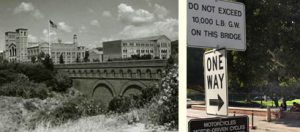
Modeled in the Roman aqueduct style by University of California supervising architect George W. Kelham, the bridge was necessary for transporting construction supplies over the ravine that divided the east and west parts of the site.
Mules pulled materials including cement sacks, lumber and bricks, over the Arroyo Bridge from the east entrance on Hilgard Avenue.
The walls of the bridge were inlaid with three huge arches, and Kelham’s Romanesque design featured intricate rosette and diamond patterns and carved limestone, decorative parapets, and a series of smaller arches running along the upper portion of the structure. The bridge – 285 feet long and 75 feet wide – stood two stories deep at its ends and three at its center.
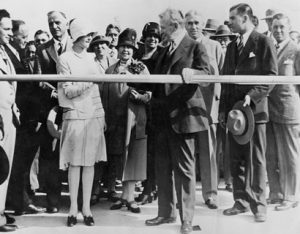
The Arroyo Bridge was dedicated in a ceremony officiated by Gov. C. C. Young on Oct. 23, 1927, marking the completion of the first structure on campus.
In the summer of 1947, the gully was filled to increase the amount of useable property on the campus.
Today, the bridge’s arches remain hidden underground at Dickson Plaza.
Top image: Gov. C.C. Young cuts the ceremonial ribbon at the dedication of the Arroyo Bridge, UCLA’s first structure at Westwood. Student Helen Fitch ’30 handed him the honorary shears. To the right, holding his hat, stands UCLA student body President Tom Cunningham ’28. UC Regent Edward A. Dickson observes from the far right.
Bottom left image: The Arroyo Bridge as it stood over the deep ravine in 1934. The bridge served as an entrance to campus until 1947, when the gully was filled in to increase the amount of useable space on campus.
Bottom right image: Today, a sign warns of vehicle weight restrictions “on this bridge,” which remains hidden from view.
Nov. 8, 1928 | Blue and gold forever
On Nov. 8, 1928, renowned American composer John Philip Sousa was greeted at the Southern Pacific railway station by the UCLA band in downtown Los Angeles during what would be his final national tour.
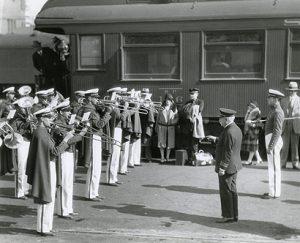
The March King, 74 years old at the time, led the Bruin band with its bombastic tubas and trilling piccolos in a rousing rendition of America’s national march, his venerable “Stars and Stripes Forever.” The band members, attired in newly commissioned uniforms, featuring a reversible blue-and-gold cape, continued to play while following Sousa’s car from Fifth Street and Central Avenue to the Biltmore Hotel.
Just one year prior, the band — originally formed in 1925 as a 50-member ROTC unit — was recognized by UCLA’s student council as an official campus organization. Musician Ben Laietsky, who had performed with Sousa’s band, was selected as the UCLA band’s first director. Bugler John Vaughn ’32 was its first drum major.
Members of the Associated Students’ executive council were also on hand to celebrate the visit. President Kenneth Piper ’29 remarked that it was a great honor for the band and UCLA students to participate in what was already being rumored as Sousa’s last visit to Los Angeles before retiring from public life.
Sousa died four years later, but the memory of that magical musical day stayed with the Bruin band members for years to come.
Image: Downtown rang to the sound of the march one fall day in 1928, when legendary conductor John Philip Sousa led the UCLA band in a rousing rendition of “Stars and Stripes Forever.”
March 18, 1929 | Class in session
The 125 students enrolled in Professor Hosmer W. Stone’s Chemistry 1A course were in a class by themselves – literally. The class, which met for the first time at 8 a.m. on March 18, 1929, was the first to receive instruction at UCLA’s new Westwood campus – months before its official opening.
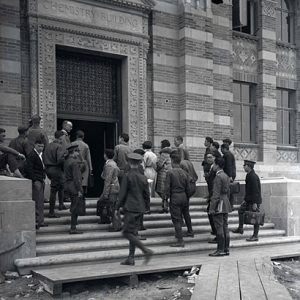
A mysterious fire had forced the early use of the new Chemistry Building (now Haines Hall) – even though only 60% of the building had been completed – and remains one of UCLA’s unsolved mysteries.
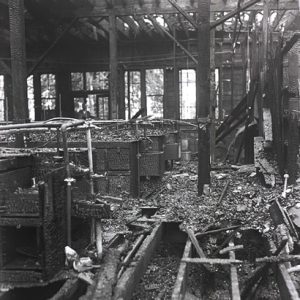
At 2:42 a.m. on Jan. 3, 1929, two students living across the street from UCLA’s Vermont Avenue campus were startled by a small explosion and subsequently found California Hall, which housed the chemistry laboratories, on fire. By the time firemen arrived, the blaze was out of control, aided by the highly combustible chemicals in the building. By dawn, California Hall was nothing more than charred embers.
The cause was not immediately clear to authorities. A chemical fire was one theory. But since a velvet curtain in Millspaugh Hall auditorium was found ablaze at approximately the same time, investigators decided arson was the likely cause of both incidents.
California Hall was a two-story wooden structure built in 1917 as barracks for the Student Army Training Corps. Chemistry instruction and labs were moved into the building after constant complaints about foul odors and corrosive fumes from the other Science Building tenants – including the biology department.
UCLA Director Ernest Carroll Moore telegraphed the news of the destruction to University of California President William W. Campbell, and measures were urgently put in place to replace all lost materials and push forward the construction of the Chemistry Building at the new Westwood campus.
No one seemed to mind the loss of the antiquated building. The Daily Bruin ran a tongue-in-cheek story that began: “ ‘Cal’ Hall – the bugaboo of the campus – the butt of many a college wise crack – no longer torments the U.C.L.A. campus.”
“Everyone said that some day ‘Cal’ Hall would burn down,” the article continued, “and finally “California” Hall gave up the struggle and submitted to the universal opinion.”
Jokes and rumors as to the cause of the fire abounded. Some campus wits placed blame on USC pranksters. Others joshed that Chemistry Department Chair William C. Morgan found a convenient way to get an emergency appropriation for new supplies and speed up the move to the larger, modernized building at Westwood. Even the characteristically stern chairman couldn’t help but quip about the matter.
“That old barracks should have burned down long ago,” Morgan reportedly said the morning after the fire. “And wouldn’t you know it – when it did, all the witnesses were looking the other way.”
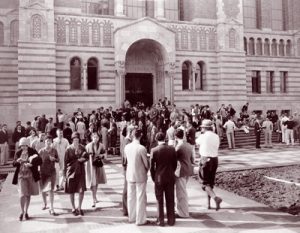
Top image: Students enter the newly constructed Chemistry Building (now Haines Hall) at the Westwood campus on March 18, 1929. A chemistry class had the honor of christening the campus after a fire destroyed the laboratories at UCLA’s Vermont Avenue campus.
Bottom image: California Hall on the Vermont Avenue campus lies in ruins after an unexplained blaze broke out in the early morning hours of Jan. 3, 1929. Rather than rebuilding from the ashes, plans were pushed forward to have the Chemistry Building on the Westwood campus ready for classes by March – six months before the campus’ official opening.
May 31, 1929 | Go West, young Bruin
Yearbooks were circulating, student government was changing hands, final semester exams were looming – everything appeared to be business as usual for springtime on UCLA’s Vermont Avenue campus. Regardless, something very unusual was going on.
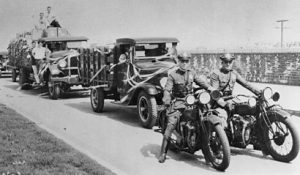
UCLA’s chief executive Ernest Carroll Moore declared a half-day holiday for May 31, 1929, so that students, faculty and staff might spend the remainder of the day taking possession of the new campus, still under construction, in Westwood.
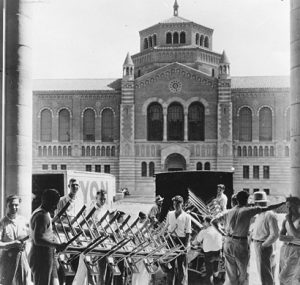
Classes dismissed at 1 p.m., and the university community amassed at Heliotrope Drive for the more than 10-mile trek west. Three truckloads of furniture and the Bruin band led the caravan to the new campus, which consisted of four completed buildings (Royce Quad), the arroyo bridge and several more projects under construction. The Rally Committee, headed by Stanley Jewel ’29, was on hand to decorate the cars that would follow with blue and gold streamers.
Special police led the motorcade of more than 500 automobiles, trucks and vans loaded with chairs, desks, filing cabinets, books and laboratory equipment. Moore met the entourage as it entered campus, and the ROTC band played from the steps of the newly completed Royce Hall.
“It was a thrilling sight to see 2,000 young people pour themselves among the buildings and into them,” Moore recalled later.
Moving continued through the entire summer, though the bulk was transferred during a three-day period, beginning in August, under the direction of assistant comptroller Robert Underhill and a staff of 300 students. He later recalled the task as “one of my finest accomplishments in my university career.”
By Sept. 18, campus officials were prepared to resume business as usual, taking registrations for the fall semester on the new campus.
Top image: On Moving Day, a caravan of more than 500 automobiles, some decorated with blue and gold streamers, made the journey to the Westwood campus escorted by police.
Bottom image: Students received a half-day holiday from classes in order to transfer materials from the Vermont campus. Moving continued throughout the summer of 1929.
Sept 20, 1929 | Registration day in Westwood
Rain had fallen the night before UCLA’s first registration day in Westwood on Sept. 20, 1929, and the dusty walks had turned to lanes of gooey mud. Only the flanges of newly laid curbs kept feet dry. Raw lumber and sacks of cement lay stacked for use. Lawns and shrubbery were nonexistent and not-quite-yet completed buildings rose starkly from the bare earth.
“I suggest two new courses,” Dean Charles H. Rieber jokingly told students. “The first on whistling to keep up courage, the second on nettle-grasping.”
Five days later, the first assembly was held in Royce Hall and Provost Ernest Carroll Moore addressed the jam-packed auditorium:
“Thus do long dreams come true. Your university welcomes you to her new house. It smells of plaster and of paint. It is not finished yet and there is mud, dust and confusion about it. No other class will ever enter here without finding grass between these buildings. But then, no other class will be the first class or have the joy of pioneers.”
March 28, 1930 | Westwood campus dedication
On March 28, 1930, an internationally prominent group of academics gathered to dedicate the Westwood campus of the University of California at Los Angeles. The significance of the day, marking another step on UCLA’s path to independence from the UC campus at Berkeley, was not lost on area newspaper writers.
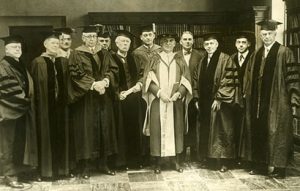
The story made the cover of the Los Angeles Times, but perhaps the most prophetic story came from the pen of student Charles Olton ’31. “Today a leading university of the world … will be consecrated to its task of educating the youth of today and of tomorrow,” wrote Olton for the California Daily Bruin.
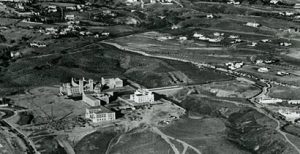
More than 5,000 people traveled to Westwood to witness the dedication ceremonies. Among the gathered scholars were UC regents, President William Wallace Campbell, Vice President and Comptroller Robert Gordon Sproul, Nobel Prize for Physics recipient Nathaniel Comfort, J. Arthur Thomson of Aberdeen University in Scotland and Dean Blyth Webster of St. Andrew’s University in Scotland.
Top image: Among the delegates attending the dedication of UCLA’s new campus: UC President William Wallace Campbell (center, holding book), Vice President and Comptroller Robert Gordon Sproul (on Campbell’s right) and Regent Edward A. Dickson (second from far right).
Bottom image: The Westwood campus in 1930.
Jan. 20, 1931 | Kerckhoff’s wish realized
For many Bruins, the iconic Gothic spires of Kerckhoff Hall, rising majestically high above campus, are second only to Royce Hall as a symbol of UCLA. Kerckhoff’s emotional appeal traces all the way back to the building’s dedication.
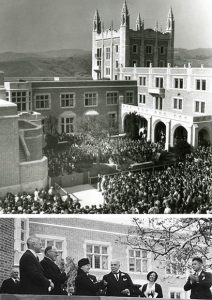
On Jan. 20, 1931, some 6,000 students gathered for official dedication ceremonies of the Westwood campus’ first student union building. The structure was made possible by a gift of $715,000 by Louise Kerckhoff, in honor of her late husband, William G. Kerckhoff, who on his deathbed asked his wife to carry out his intentions to provide funds for a student union.
Louise Kerckhoff ensured that his wishes were not only carried out, but that the building honored his memory. She visited the construction site almost daily to make certain that the workmanship and materials met her exacting standards. Details of Kerckhoff’s life are embedded in the building. The stained glass images of a redwood tree and a dam on the fourth floor, for example, refer to Kerckhoff’s successful career in the lumber business and his contributions to the development of hydroelectric power.
Louise Kerckhoff also gave $100,000 to fully furnish the facility – making the $815,000 donated the largest single gift by an individual to UCLA up to that point.
Too overcome with emotion to speak at the dedication ceremony, Louise Kerckhoff left words to others as she silently presented the key to the building to California Gov. James Rolph Jr., who accepted on behalf of the people of California.
“Mr. Kerckhoff was a man of vision, of kindly instincts, generous to a fault,” Rolph said, “and he ever bore in mind that some parts of his riches should be given for others to enjoy.”
Top image: Some 6,000 students help celebrate the official opening of Kerckhoff Hall on Jan. 20, 1931
Bottom image: From the left, prominent UC notables and friends attend the opening ceremonies of Kerckhoff Hall, including Allan C. Balch; Ernest Carroll Moore, director of UCLA; Louise Kerckhoff; California Gov. James Rolph, Jr.; Lucy Guild ’31, president of the Associated Women Students of UCLA; and Earle Swingle ’31, president of the Associated Students of UCLA
Feb. 25, 1931 | Waving the blue and gold
In 1931, loyal Bruin fans found a new way to celebrate victories, courtesy of the West Los Angeles Rotary Club. At a noontime ceremony on February 25, near the flagpole on UCLA’s main quad, Rotary Club president Edward Coe formally presented UCLA’s first victory flag to ASUCLA President Earle Swingle ’31, who accepted on behalf of the student body.
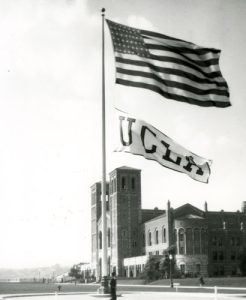
The banner, which for years was flown below the American flag following athletic victories, was an impressive gift. The 12- by 31-foot flag read “UCLA” spelled out in blue and gold across a massive white field.
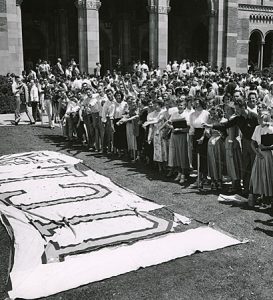
“This victory flag is but one of the bonds between the university and the Rotary club,” Coe told the assembly of 200 students and guests, as reported in the Daily Bruin. “The university and the club are working hand in hand and will continue this relationship that is so beneficial to both.”
The ceremony included yells led by Ralph Green ’31, the singing of “Hail Blue and Gold” and a luncheon for selected guests, including former Daily Bruin editor Carl Schaefer ’31. The idea for the flag was Schaefer’s, and the gift was the result of an editorial campaign waged in The Bruin during fall semester 1930.
This UCLA victory flag was used for the next 18 years, until the torn and weather-beaten banner finally was retired and replaced with a flag purchased through contributions from alumni, students and friends of UCLA.
Top image: For years, the victory flag was flown below the American flag on UCLA’s main quad following athletic victories.
Bottom image: In efforts to raise funds for a new victory flag, the soon to be retired flag was outspread on the quad and students made their contributions by tossing coins onto the worn banner.
Jan. 15, 1932 | Westwood’s winter wonderland
One of the most beautiful and rare mornings to ever befall UCLA occurred Jan. 15, 1932, as the campus was unexpectedly covered in a wintry blanket of snow.
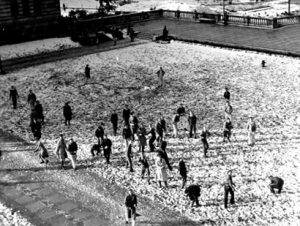
Bruins arriving to campus by 8 a.m. found a never-to-be-forgotten panorama: redbrick buildings topped with white icing, trees and shrubs made cottony, and Royce Quad overlaid with two inches of glistening snow.
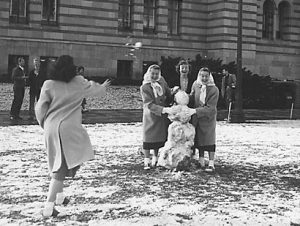
It soon became clear that instead of the usual scholarly activities, the order of the day was snowman making and a pandemonium of snowball fighting. Some professors, joining in the diversion, officially dismissed classes. Those professors who tried to charge through the barrage to maintain a semblance of order, found that “personalities were not respected,” according to the Daily Bruin.
The playful mayhem was quickly met by a police officer. But as he reached Royce Hall, he was himself deluged with snowballs from all sides, including those thrown from an overhead balcony.
The administration was understanding of the exuberant spirits, however: “Let them have their fun,” The Bruin quoted UCLA leaders as saying. This, even after rumors that Ernest Carroll Moore, UCLA’s chief executive, was hit by a snowball — a claim denied by his office.
For three hours, “only the brave ventured out of buildings into the war zone,” The Bruin wrote. Then, as suddenly as it appeared, the snow vanished — melting by 11 a.m., under the bright sun.
As UCLA returned to its normal state, evidence of the morning’s events remained in a few reported black eyes and other minor injuries, a damaged lamp post, a shattered chandelier and 14 broken windows — some of which were reportedly attributed to professors’ inexpert aim. A good sport, Dean of Men Earl J. Miller offered to pay for damages.
In the end, “all was forgiven,” wrote the alumni magazine, “for snow on the UCLA campus is a rare experience indeed.”
Top image: UCLA’s first snowfall, 1932.
Bottom image: A second snow in January 1949.
Aug. 3, 1935 | Into the woods
It all began with a Depression-era relief project.
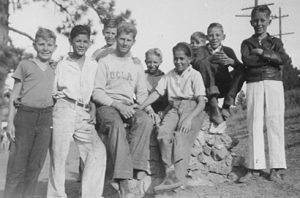
Eleven UCLA students organized a food drive in 1934 to benefit needy children and families living in West Los Angeles. But the student volunteers wanted to do more.
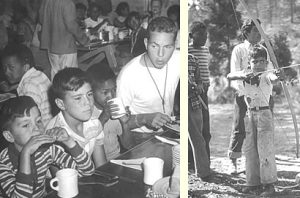
Through the efforts of several students on the board of the University Religious Conference an outdoor summer camp was organized, and on August 3, 1935 UniCamp welcomed its first official campers.
The initial University Camp, or UniCamp as the program has come to be known, was scheduled with two 10-day sessions from Aug. 3 to 23, 1935. With the guidance of their UCLA student-counselors – among them, future Olympian James LuValle ’36, M.A. ’37 – 54 children from economically disadvantaged backgrounds were invited to set up camp in the San Bernardino Mountains at Big Pines.
That first year, for just $8 each, campers 13 to 18 years old enjoyed traditional camp and educational activities that enabled them to learn from each other and the great outdoors. UniCamp leaders hoped the exposure to a new environment would empower them to explore new avenues of self-expression and strive for brighter futures.
Today, UniCamp hosts over 1,000 children every summer from low-income families in Los Angeles. Campers are selected in conjunction with partner social service agencies, schools, and shelters, inviting them to a week-long summer camp experience.
The program currently operates as an independent non-profit organization that relies on student-driven fundraising and donations from various entities on campus, as well as private business and community organizations. Although campers still attend UniCamp for a minimal charge, the cost to send a child to a week of camp is over $500.
In 1948, UniCamp became UCLA’s official student charity. Along the way, it benefited from financial support from the long-running (though now dormant) spring Mardi Gras fundraiser and has expanded to include multiple weeklong sessions.
Over the years, thousands of campers and UCLA student-counselors have mutually benefited from UniCamp, still located in the San Bernardino Mountains. This poem, from that first session in 1935, continues to echo the UniCamp spirit:
One road leads to the mountains,
One road leads to the sea,
One road leads to the city,
But the open road for me.
There’s a spell around the camp fire,
And a lure of the campers’ code
That bids me take my pack sack
And follow the open road.
Top image: The first UniCampers were divided into two separate sessions, one 10-day period for boys and one 10-day period for girls. Here, a student counselor poses with his all-male camp group in 1935. Today, coed multiple one-week sessions are held throughout the summer.
Bottom left image: Campers and counselors gather at the communal dining hall for mealtime in this photo circa 1950s. The dining room and cook, which previously were under management of the University Religious Conference, provided three meals a day for campers.
Bottom right image: In this circa 1940s photo, a young camper focuses intently on his archery target, while others eagerly wait their turn. Centered around the outdoor summer camping experience, traditional activities during the first session included swimming, fireside gatherings and archery – activities which continue to this day.
Nov. 10, 1937 | Brawling Bruins
In 1937, sophomore class President Bob Stabler ’40 was kidnapped from his fraternity house by a band of freshmen, just days before the annual competition the California Daily Bruin called a “very gory” event – “what with the goo and mud and bodies strewn all over Spaulding Field.”
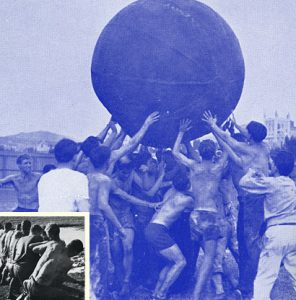
On Nov. 10, freshmen and sophomores met on the field for the annual Freshman-Sophomore Brawl, an event where freshmen, or “yearlings,” and second-years squared off in a battle for respect. For the freshmen, victory meant possible liberation from a slew of embarrassing demands commonly imposed by upperclassmen that included being required to sport buttons with the word “froshie” on them, or small green hats called “dinks.”
Hosted by the Men’s Athletic Board, the male-dominated tradition was made up of various strength-based competitions, including a tug-of-war, sock race, tie-up, tire tussle, relay races and push-ball. The push-ball was about seven feet in diameter and weighed several hundred pounds. The object of the game was to push, or “rush” the ball onto the opponent’s side over the goal line – meant to symbolize class rushing.
A point-based system was used to determine the brawl winners. Although not an official part of the event, if a class president was kidnapped and brought to the competition in chains, an extra point was added to the kidnappers’ score. In 1937, Stabler managed to escape captivity just days before the competition, and the freshmen were unable to redeem him for the extra point. Despite his flee, by the end of the day the freshmen turned out victorious, earning their dignity with a final score of 7-1.
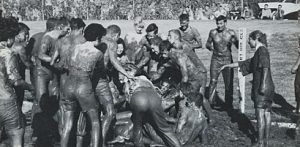
Over the years, the competition would evolve. First, as part of a larger Men’s Greek Week Mud Brawl in the 1950s and 1960s, with the main competition being a muddy tug-of-war between freshmen and sophomores. In 1959, female class members got their chance to hold their own in the slop, as a women’s tug-of-war was added. The event left no participant untouched, as the field was transformed into a muddy morass, with students covered up to their necks in mud. But the brawl, as it was first conceived, faded away from annual campus tradition.
Top image: Freshmen and sophomores in 1937 struggle to “rush” the ball (meant to symbolize class rushing) onto the opponent’s side to score points. The freshmen class would rise from the mud victorious.
Top inset image: Years later, the tradition evolved into the Men’s Greek Week Mud Brawl featuring a muddy frosh-soph tug-of-war as the main event. In 1962, both classes struggle to pull each other into the pool of mud not far from Sproul Hall.
Bottom image: The formerly male-dominated event turned coed in 1959 with the addition of a female tug-of-war. In this 1962 photo, both male and female students jumped into the muddy action.
June 11, 1938 | A matter of degrees
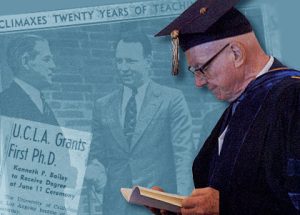
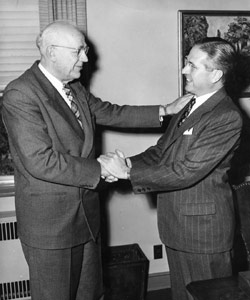
As Kenneth P. Bailey ’34, M.A. ’36, Ph.D. ’38 walked down the aisle at the Hollywood Bowl on June 11, 1938, he entered the pages of history by becoming UCLA’s first graduating doctoral candidate and triple degree holder. But Bailey’s personal achievement represented a triumph for all of Los Angeles, as it marked the end of a long struggle to establish graduate study at UCLA.
When Bailey enrolled at UCLA in 1931, earning an advanced degree was not a possibility. Twelve years after UCLA’s founding, graduate education was still limited to the University of California’s Berkeley campus.
In 1932, the Los Angeles Chamber of Commerce and the Southern Alumni (later to organize as the UCLA Alumni Association) joined with UC Regent Edward A. Dickson, UC President Robert Gordon Sproul and UCLA Provost Ernest Carroll Moore in lobbying the regents and Legislature and calling for the establishment of graduate degree programs at UCLA.
It was an uphill battle against strong opposition from those committed to restricting graduate work to Berkeley. Only after UCLA alumni leaders appeared before the Board of Regents to advocate their cause did the regents vote the start-up funds for advanced study at UCLA.
In 1933, graduate study was authorized for the Master of Arts. Approximately 125 students enrolled. Programs were offered in 16 fields, and 42 master’s degrees were awarded at the end of the first year. The Graduate Division was established officially in 1934, and the mandate was expanded in 1936 to include the doctoral degrees. Two years later, Bailey was handed his diploma by President Sproul and a memorable newspaper headline proclaimed: “Bruin, Brain, Brawn.”
Today, nearly 12,000 graduate students study at UCLA.
Background image: Earle R. Hedrick (left), UCLA’s chief executive, congratulates Kenneth P. Bailey on being the first student to earn a Ph.D. at UCLA.
Foreground image: Bailey, whose doctorate is in history, was invited back to UCLA in 1988, in honor of the 50th anniversary of his accomplishment. Bailey died in 2000.
Dec. 12, 1942 | Rivals bond in war effort
One year after Japan attacked Pearl Harbor, USC-UCLA football organizers marked the anniversary by turning the annual crosstown grudge match into a million dollar war bond drive. The two schools would compete against each other to sell bonds along with game tickets and raise money to support the war effort.
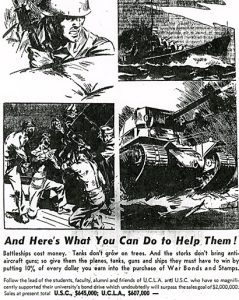
Bruin fans wanting tickets to the Dec. 12, 1942 game received a letter from head football Coach Babe Horrell urging them to purchase the war bonds and a blank bond application. Bonds were $18.75 each, but a $5,000 investment would win fans free seats on the sidelines with their team.
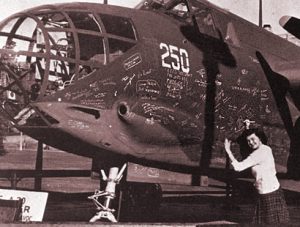
The student War Savings Committee chaired by Tom Papich ’43 marshaled star power and organized campus events to help the Bruins best the Trojans in fundraising. In the week leading up to the big game, defense stamps were the currency of the day. They earned students the right to catch popular band leader Freddy Martin at the All-U Sing, autograph the Douglas bomber A-20 on display, see a two-man Japanese submarine captured in the Pearl Harbor attack and dance the night away to the sounds of Rudy Vallee and his Coast Guard Ensemble (comprising members of the day’s most popular big bands).
By Tuesday, the competing campuses had raised $952,700, and the final goal was doubled to $2 million. UCLA trailed by $250,000, but made up ground over the next few days, chalking up $610,000 to USC’s $640,000 by Saturday.
The effort reached a climax on game day. During half-time, 80 Army and Navy ROTC students accompanied 80 female students to work the crowd of 80,000 and sell more bonds. All-Americans Kenny Washington ’41 and Morley Drury raffled off the ball used for the kickoff, while comedian and Bruin fan Joe E. Brown raffled off the game football. Bruin and Trojan card stunts plugged sales while the marching bands spelled bond slogans on the field and, according to the Daily Bruin, “blew their horns right in ‘Der Fuehrer’s Face’” (a reference to a then-popular patriotic parody song by Spike Jones and his City Slickers).
The Bruins won the day, 14-7, beating the Trojans for the first time and taking the Victory Bell home on their way to a first-ever season-ending Rose Bowl appearance.
The Daily Bruin didn’t reveal which school finally won the war bond drive, but it did report that after all receipts were tallied, the united efforts of the rivals resulted in $2,097,000 for the war effort.
Top image: UCLA students, like Alvira McCarthy ’44, anxious to help raise funds for the war effort could pay 25 cents to autograph a Douglas bomber A-20 displayed on campus between the men’s and women’s gyms.
Bottom image: An advertisement in the Daily Bruin the day before the big game encouraged fans to: “Stay behind the team but above all else stay behind your country.”
May 13, 1943 | Springtime Revelry
Mardi Gras – for decades UCLA’s largest student-run activity – had roots in a “Carnival” held on May 13, 1943 in the women’s gym that featured jigs and reels with Elizabethan costumes and athletic competition.
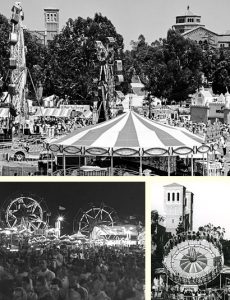
Some accounts describe Mardi Gras festivities beginning as a masquerade ball in 1941, or earlier as an annual event presented by a Masonic affiliate club. However, as little record exists recounting the ball, the details of the true origins of the extravaganza remain unclear. What is known, is that an event called “Mardi Gras” was held on campus in 1945, furthering the festival spirit of the 1943 social. Sponsored by the University Recreation Association, the evening included dancing and 40 decorated concessions operated by university organizations and ended with the coronation of the king, a favorite professor elected by the students.
As the event evolved, UCLA’s annual tradition emerged. Held in spring, the festivities moved between various outdoor campus locations until finally settling onto the Intramural Field. Months of preparation culminated with the annual carnival and proceeds benefited UniCamp, a summer camp for underprivileged children and UCLA’s official charity.
In a given year, more than 130 student organizations competed for awards for the best entertainment, food or music. Visitors elected Mardi Gras royalty by casting penny votes. Mimes and clowns made their way through myriad themed booths. Some of the more popular attractions included the Ferris wheel and House of Horrors.
Through the years, the entertainment grew in size and scope. In the 1960s, a go-go show thrilled spectators, and actress Jayne Mansfield crowned John Wooden as the Mardi Gras king. In 1975, Mayor Tom Bradley had a go around the ever-popular Fun House. In the 1980s, plans included a laser show as the featured event and appearances by Bob Newhart as the 1985 grand marshal.
At its height of popularity, Mardi Gras attracted over 80,000 visitors and netted more than $200,000 in proceeds for UniCamp. The amusement was a featured local attraction. “UCLA’s Mardi Gras is a high-spirited carnival for the whole family,” described the Los Angeles Times in 1987. “From roaming Smurfs to daredevil rides…the weekend festival at UCLA’s Athletic Field is packed with old-fashioned sideshow atmosphere.”
The celebration continued for more than half a century, until financial difficulties and security concerns caused the tradition to end. In 1995, UCLA held its final Mardi Gras.
Image: Traditionally, UCLA’s Mardi Gras lasted well into the evening hours throughout the weekend. Tens of thousands attended every year, including notable celebrities, enjoying fun-filled hours of games, rides, food and fireworks.
Aug. 14, 1945 | Sirens sound celebrations
To a campus grown accustomed to alarming news and air raid signals, the sirens that sounded at 4:30 p.m. Aug. 14, 1945 held special significance. The “all clear” signal issuing from sirens atop the Physics Building was a message not just to campus, but to the entire world. Emperor Hirohito had announced Japan’s surrender, officially ending World War II. The campus was quick to celebrate V-J Day (short for Victory over Japan).
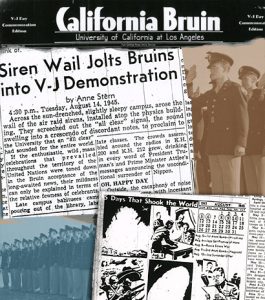
Anne Stern ’47 described the scene for California Bruin readers in the Aug. 17, 1945 edition.
“Late campus habituees came pouring out of the library, labs, late classes. The crowds assembled around the radios in K.H. [Kerckhoff Hall] 200 and K.H. 212 grew, drinking in every word of President Truman’s and Prime Minister Attlee’s messages announcing the unconditional surrender of Nippon.
“Outside, the cacophony of noise mounted in volume, with incessant honking of automobile horns echoing and augmenting the sound of sirens.”
The university band, routed from a rehearsal session by the world-shaking development launched into a spontaneous pep rally on the lawn in front of a campus gym. Overflowing cars left campus headed toward Westwood, Stern reported, all intent on making the most noise. But amidst the joyful celebrations, there was reflection as well.
“Many tears were openly or unnoticedly wiped away during the first realization that peace was finally returning to a world that had been constantly threatened by totalitarian aggression,” she wrote, “and that men in the services were coming home, safe.”
As the world adapted to the circumstances of a newfound peace, so too did UCLA. In just two months, 16 professors, some returning to UCLA from stints in government service, boosted faculty numbers. Additional support staff came onboard to handle registration.
Enrollment swelled to 7,000, the university’s largest since the United States had entered the war in 1941.
“Manpower will still be on the scanty side,” the California Bruin reported in the Oct. 25, 1945 registration issue, “for 4,500 of the fall term’s population will be of the weaker sex. Approximately 1,000 of the 2,500 expected males will be veterans, who will add maturity to the male element which for so long consisted mostly of seventeen year olds.”
Image: Announcement of Japan’s surrender gave rise to spontaneous celebrations all over campus on Aug. 14, 1945, which then dutifully were reported in the California Bruin. Though surrender was announced by Emperor Hirohito on Aug. 15, news of V-J Day (short for Victory over Japan) reached UCLA a day earlier due to the difference in time zones.
Oct. 19, 1945 | Medical school in the making
On Oct. 19, 1945, University of California President Robert Gordon Sproul presented a carefully drawn study to the UC Board of Regents outlining the urgent need for additional medical facilities in Southern California — pointing out that two-thirds of Los Angeles’ doctors had been educated at medical schools elsewhere. Another study by a committee of the southern regents reached the same conclusion.
The regents voted to establish the new school at UCLA and Sproul was authorized “to take such action as may be necessary … including a request to the governor that adequate budget provisions … be submitted to the Legislature.”
Assemblyman M. Philip Davis had already submitted a bill to establish a medical school at UCLA, but it languished in committee. However, as luck would have it, on a flight to San Francisco in November 1945, he happened to sit next to Gov. Earl Warren, giving Davis an opportunity to explain why a new medical school was needed.
“I’ll support your bill if you get it through the Legislature and to my desk,” Warren promised.
True to his word, the following February, Warren signed Assembly Bill 35 and its $7 million provision for a medical school at UCLA.
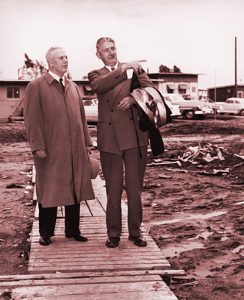
Image: In 1949, Gov. Warren (left) and UCLA’s first medical school dean, Stafford Warren, inspect the future site.
April 15, 1947 | "The Name. The Legend. The Man."
When former Bruin Jackie Robinson took his position on Brooklyn’s Ebbets Field in 1947, onlookers witnessed one of history’s great milestones – Robinson breaking the color barrier in baseball’s major leagues.
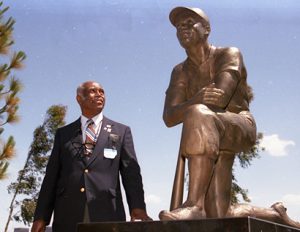
Almost four decades later, with the help of older brother Mack Robinson a bronze statue in honor of the Brooklyn Dodger great was unveiled at UCLA’s Jackie Robinson Stadium.
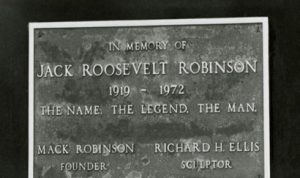
After previous failed attempts to have their hometown of Pasadena, Calif., erect a tribute statue, Mack Robinson took the mission upon himself. He established a non-profit organization to raise $100,000 and noted sculptor Richard H. Ellis was commissioned to create the statue. Mack found the ideal site for its display – Jackie’s namesake stadium at UCLA.
Jackie Robinson Stadium (on the site formerly known as Sawtelle Field near the Veterans Administration) has served as the home of Bruin baseball since 1981. The previous baseball venue, Joe E. Brown Field, was leveled to make way for Pauley Pavilion in the 1960s. Real-estate entrepreneur Hoyt Pardee ’41 donated funds for the construction of the new Bruin field and requested it be named in honor of his classmate Jackie Robinson. The Daily Bruin reported Pardee’s motivation: “I admired Jackie Robinson as a fellow classmate for his exploits on the gridiron, the baseball diamond, the court and on the track.”
Robinson enrolled at Pasadena City College in 1937 and quickly dominated Pasadena sports before transferring to UCLA in 1939 on an athletic scholarship. Winning letters in four sports – baseball, football, basketball and track – family obligations swayed him to leave school in 1941, before earning his degree.
After two years of military service, Robinson played for the Negro American League Kansas City Monarchs before Brooklyn Dodgers executive Branch Rickey, signed him to the minor league Montreal Royals in 1946. In a critical move toward gradually ending racial discrimination that prohibited players of color in white professional leagues, Robinson made his major league debut with the Dodgers on April 15, 1947.
Despite Rickey’s support, Robinson’s presence on the field evoked racial epithets and harsh taunts. In response to Rickey’s urging for a player “with the guts not to fight back,” Robinson took a non-confrontational approach to the insults. “I knew that any mistake I made would be magnified because I was the only black man out there,” Robinson said years later.
Despite the racism he faced during his first years in the majors, Robinson pushed forward and blazed a path for future minority athletes. During his 10 years with the Brooklyn Dodgers, the six-time all-star earned honors ranging from Rookie of the Year to winning the 1955 World Series title. In 1962, he became the first African-American to be elected to the National Baseball Hall of Fame. After his retirement, he went on to champion civil rights until his death in 1972. In 1984, Robinson was a charter inductee into UCLA’s Athletics Hall of Fame.
Top image: Mack Robinson led the effort to commission a statue of his younger brother, Jack “Jackie” Roosevelt Robinson, permanently on display at UCLA’s baseball stadium.
Middle image: The bronze statue of Robinson serves as a reminder of the former Bruin’s legacy. Robinson’s baseball jersey – No. 42 – was retired at Dodger Stadium in 1997, 50 years after he broke the color barrier in professional baseball.
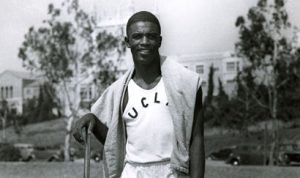
Bottom image: Jackie Robinson, here in his UCLA track uniform, is the only athlete in UCLA history to letter in four sports – baseball, football, basketball and track. Baseball was considered Robinson’s “worst” sport at UCLA.
July 18, 1947 | Origins of law
Without any pressure whatsoever on the part of university officials or alumni, Assemblyman William H. Rosenthal of Los Angeles introduced a bill in the closing minutes of the 1947 session of the Legislature appropriating $1 million for a law school building at UCLA. “I just happened to like UCLA,” Rosenthal said. “I thought it needed a law school.”
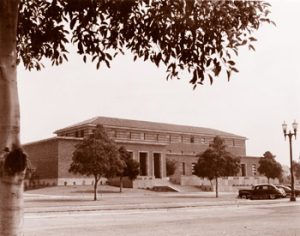
Coauthored by nine Los Angeles assemblymen and one from Santa Barbara, the bill met no resistance in the closing rush of the Legislature and was signed by Gov. Earl Warren on July 18, 1947.
Accredited by the California Bar Association even before it opened its doors, the UCLA School of Law got off to a start in September 1949. The permanent building was completed in 1951, and the law school’s pioneer class of 44 graduated in 1952.
Top image: The UCLA School of Law
Bottom image: The Clarence Dykstra (left), UCLA’s chief executive from 1945-50, greets L. Dale Coffman, the law school’s founding dean.
Nov 20, 1954 | Bruins shut out Trojans 34-0 in the big game
On Nov. 20, 1954, UCLA’s undefeated football team battled it out with USC in front of 102,548 fans at a sold-out Coliseum. The Bruins had gained a sense of invincibility during the season by shutting out four of the eight teams they played and holding all but one other team to a single touchdown.
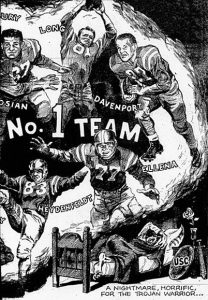
But in a closer contest than expected, the Bruins — led by Coach Henry “Red” Sanders — held only a 7-0 lead entering the fourth quarter. In the final 15 minutes, however, the Westwood 11 exploded with four touchdowns to rout the Trojans 34-0, earning a perfect pigskin season (9-0) and a second consecutive Pacific Coast Conference crown.
In post-game defeat, Trojan coach Jess Hill told the Daily Bruin, “They’re the best team we’ve played, but they’re not that good. I don’t know the statistics … I’ll never admit that they’re 34 points better than we.”
But when the final statistics were released, it was revealed that the Trojans had gained only a net of five yards from running plays and 103 from passing — completing only nine passes while throwing five interceptions. When later asked by reporters if the Bruins deserved their No. 1 ranking, Hill replied, “Yes sir I do!”
The 1954 team — later voted national champions by United Press International and No. 2 by The Associated Press — set numerous records, including points in a season (367), points in a game (72) and touchdowns in a season (55). It also led the nation in scoring offense (40.8 average) and scoring defense (4.4 average).
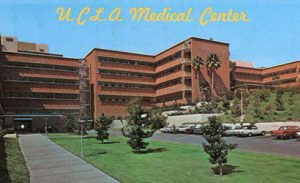
July 7, 1955 | UCLA Medical Center admits first patients
Heralded as the first medical facility of the Atomic Age, the UCLA Medical Center had established a reputation for innovation even before admitting its first patients on July 7, 1955. Working under the direction of the first medical school dean, Dr. Stafford Warren, UCLA researchers already had made two major cancer-related discoveries and founded one of the nation’s largest atomic medical studies programs.
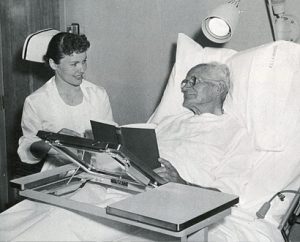
The newly opened facility was equally impressive, boasting use of the first atomic smasher for medical purposes as well as beds for 320 patients in semi-private rooms and capacity to treat an additional 500 patients per day through a variety of outpatient departments.
“Because this is really going to be an entirely new kind of medical school and research center,” Warren told the Los Angeles Times, “we have had to plan it for 50 years ahead of time — for A.D. 2000 instead of for 1953.”
The UCLA Medical Center continues to fulfill Warren’s original vision. Though it is one of the youngest academic medical centers in the country, it’s been repeatedly ranked as the best hospital in the Western United States by U.S. News & World Report.
In 2008, UCLA’s new state-of-the-art academic medical facility — home to the Ronald Reagan UCLA Medical Center, Mattel Children’s Hospital UCLA and the Resnick Neuropsychiatric Hospital at UCLA — opened its doors.
Top image: Admitted on July 7, 1955, 72-year-old Frederic Stoetzel became the first patient operated upon at the UCLA Hospital on the day following his admission. Under the care of surgeons Dr. William Longmire and Dr. Rodney Smith, Stoetzel made a full recovery and returned to UCLA for his subsequent medical care.
Bottom image: A postcard depiction of the medical center, completed in 1955.
May 3, 1957 | Under the Stars
One of UCLA’s oldest traditions, Spring Sing got its start nearly 70 years ago as fraternities competed for the title of “Champion Serenaders of Sorority Row.”
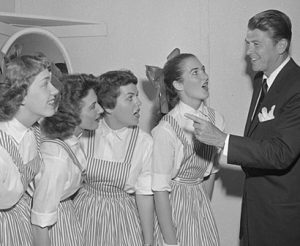
As its popularity grew, William C. Ackerman, ASUCLA director, arranged for the student musical competition to be held in Royce Hall in 1944. At its height in the late 1950s and early 1960s, more than 10,000 people attended the event, held in the campus’s amphitheater and then in the Hollywood Bowl. Celebrities — such as actor Ronald Reagan — served as master of ceremonies and judges.
On May 3, 1957, Reagan served as the master of ceremonies for a sixth time as an audience of 8,000 heard vocal selections from more than 500 student participants.
Interest in Spring Sing waned during the political activism of the late ’60s, and the event fell dormant in 1968. A decade later, it was revived by students and alumni and was moved back indoors to Royce Hall.
In 1986, the Student Alumni Association became the official organizer of the event in an attempt to restore Spring Sing to its original grandeur. Since this time, the event has enjoyed sell-out crowds under the stars in the Los Angeles Tennis Center as well as Pauley Pavilion.
Image: Members of the Delta Zeta quartet test out their vocals for Master of Ceremonies Ronald Reagan in a warm-up to the May 3, 1957, Spring Sing. PHOTO: Los Angeles Times Photographic Archives, UCLA Library Department of Special Collections.
Nov. 19, 1959 | Life on The Hill begins
UCLA’s 40-year-status as a commuter college changed significantly on Nov. 19, 1959, when a crowd of University of California and UCLA luminaries dedicated Clarence A. Dykstra Residence Hall. The 10-story structure was designed to house approximately 800 men. Space opened up to women 18 months later.
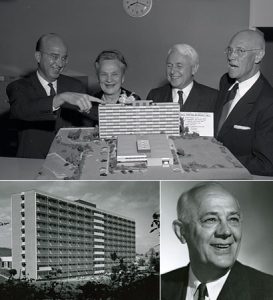
The construction of Dykstra Hall marked the beginning of an on-campus housing expansion, as three additional high-rises — Sproul, 1960; Rieber, 1963; Hedrick, 1964 — were built to accommodate the postwar baby boom generation. The building of Dykstra also signaled the end of previous UC regental policy, which prevented the construction of student housing on campus. This turning point came about thanks to the passionate crusading of Clarence Dykstra, who served as UCLA’s third chief executive from 1945-50.
Dykstra had long been a proponent of creating student housing at American universities as a principle of fostering cultural and intellectual life. From the moment he arrived at UCLA, he began pushing the issue. In a speech presciently titled, “Tomorrow’s Colleges Will Be Crowded Too!” Dykstra cited a “genuine need for adequate student housing,” and said that “students must be able to live together as an intellectual unit.”
Though he died in office and never saw the results of his campaign, the opening of the facility fittingly honored Dykstra’s efforts and his vision for the future of UCLA.
Top image: From left, UC President Clark Kerr, Lillian Dykstra (widow of Clarence Dykstra), Chairman of the UC Board of Regents Donald McLaughlin and UCLA Chancellor Vern Knudsen are greatly pleased with the architectural model for the new residence hall.
Bottom left image: The completed Clarence A. Dykstra Hall is the realization of Dykstra’s vision for UCLA’s future.
Bottom right image: Dedicated in 1959, Dykstra Hall was named for UCLA chief executive, Clarence Dykstra, who lobbied strongly for its construction.
Dec. 10, 1960 | A Nobel moment
On Dec. 10, 1960, UCLA chemistry professor Willard F. Libby took the stage in Stockholm, Sweden, and stepped into history. Libby accepted the Nobel Prize for Chemistry from Gustav VI Adolf, king of Sweden, becoming the first UCLA professor to be recognized with a Nobel Prize.
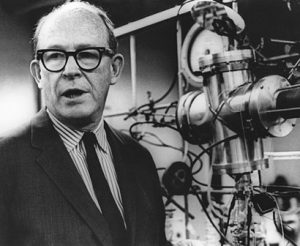
Libby was recognized for developing carbon dating, which revolutionized many academic fields. The method uses carbon-14 (an isotope of carbon with an atomic weight of 14 found in carbon dioxide) for age determination in archaeology, geology, geophysics and other branches of science.
“The future of the world, dependent as it is upon atomic energy, requires more understanding and knowledge about the atom,” Libby said in his Nobel banquet speech. “I hope that in some small way our efforts have helped people to learn about the atom and the way in which it works and may have helped them to see that isotopes are real and that they may hold much promise for the future — that in them lies a principal hope for the betterment of human life on earth and for the preservation and improvement of our standard of living.”
Later that December, Libby was one of 15 scientists singled out for special note as Time magazine chose “scientists” to receive its “Men of the Year” title.
In 1962, Libby became the founding director of UCLA’s Space Physics Center. He died in 1980.
Image: Upon receiving his Nobel Prize, Professor Willard F. Libby joined an elite group of Bruins — Ralph Bunche ’27 was awarded the prize for peace in 1950, and Glenn Seaborg ’34 received the prize for chemistry in 1951.
April 3, 1961 | Bruins get a den
It took years of planning, a $500,000 bond measure and almost four years of construction, but on April 3, 1961 UCLA’s new student union officially opened. Construction had gone over schedule and over budget, but the new facility, described as “modernistically clean-lined,” was a celebrated addition to the UCLA campus.
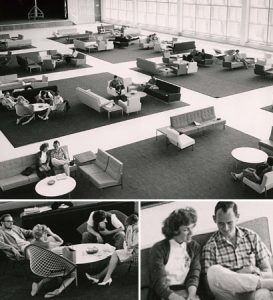
Located at the geographic center of campus, the five-story structure offered Bruins their own den (to use suburban vernacular of the time) for playing, shopping, meeting and relaxing. Designed for the modern student’s life, the building featured rooms for billiards and table tennis, a TV lounge, space for meetings and playing cards, a 10-lane bowling alley, indoor and outdoor dining areas, a coffee shop and a grand ballroom.
But it wasn’t all play and no work; ASUCLA moved its students’ store, selling books and supplies, into the first floor. Nor was the facility a gift. Several generations of Bruins repaid the 40-year construction bond through student fees.
The student union eventually would be named for the man who helped bring the project from the drawing board to reality. William C. Ackerman ’24 served as executive director of the Associated Students for 34 years, and had captured UCLA’s first NCAA championship in 1950 as the men’s tennis coach. The building was renamed Ackerman Union upon “Mr. A’s” retirement in 1967.
Image: The new student union ballroom offered Bruins a stylish lounge by day and space for 1,000 couples to dance by night.
Feb. 8, 1963 | A league of his own
n the early 1960s, with the UCLA athletics budget running in the red, Chancellor Franklin D. Murphy looked to J.D. Morgan ’41, an insider with business acumen, to oversee and stabilize the troubled program.
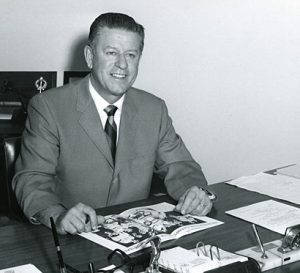
As UCLA’s new director of intercollegiate athletics, Morgan – previously the associate university business manager and men’s tennis coach – would soon revitalize the sports program, catapult Bruin teams into the national spotlight, and ultimately redefine UCLA athletics as a model looked to by universities across the country.
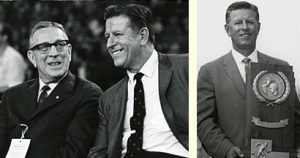
On Feb. 8, 1963, when Murphy announced his selection of Morgan to succeed the retiring Wilbur Johns ’25, restoring financial stability to the program was at the forefront of his mind. Murphy’s two other priorities were to bring competition back to the UCLA campus and to expand the minor sports, thus encouraging greater student participation.
“We needed a competent business person who also knew something about athletics and [had an] abiding interest in sports,” Murphy would later reflect.
As associate business manager, Morgan was instrumental in arranging the financing for several major campus building projects, including Ackerman Student Union and the four high-rise residence halls. At the time of his appointment, plans for an on-campus indoor sports arena were moving forward. During his 16-year tenure, Morgan would not only oversee the completion of Pauley Pavilion, but also of Drake Stadium, Spaulding Field and a boathouse for crew in Marina del Rey.
Under Morgan’s direction, UCLA won an unprecedented 30 NCAA championships – 10 in basketball, seven in volleyball, six in tennis, four in track and field, and three in water polo – more than any other university during that same period. His main objectives for the program included rekindling Bruin “family” support, providing greater assistance for the coaching staff, and fostering a strong and balanced recruiting program.
Over the years some found him difficult, even arrogant. He was known to engage in battles with alumni, the press and referees, oftentimes vilifying the officials as he sat on the Bruin basketball bench during road games. These outbursts were so frequent that in an effort to limit his public displays, rival Pac-8 basketball coaches came together and voted to ban athletic directors from the team bench.
Morgan’s success was fueled by his intense competitive nature and fierce Bruin loyalty. A career Bruin, Morgan came to UCLA in the late 1930s and was a four-year letterman on the men’s tennis team, serving as team captain in 1941. Following graduation from the UCLA School of Business Administration, he commanded a Navy torpedo boat in the South Pacific during World War II before returning to his alma mater in 1946 to accept a position in UCLA’s accounting office and simultaneously serve as assistant tennis coach under William C. Ackerman ’24.
Following Ackerman’s retirement in 1949, Morgan was anointed head coach of the men’s tennis team and went on to mentor Bruin tennis legends Arthur Ashe ’66 and Charles Pasarell, among others. He guided his teams to six NCAA championship titles, and continued coaching after taking on the directorship, stepping down from coaching in 1966 to focus full-time on athletic director duties.
In 1979, after 33 years at UCLA, Morgan was forced to announce his retirement due to rapidly failing health. He continued to serve as a consultant to the athletic department until his death in December 1980.
At the time of his retirement, when asked by the Herald Examiner what UCLA would miss most about him, he replied: “They’re going to miss my style.”
Top image: J.D. Morgan ’41 established a broad-based athletic program during his 16 years as UCLA’s director of athletics, leading the Bruins to 30 NCAA championship titles. The J.D. Morgan Center – the current home of UCLA intercollegiate athletics – was formally dedicated in his honor in 1984.
Bottom left image: Coach John Wooden and J.D. Morgan enjoy a moment on the sidelines. During his tenure, Morgan would regularly sit on the Bruin bench and watch as UCLA dominated college hoops. Wooden, who had coached 15 previous Bruin teams, won the first of his 10 NCAA championships during Morgan’s first year as chief of athletics.
Bottom right image: Morgan, a four-year varsity letterman and captain of the 1941 tennis team, coached six teams to NCAA championship titles.
Feb. 21, 1964 | UCLA welcomes presidents
On Feb. 21, 1964, U.S. Marine helicopters bearing President Lyndon B. Johnson and Mexican President Adolfo Lopez Mateos landed on the athletic field, while an audience of 34,000, sitting in a temporary stadium constructed nearby, eagerly awaited them.
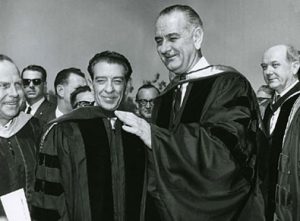
In the background, the “Big C,” normally blue in color, was painted a more patriotic red, white and blue, while Sproul Hall was draped in American colors on one side and the green, white and red colors of the Mexican flag on the other. In the center, a giant greeting: “UCLA Welcomes Presidents.”
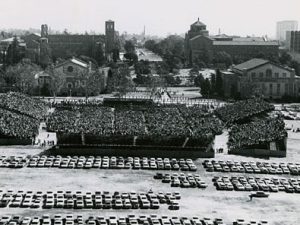
Johnson and Lopez Mateos, in Southern California to discuss a wide array of policy issues, stopped at UCLA to be keynote speakers at the 96th Charter Day ceremony, an anniversary celebration of the University of California’s founding in 1868. At the end of the ceremony, both heads of state were awarded honorary doctorates of law by UC President Clark Kerr.
Johnson, the first American president to speak at UCLA while in office, reaffirmed the solidarity between the United States and Mexico, but spoke primarily of the “dangers of today” – confirming foreign-policy aims in Vietnam, Cuba, Panama and Cyprus.
Johnson concluded his remarks by saying: “Let us, with brave hearts and with cool heads, advance with the task of building the citadels of peace, in a world set free from fear.” The speech, billed by the White House as a major foreign-policy address, aired on national TV and received international press coverage.
Lopez Mateos, whose Spanish message was translated, emphasized the role of the university and its members in the world-at-large. “Knowledge and freedom cannot be kept apart,” the Mexican president said. University students have the power to make a difference in society, Lopez Mateos continued, noting that “from these classrooms will go forward many young people with talent and dedication, who will apply their best efforts to contribute to the study of human relations and, especially, to the operation of law as the basis for order, peace, progress and fraternity.”
Top image: Mexican President Adolfo Lopez Mateos and President Lyndon B. Johnson visit campus on Charter Day.
Bottom image: An audience of 34,000 crammed into the stadium – built just for the day – to hear the presidents speak.
Sept. 22, 1964 | Building on vision
“Stein has contributed this wonderful clinic to treat the eye problems that come from the TV programs he makes.” Bob Hope’s quip captured the tone of the ceremony, which marked a milestone in the creation of the Jules Stein Eye Institute at UCLA. On Sept. 22, 1964, ground was broken for what the Los Angeles Times called the “largest project ever conceived for eye research, education and treatment.”
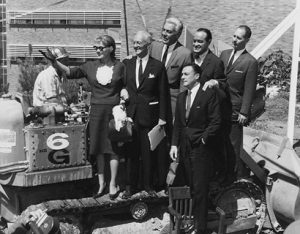
With elements of a Hollywood production, the scene included a brass band and an enactment of Chancellor Franklin D. Murphy as superintendent of the excavation with Stein at the helm of the machinery. Doris Stein, Jules’ wife, christened the event by breaking a bottle of champagne on a tractor.
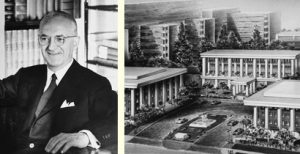
The day was long in coming. Becoming the head of UCLA’s division of ophthalmology in 1959, Dr. Bradley Straatsma recognized a need for expanded resources, including space, which was a premium among the divisions of the school of medicine in the new medical center. The answer came from physician, philanthropist and entertainment industry leader Jules Stein.
While known for establishing the Music Corporation of America and later serving as the agent for many of Hollywood’s leading personalities, Stein’s background was in ophthalmology, a pursuit furthered by his co-founding the non-profit Research to Prevent Blindness in 1960.
Stein’s initial pledge of $1.25 million was hailed at the time as “the largest private grant in the history of UCLA” according to UCLA Alumni Magazine. The $6-million cost of the institute was financed by gifts from almost 100 individuals, businesses and foundations, university funds and a federal grant.
Two years later, the institute was officially dedicated. Built next to the Center for Health Sciences, the five-level, 83,000 square foot structure designed by Welton Becket and Associates, could serve more than 2,000 patients per month. Design features included variegated red Portasanta marble with accents of natural Italian travertine and a children’s area complete with a sculptured ceramic, “Small World” inspired mural created for the institute under the supervision of Walt Disney.
Repeatedly ranked as the No. 1 eye care center in the Western United States, the institute combines the care of patients, research, education and outreach toward the preservation of sight and the prevention of blindness.
“If I am remembered by those who came after me,” Stein told the Times, “it will be as a man who helped in the struggle against blindness.”
Top image: Among the 300 celebrants at the Jules Stein Eye Institute groundbreaking were: (from left to right) Bette Davis, Jules Stein, Cesar Romero, Gene Kelly and Bob Hope.
Bottom left image: Stein, who died April, 29, 1981, divided his estate between his family and UCLA.
Bottom right image: Through the years, the institute has developed into a multi-building complex. An artist’s rendering includes the yet-to-be constructed Edie and Lew Wasserman Eye Research Center (left), the Jules Stein Eye Institute building (center) and the Doris Stein Eye Research Center (right), which was dedicated in 1989.
April 27, 1965 | "Segregation must die"
More than 4,500 students and faculty gathered near Janss Steps on April 27, 1965 to hear the Rev. Martin Luther King Jr. speak about racial injustice and the evils of segregation.
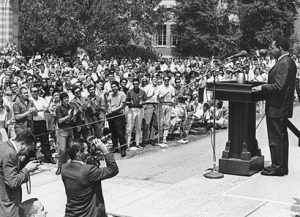
Under heavy guard and the gaze of television cameras, the 1964 Nobel Peace Prize recipient addressed the UCLA community and the nation on the need for racial integration, increased educational opportunity and guaranteed voting rights. The hour-long speech came just one month after his successful march from Selma to the Alabama capital of Montgomery, and outlined both the accomplishments and setbacks of the civil rights movement. King also appealed to students, specifically recruiting them for a summer program that would work to double the number of blacks registered to vote in the South.
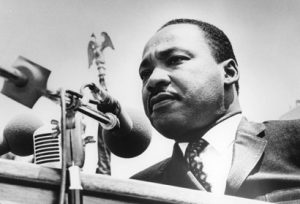
The crowd – which filled the quad between the men’s and women’s gyms and stretched up into the hills along Janss Steps – remained intent as King spoke, interrupting only with an occasional thundering ovation.
“It may be true that you can’t legislate integration, but you can legislate desegregation,” King said. “It may be true that morality cannot be legislated, but behavior can be regulated. It may be true that the law cannot change the heart, but it can restrain the heartless. It may be true that the law cannot make a man love me, but it can restrain him from lynching me.”
King warned that while progress had been made there was no time for complacency.
“Old Man Segregation is on his deathbed,” King said. “But history has proven that social systems have a great last-minute breathing power, and the guardians of the status quo are always on hand with their oxygen tents to keep the old order alive.”
He continued: “If democracy is to live, segregation must die.”
Top image: King was invited to campus as part of ASUCLA’s Speakers Program, which hosted notable social activists and political figures of the time. Students later presented him with $700 they had collected for his work on voter registration efforts in the South.
Bottom image: In his hour-long speech, King encouraged the use of “massive action programs” to end the segregation afflicting the nation.
Dec. 1, 1965 | Voices on high
The grassy knoll nestled between Kerckhoff Hall and Bruin Walk has long served as the platform for everything from shouting matches and student protests to impromptu celebrations and performances.
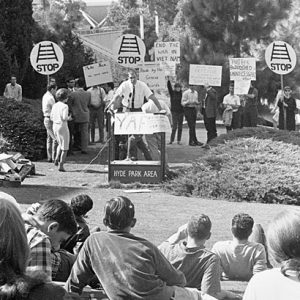
Having survived a shift from its original location near Janss Steps, where it was dubbed “Hyde Park” – a reference to the London park well-known for its public displays of free speech – it was renamed on Dec. 1, 1965 by the Student Legislative Council in memory of beloved philosophy professor and activist Hans Meyerhoff ’36, M.A. ’38, Ph.D. ’42.
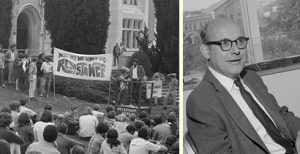
Meyerhoff, known for using his philosophy teachings to understand the societal concerns of the time, had unexpectedly died one month earlier in a car accident. Just before his death, he represented the Vietnam War opposition speakers at UCLA’s Hyde Park. Meyerhoff delivered his speech atop the green soapbox to over 2,000 students who had congregated to hear opposing views on the conflict.
Meyerhoff immigrated to the United States in 1934 because of a Nazi edict forbidding the matriculation of Jewish students in German universities. He enrolled at UCLA, continuing his education until receiving his doctorate in 1942. He then went on to serve in the U.S. Army. Meyerhoff returned to UCLA in 1948, joining the philosophy department, where he taught until his death.
In January 1966, the UC Board of Regents formally approved Hans Meyerhoff Park in memory of the philosophy professor.
The creation of a space for public expression on campus originated during the Free Speech Movement at UC Berkeley in the 1960s. Although supported by UCLA’s administration, some doubted the area’s usefulness and longevity. Byron Atkinson, dean of students at the time, suggested to Chancellor Charles E. Young that “within a year or two its use will become as imaginary as its boundaries.”
In subsequent years, students have gathered in Meyerhoff Park to commemorate the shootings at Kent State University, bring attention to victims of genocide, rally on affirmative action, or anxiously await the results of student body government elections. Given its prominent location amid the heavy foot traffic of Bruin Walk, Meyerhoff Park has remained a popular location for students, faculty and staff to host rallies and debates and where onlookers can turn into impromptu participants at moment’s notice.
Top image: Ralph Westfall, president of the John Birch Society, speaks in favor of the Vietnam War during a rally held in Hyde Park on Oct. 15, 1965. More than 2,000 students congregated to hear speakers voice their opinions on the war. Prof. Hans Meyerhoff represented the opposition and condemned American policy toward the war.
Bottom left image: Some 600 students at Meyerhoff Park are urged to oppose the draft during a gathering as part of a National Day of Resistance on Nov. 14, 1968. Hyde Park was relocated in 1964 next to Kerckhoff Hall after its original site by Janss Steps was thought to inhibit the flow of student participation.
Bottom right image: Prof. Hans Meyerhoff ’36, M.A.’38, Ph.D.’42, known for his philosophical teachings and dedication to his students, taught in the philosophy department until his sudden death in a car accident in November 1965. Hans Meyerhoff Park was named by the students in his memory.
Feb. 7, 1966 | A leisure complex
The Sunset Canyon Recreation Center made its debut on Feb. 7, 1966. Designed as a space where the burgeoning university community could find sanctuary from the pressures of campus life, the facilities on the nine-acre property at the northwest end of UCLA included swimming pools, a picnic area, an outdoor amphitheater, and rooms for dances and art exhibitions.
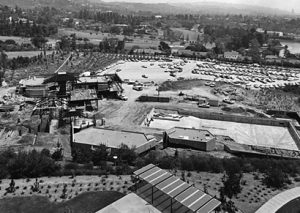
Within its first year, the demand for use of the center proved to be greater than could be accommodated, and forgotten was the project’s inauspicious conception.
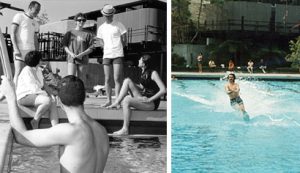
After announcement of the plan in 1962, a campus poll indicated that students resented the idea of constructing the facility due to the perception that the administration would use funds taken from a student fee increase without their consultation. They argued that the funds would be better applied to more primary needs like married students’ housing and increased parking.
In response, Associate Dean of Students Norman P. Miller ’39, who as campus recreation coordinator championed the project, cleared up these misconceptions in a statement outlining university goals for the recreation area, including its intended contribution “to educational objectives through creative uses of leisure time on campus and to reduce the anonymity and impersonal atmosphere of a large urban university.”
Shortly after the center’s opening, the Los Angeles Times highlighted the unique nature of the space on a university campus. The designers focused on creating a space that would be “non-rectangular, defying modules, minus the defined spaces” of a student union. “The emphasis was on nonemphasis, to make something people could shape to their own needs.”
“At UCLA, as elsewhere, we tend to place a higher value on disciplined leisure (which is more like work and hence less suspicious) than spontaneous sport,” the story continued. “If the university students of now are going to be at the ramparts of tomorrow, then their capacity for recreation is worth watching.”
A letter to the editor of the Daily Bruin perhaps best summed up the students’ ultimate thinking: “When someone orders you to have fun, you should do it.”
Top image: The property that would be home to the Sunset Canyon Recreation Center was deeded to the university by the Bel-Air Association, with restrictions that precluded its use for the construction of large buildings such as residence halls, classrooms or parking structures.
Bottom left image: Students overwhelmingly took to the pool seeking sanctuary from the pressures of campus life.
Bottom right image: Shortly after its opening, the pool became a practice space for the UCLA Boat and Water Skiing Club. Early on, like a one-sided tug-of-war, students pulled skiers at the end of a 75-foot rope to practice getting up on skis. A winch was later installed to automate this process.
Nov. 28, 1967 | "The Great One"
Starting quarterback from 1965-67, Gary Beban led the Bruins to a 24-5-2 record and a Rose Bowl victory during his three-year reign, earning him the nickname “The Great One.” On Nov. 28, 1967, he was honored with the prestigious Heisman Trophy, awarded annually to the nation’s top college football player.
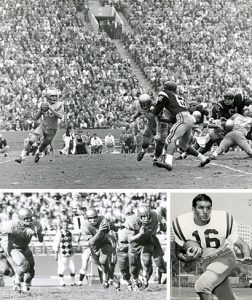
Beban, who had finished fourth in Heisman balloting the previous year, edged out USC running back O.J. Simpson for the 1967 award. Beban received 1,968 total points to Simpson’s 1,722. In first place points, Beban drew 369 points, followed by 278 for Leroy Keyes of Purdue and 261 for Simpson.
“There’s no doubt Gary was the best college football player in the country,” UCLA Head Coach Tommy Prothro told the Los Angeles Times. “But more important, he’s a great young man personally, besides being an outstanding player. The thing he did best for us, I think, was give the rest of our kids a tremendous amount of confidence.”
Perhaps Beban’s most spectacular performance came against USC in 1965. With the Bruins trailing 6-16 with four minutes to play, he unloaded two aerial touchdown “bombs,” one for 34 yards in the end zone and the other on a 52-yard play (47 yards in the air), for a 20-16 victory to give UCLA the conference title and Rose Bowl bid. Later that season, he scored both Bruin touchdowns in the 14-12 Rose Bowl victory over Michigan State on New Year’s 1966.
Beban, who became the West Coast’s greatest total-offense performer in history, led the Bruins in passing and scoring.
In 1967, Beban was picked in the NFL draft by the Los Angeles Rams and traded to the Washington Redskins. In 1970, he left the Redskins and professional football for a career in real estate. He completed his UCLA bachelor’s in history in 1970.
Although Beban’s pro football career was short-lived, his mark at UCLA will not soon be forgotten. Beban’s No. 16 jersey was retired and he remains the only Bruin to have won the coveted Heisman. In 1984, Beban was elected as a charter member of the UCLA Athletic Hall of Fame.
Top image: Quarterback Gary Beban (left) rolls out to pass against USC in a Bruin come-from-behind 20-16 win over the Trojans before 94,085 at the Coliseum on Nov. 20, 1965.
Bottom left image: Beban (with ball) became the West Coast’s greatest total-offense performer.
Bottom right image: Nicknamed “The Great One,” Beban won the coveted Heisman Trophy in 1967.
March 18, 1968 | Wading into the Inverted Fountain
UCLA’s most unconventional fountain started off in a most ordinary way: shooting water skyward. But Chancellor Franklin Murphy had other ideas.
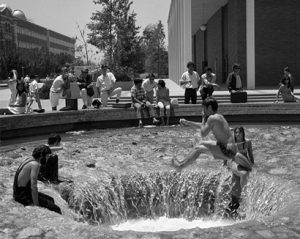
He challenged UCLA’s architectural landscape team to do something other than “squirt water into the air,” said Howard Troller, the Inverted Fountain’s principal designer.
Soon after that, the team realized Murphy’s challenge was in fact a necessity. A wind tunnel in Franz Hall Court would spray the fountain’s water in myriad directions, with the potential to catch unsuspecting passers-by.
Troller then turned to a childhood memory — an image of Yellowstone’s bubbling mud pots and hot springs — which left a lasting impression. He had long been looking to portray that natural landscape in a modern representation and now had the perfect opportunity.
On March 18, 1968, Troller’s vision was complete. Unlike traditional fountains, the water of the Inverted Fountain flows inward across a bed of multi-colored rocks, handpicked by Troller in Claremont, Calif. The current then meets at an off-center well, creating a miniature waterfall plunging into a 12-foot wide, 5-foot deep center that recirculates the water at 10,000 gallons per minute. The water’s movement adds a natural, yet distinct, sound to the south end of campus – that of a flowing mountain stream.
Since its unveiling, the Inverted Fountain has become steeped in student tradition and lore. During orientation, freshmen are commonly “initiated” by being told to wade in or touch the water, and then forewarned that doing so again before graduation will tack on an extra quarter to their academic career. That’s why one just might see graduating seniors wading into the fountain to celebrate their last final exam, water guns in tow to blast nearby underclassmen. At least, that’s how the story goes.
Image: The Inverted Fountain has been a popular recreational ground for students since its inception in 1968. These students, in the 1970s, test out their cannonball skills before measures were taken to cut the depth of the pool, thereby limiting such play.
June 27, 1968 | "The Waffle" renamed after Nobel laureate
Soon after the Social Sciences building opened in 1964, waggish students dubbed it “The Waffle” and the name stuck. But UCLA administrators had better ideas for the 11-story building. On June 27, 1968, the Daily Bruin announced that the tallest structure on campus would be named for an alumnus of international stature: Ralph Bunche ’27.
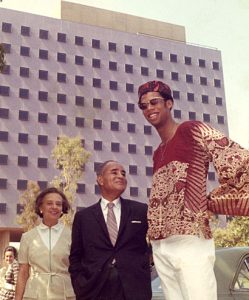
More than 20 years earlier, Bunche had helped create the United Nations, where he later served for almost two decades as an undersecretary. He had played a pioneering role in race relations, human rights, decolonization, international mediation and peace–keeping. In 1950, Bunche became the first African–American indeed, the first person of color of any origin to be awarded the Nobel Peace Prize, honoring his success at bringing about the 1949 Rhodes armistices between Israel and the neighboring nations of Egypt, Jordan, Lebanon and Syria.
At the building’s official dedication on May 23, 1969, Bunche said that he originally did not have “a burning desire” to attend college, but that he went at the insistence of his determined grandmother. Once enrolled, however, Bunche said he very quickly gained a sense of purpose, confidence and self-respect.
“Nothing could have been more indispensable to me at that critical stage of my life,” Bunche said. “UCLA was where it all began for me, where in a sense I began. College for me was the genesis and the catalyst.”
Image: When Nobel laureate and former Bruin basketball guard Ralph Bunche ’27 and his wife, Ruth, bumped into UCLA basketball player Lew Alcindor ’69 (Kareem Abdul-Jabbar) outside the Bunche Hall dedication ceremonies on May 23, 1969, longtime campus photographer Thelner Hoover ’30 caught the moment for posterity.
Oct. 29, 1969 | A crash into the future
“Lo.”
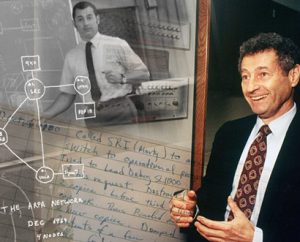
Inauspicious, perhaps, but then an infant’s first word generally is. Besides, no one on Professor Leonard Kleinrock’s 40-person team suspected that they were starting a revolution of global proportions on Oct. 29, 1969.
That was the day Kleinrock and a student assistant, Charley Kline ’70, M.S. ’71, Ph.D. ’80 sent the first “host-to-host” message over ARPANET (Advanced Research Projects Agency Network), the precursor to today’s Internet.
Programmers at UCLA — officially the first node on the network — were attempting to logon to the Stanford Research Institute (SRI) Host. The UCLA team was attempting to send the message “log” over the system to SRI. The first two letters made it, but the connection crashed before the “g” arrived. The second attempt at logging on worked.
Though the team hadn’t guessed at the social and business implications its work would eventually have, members realized that something extraordinary had happened at UCLA.
“As of now,” Kleinrock said at the time, “computer networks are still in their infancy. But as they grow up and become more sophisticated, we will probably see the spread of ‘computer utilities’ which, like present electric and telephone utilities, will service individual homes and offices across the country.”
Image: Professor Leonard Kleinrock guided the UCLA team that sent the first “host-to-host” message. The record above is a sketch of how the ARPA Network functioned along with an excerpt from the IMP Log that the UCLA kept. Kleinrock was supervising student programmer Charley Kline on Oct. 29, 1969, when they set up a message transmission to go from the UCLA SDS Sigma 7 Host computer to the Stanford Research Institute’s SDS 940 Host computer.
July 1, 1974 | Women get in the game
In 1974, anticipating the enforcement of federal regulations — popularly known as Title IX — which would prohibit sex discrimination in university athletics, Chancellor Charles E. Young M.A. ’57, Ph.D. ’60 announced the establishment of the Department of Women’s Intercollegiate Sports. The department introduced 10 varsity women’s teams and one coed squad (badminton) in its initial year.
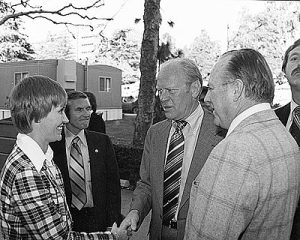
With the move, UCLA became one of a few universities that elevated women’s programs to full status. Caspar Weinberger, secretary of the U.S. Department of Health, Education and Welfare — the government agency responsible for Title IX — cited UCLA’s efforts as a model for the country to follow.
A year later, Judith Holland, appointed the department’s first full-time athletic director, was busy establishing a foundation for the program. Holland began with a meager $283,000 budget. She devoted the majority of those funds to scholarships, which meant she could only hire a part-time coaching staff. “I still recruited the best coaches but sold them on the ‘blue and gold’ and what would happen over time,” she says.
During Holland’s first year, UCLA recruited 188 women, with Holland doing much of the recruiting herself. With an eye to the department’s future, Holland implemented a five-year plan to help bolster the program’s available funding, allow for full-time coaches, provide more aid for student-athletes, and increase travel funds.
While the department was started as a separate unit, the intention was always to eventually integrate it under the Department of Intercollegiate Athletics. In 1981, that finally happened. Also that year, the NCAA first began to provide championships for women’s athletics, and Holland switched UCLA’s teams from the Association for Intercollegiate Athletics for Women to the NCAA.
“The first and foremost goal was to be the best women’s collegiate program in the nation,” Holland recalls. “I believe that we did accomplish this goal.”
In 2007, a victory by the women’s water polo team allowed UCLA to become the first university to reach 100 NCAA national championships.
Image: Judith Holland, director of the Department of Women’s Intercollegiate Sports, greets former President Gerald Ford during his visit to UCLA in 1978. Three years earlier, President Ford signed Title IX regulations, which included the provision prohibiting sex discrimination in athletics and established a three-year window for educational institutions to comply.
March 29, 1975 | "Coach" retires
During the March Madness of 1975, the qualifier that would take the UCLA men’s basketball team to the NCAA championship game and ultimately lead to an unprecedented 10th NCAA crown would also signal the end of an era. After 27 seasons (1948-1975) and a streak of unparalleled wins, Coach John Wooden unexpectedly announced his retirement moments after UCLA’s semifinal victory on March 29, 1975.
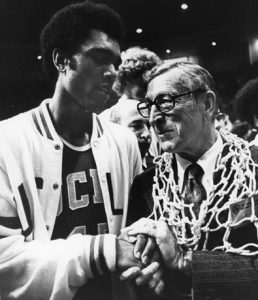
The 75-74 overtime win against Louisville left spectators spellbound, but not as much as the unforeseen notice of Wooden’s resignation. UCLA Athletic Director J.D. Morgan summed up the feeling of the night when he expressed his sentiments over Wooden’s resignation to the Los Angeles Times: “It’s the end of the active coaching career of the greatest college coach of all time.”
True to his word, the 1975 NCAA championship game two days later would be Wooden’s last on the job. “Coach,” as he was affectionately dubbed by players and revering fans alike, led the Bruins in a 92-85 triumph against Kentucky in San Diego to win their 10th national title in 12 years.
Directly after the win, Wooden attended his final press conference as coach. “I’m going to try and keep busy, occupied, and hope I have enough things so I won’t go stale,” Wooden said, according to the Times. “I won’t coach again, ever, but I always hope to be involved in some way with basketball.”
For years, the faithful coach remained a presence during games in Pauley Pavilion, sitting back and enjoying the plays as a spectator, from his reserved seat right behind the Bruin bench.
Image: Junior point guard Andre McCarter ’76 embraces Wooden after the Bruins’ championship triumph on March 31, 1975. Wooden unexpectedly announced his retirement two days prior.
Aug. 18, 1982 | A gridiron home
Notwithstanding the decades-old rivalry between the Bruins and Trojans, UCLA Chancellor Charles E. Young M.A. ’57, Ph.D. ’60 and USC President James Zumberge found themselves allied over football in the summer of 1982.
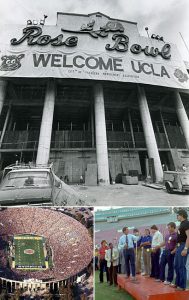
The issue of mutual concern: negotiations between the Los Angeles Coliseum Commission and the Oakland Raiders in the NFL team’s impending move to Los Angeles.
USC and UCLA had called the Coliseum their home since the 1920s. The teams also shared the facility with the NFL’s Los Angeles Rams from 1946 to 1979, when the Rams moved to Anaheim.
But after a heated meeting of the Coliseum Commission in July 1982 — over what both Young and Zumberge viewed as preferential treatment for the Raiders regarding scheduling and revenue sharing — Young announced his intention to open negotiations with the city of Pasadena to relocate UCLA’s home football games to the venerable Rose Bowl stadium, beginning with the upcoming season. The UC Board of Regents approved the move, over the objections of Los Angeles mayor and Bruin alumnus Tom Bradley.
On Aug. 18, 1982, the city of Pasadena, the Pasadena Chamber of Commerce and the Pasadena Tournament of Roses Association welcomed the Bruins to their new home field.
Head Coach Terry Donahue ’67, M.A. ’77 introduced his players to more than 1,000 cheering fans, who came to inspect both players and field. “We begin our season here on Sept. 11,” Donahue said, “and there’s no doubt in my mind that if everything goes well, we’ll end it here on Jan. 1, 1983.”
The Bruins did just that, with a 24-14 victory over Michigan on New Year’s Day, and the move to the Rose Bowl ushered in a new era in UCLA football.
The Bruins were the Pac-10 representative in the Rose Bowl game on New Year’s Day in three of the first four years, each ending with a Bruin victory over the Big Ten champion (1983 vs. Michigan; 1984 vs. Illinois; 1986 vs. Iowa) on what was then and continues to be the Bruins’ home field.
Top image: The Rose Bowl undergoes some upgrades before the Bruins move.
Bottom left image: A sold-out crowd of 104,991 watched the Bruins win, over Big Ten champion Michigan on New Year’s Day, 1983.
Bottom right image: Head Coach Terry Donahue introduces his players to fans gathered during the official Rose Bowl welcome party.
July 28, 1984 | The 23rd Olympiad begins
Forty-eight UCLA students and alumni representing the United States and 10 other countries competed valiantly during the 1984 Summer Olympic Games in Los Angeles. These Olympians – the largest number of any university – won 37 medals: 17 gold, 14 silver and six bronze.
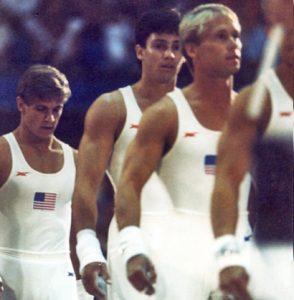
Three of the six members of the U.S. men’s gymnastics gold-medal winning team, whose surprising victory over the People’s Republic of China was headlined “the Miracle of L.A.” by the Los Angeles Times, were UCLA athletes: Peter Vidmar ’83, Mitch Gaylord and Tim Daggett ’86. It was the first gold ever for U.S. men’s gymnastics.
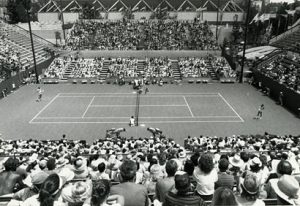
Vidmar also won gold on the pommel horse and silver in the men’s all-around competition — he missed the gold by just 0.025 of a point. Gaylord earned four medals, including the team gold, which he helped the squad win with his risky signature release move, the Gaylord II.
More than 160,000 spectators came to Pauley Pavilion to witness the gymnastics competitions firsthand.
In addition to hosting gymnastics, UCLA held the tennis “demonstration” tournament in the newly constructed Los Angeles Tennis Center, and served as an Olympic Village that officially opened on July 14, housing more than 4,000 athletes, coaches and trainers from 62 countries in campus residence halls. A “main street” of shops on the upper concourse of Drake Stadium overlooked the 142 Flags of Nations on the playing fields below.
For 16 days in the summer of 1984, the UCLA campus, normally more tranquil in the summer months, bustled under the glow of international attention and contributed to one of Los Angeles’ finest hours.
Top image: Three of the six members of the U.S. men’s gymnastics gold-medal winning team line up in Pauley Pavilion. The UCLA athletes pictured are Peter Vidmar ’83 (left) and Mitch Gaylord (center).
Bottom image: UCLA held the tennis “demonstration” competition during the 1984 Olympics in the newly constructed Los Angeles Tennis Center.
Sept. 30, 1984 | Mighty Bruins
It may seem like The Bruin has always kept guard over UCLA, but the iconic statue in Westwood Plaza is a relative newcomer to campus.
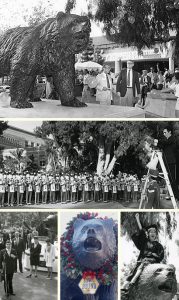
Its origins can be traced to the 50th Anniversary Committee organized by the UCLA Alumni Association to mark its first half-century. On September 30, 1984, the Association unveiled two of its gifts to campus before a crowd of nearly 1,000 alumni celebrants.
The first was The Bruin, a teeth-baring bronze statue measuring 10 feet long, 6 feet tall, 3 feet across and weighing more than 2 tons, and billed at the time as the largest bear sculpture in the United States. Costing $37,000 to cast and another $10,000 for artist Billy Fitzgerald’s fee, the ferocious grizzly was a departure from UCLA’s familiar, friendly Joe Bruin mascot.
Alumni had been frustrated for years by the lack of an appropriate Bruin symbol on the campus. The Bruin, walking on all fours, was intended to demonstrate a fluid forward movement symbolizing the ongoing strength and progress of UCLA.
“You’ll notice that it’s formidable,” Alexander Hamilton ’24, founding member of the Alumni Association, told the Los Angeles Times. “It’s the antithesis of fragility.”
For the presentation of the second gift, Academy Award-winning composer Bill Conti led the 250-member UCLA Bruin Marching Band in the rousing debut of “Mighty Bruins,” a new fight song for UCLA.
UCLA had long shared a fight song with UC Berkeley, with UCLA’s version dubbed “Sons of Westwood.” Alumni, tired of listening to the same song whenever there was a touchdown at a UCLA vs. UC Berkeley game, decided it was time UCLA stepped out from Berkeley’s shadow and commissioned an original fight song.
The Alumni Association sponsored a contest soliciting lyrics from students and alumni, with a $1,000 prize for the winning composition, and Conti agreed to write the song. In the end, he combined lyrics submitted by Barbara Lamb ’66 and Don Holley ’84 and set them to music.
Conti said he wanted the fight song to “stand the test of time” and told the Daily Bruin, “It is not right for a top-caliber university like UCLA to be sharing a fight song, especially with the excellent athletic tradition which UCLA possesses.”
“Mighty Bruins” made its gridiron debut as UCLA’s official fight song at the October 6 game against Stanford, with Conti again conducting the UCLA Bruin Marching Band.
With both gifts marking their 25th anniversaries, it’s hard to imagine UCLA without either one of them.
Top image: Past UCLA Alumni Association president James Thayer ’48 and Chancellor Charles E. Young M.A. ’57, Ph.D. ’60 are among the celebrants at the Alumni Association’s 50th anniversary party. The Association presented The Bruin to campus during the celebration on Sept. 30, 1984.
Middle image: The UCLA fight song “Mighty Bruins” debuts with its Academy Award-winning composer Bill Conti conducting the UCLA Marching Band.
Bottom left image: The Bruin stood guard during the March 4, 1988, visit of Prince Andrew and his wife, Sarah Ferguson, the Duchess of York.
Bottom middle image: Bruins, Rose Bowl-bound!
Bottom right image: A lofty perch for a jubilant graduate.
Oct. 13, 1988 | Up for Debate
Tension was in the air as a nation watched, listened and judged as Vice President George Bush and Massachusetts Gov. Michael Dukakis took the center stage at UCLA’s Pauley Pavilion on Oct. 13, 1988, for the second and last debate of the presidential campaign. Polls showed Republican Bush nudging 2% to 6% ahead of Democrat Dukakis.
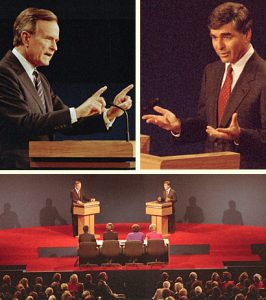
Events leading up to the night were nearly as dramatic as the debate itself. A week earlier, the League of Women Voters yanked its sponsorship to host the event at the Shrine Auditorium, citing interference by the two major campaigns that touched everything from format and panelists to, infamously, the height of the podiums.
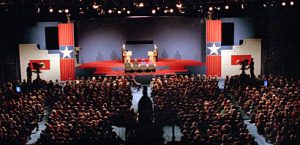
With only six days until the debate, the Commission on Presidential Debates called on UCLA to host the event. Workers scrambled to transform the basketball arena into a television studio. More than 37 miles of cable and 412 telephones were installed on campus for media hookups. Ed Fouhy, newly appointed executive producer, knew he had an enormous task ahead of him, but was happy to rely on UCLA’s experience. “UCLA is a big time university and is used to big time events,” Fouhy told The Daily Bruin. (Only four years prior, Pauley was home to the gymnastics events during the 1984 Olympics.)
The campaigns limited attendance to 2,000, but more than 67 million viewers tuned in on the major networks and cable news channels. CNN anchor and debate moderator Bernard Shaw opened the evening with the question that would define the night: “Governor, if Kitty Dukakis were raped and murdered, would you favor an irrevocable death penalty for the killer?” Afterward, news commentators debated the fairness of the question, but most conceded that Dukakis failed to seize the moment with his answer. Though analysts said they felt Bush hadn’t performed well either, he began pulling ahead in the polls several days after the debate and went on to win the election.
After the election, Dukakis announced that he would not run for re-election as governor of Massachusetts. In 1991, Dukakis became a visiting professor at UCLA’s School of Public Policy & Social Research (now the School of Public Affairs).
Top image: In 1988, presidential hopefuls Vice President George Bush and Massachusetts Gov. Michael Dukakis face off at UCLA’s Pauley Pavilion during the final debate of the presidential campaign. CNN’s Bernard Shaw moderated the event, as candidates were questioned in turn with two minutes to respond and one minute to rebut. Panelists included Andrea Mitchell from NBC, Ann Compton from ABC and Margaret Warner from Newsweek.
Bottom image: Pauley Pavilion, home of Bruin basketball, was transformed in just a matter of days to accommodate the presidential stage and a throng of media crews. Although venue capacity allows seating for more than 10,000 people, attendance was limited by the campaigns to just 2,000. Approximately 40 UCLA students served as ushers.
Sept. 21, 1992 | Studying under a big top
Generations of Bruins associate research with the elegant bricks, rich wood and detailed tiles of the venerable Powell Library Building. But the class of 1996 is more likely to conjure images of shiny aluminum, yellow-and-white canvas, and exposed cables and fasteners. For them, Powell was an off-limits construction site, while Towell — shortened from Temporary Powell Staging Facility — was the place to study.
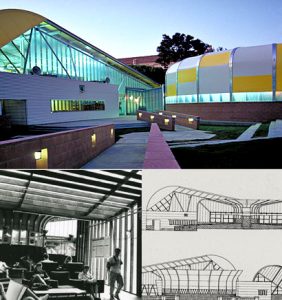
On Sept. 1, 1992, as Powell was being readied for a seismic upgrade, staff began moving approximately 150,000 of the library’s volumes and journals into Towell; the balance was sent to storage. The two-story, 36,000-square-foot building — down from Powell’s spacious 100,000-square-feet — officially opened on Sept. 21.
Nestled between the Men’s Gymnasium (now the Student Activities Center) and the Dance Building (now Glorya Kaufman Hall) at the bottom of Janss Steps, the startling structure elicited comparisons to both a circus tent and a Martian exploration base. Husband and wife team Craig Hodgetts, UCLA associate professor, and Hsin-Ming Fung M.Arch. ’80 of Hodgetts + Fung employed a sense of playfulness in their work, while still meeting severe time constraints to complete the $3.2 million structure.
Towell’s eye-popping appearance initially got a mixed reception from students, but garnered rave reviews in the press. The New York Times architecture critic Herbert Muschamp wrote, “With its playful air of spontaneity bolted down by innate rigor, the Temporary Powell revives informality as an architectural ideal.”
Powell reopened in September 1996, and Towell briefly was repurposed as classrooms and by ASUCLA as retail space. In May 1997, Daily Bruin writer Brent Eldridge ’99 penned a sly 45-line, rhymed-couplet ode upon the occasion of Towell’s decommissioning, which ended:
With these undying words I speak to thee:
Thou honored relic of retired towers,
Homage I paid thee hour by hour:
Myself never knowing that all the while
Thou were but a great aluminum pile.
Top image: Towell architects Hodgetts + Fung employed off-the-shelf industrial components to realize a unique and functional vision.
Bottom Left image: Architectural critic Barbara Lamprecht compared Towell’s curved reading rooms to the 14th century Chapter House at Wells Cathedral.
Bottom Right image: Towell featured two reading rooms, 500 study carrels and a 40-station computer lab.
Sept. 30, 1992 | Gallery of World Arts Unveiled
For years, approximately 30,000 pieces of ethnic art lay hidden in a cramped basement.
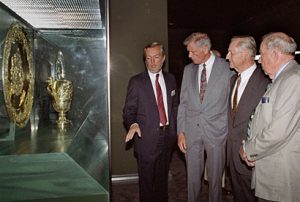
Located on the ground floor of Haines Hall, UCLA’s Museum of Cultural History was host to one of the largest collections of African and South Pacific art in the United States. Unfortunately, few people were familiar with the distinguished collection due to its obscure location.
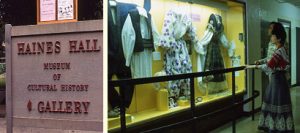
On Sept. 30, 1992, that all changed as the Fowler Museum of Cultural History officially opened its doors in a more prominent and permanent space near the base of Janss Steps, just west of Royce Hall.
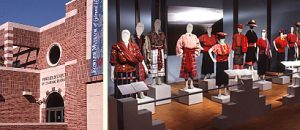
Originally established in 1963 as the Museum and Laboratories of Ethnic Arts and Technology by Chancellor Franklin D. Murphy, the museum began as an independent research unit, acquiring artifacts over the years from donations and archaeological digs.
The name was changed to the Museum of Cultural History in 1971 and by 1975 its collections ranked it among the top four university museums in the country, in numbers and in quality.
In 1981, Chancellor Charles E. Young, along with museum director, Christopher Donnan, developed a vision for a new building that would fully exhibit the immense collection. The $22-million structure was funded by both private gifts and state resources. It was named in honor of the late Francis E. Fowler Jr., inventor and avid silver collector, and his sons, Francis III and Philip, the facility’s principal benefactors.
The new museum featured 170,000 pieces from the contemporary, historic and pre-historic cultures of Africa, Asia, Oceania and the Americas. Its inaugural exhibitions included items from African culture, Maya dress, ancient Peruvian ceramics, and the permanently housed Fowler collection of European silver.
“Our collections represent the artistic traditions of the world and include some of the finest examples anywhere,” Donnan said at the time. “The new building will increase the museum’s profile within the university and Southern California community, and enhance its ability to conduct research, produce publications, and attract more visitors to exhibitions and related programs.”
Since its inception, the Fowler has provided visitors with glimpses into world arts and culture, as well as notable individuals through exhibitions including: “The Watts Towers Exhibits,” “Sacred Arts of Haitian Vodou,” “Che Guevara: Icon, Myth and Message,” and more recently “Intersections: World Arts, Local Lives.”
Top image: From left, Fowler Museum Director Christopher Donnan gives a tour on opening day to Chancellor Charles E. Young, Philip Fowler and Chancellor Franklin D. Murphy. Donnan highlights several of the more than 250 silver pieces donated by the museum’s primary benefactor Francis E. Fowler, Jr.
Middle left image: A sign directs viewers to the gallery in the basement of Haines Hall. The original museum, established in 1963 by art enthusiast Chancellor Murphy as the Museum and Laboratories of Ethnic Arts and Technology, was later renamed the Museum of Cultural History.
Middle right image: On-lookers admire an early exhibit of festive dress from Yugoslavia at the Museum of Cultural History.
Bottom left image: After 40 years, the Fowler has grown from a confined basement to a state-of-the-art facility. In 2006, the name of the museum was formally changed to the Fowler Museum at UCLA.
Bottom right image: One of the Fowler’s debut exhibits in 1992 was “Threads of Identity: Maya Costume of the 1960s Highland Guatemala.” The new showrooms were a stark contrast to the museum’s once cramped and limited space.
June 7, 1993 | A hunger strike ends, a center is born
More than 1,000 students, faculty and community supporters stood outside Murphy Hall on June 7, 1993 to celebrate the end of a 14-day hunger strike and the creation of the César E. Chávez Center for Interdisciplinary Instruction in Chicana and Chicano Studies, culminating a story that began at least 20 years earlier.
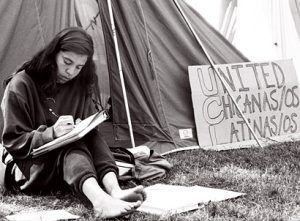
UCLA first established an interdisciplinary Chicano studies program in 1973, drawing on faculty and courses from different departments to constitute an undergraduate major in the field. But the retrenchment in California’s social and budget policies during the 1980s, and the recession of the early 1990s, took a toll on the program, reflected with lowered enrollments and graduates. By 1989 funding had dwindled significantly and UCLA suspended new admissions to the program the following year.
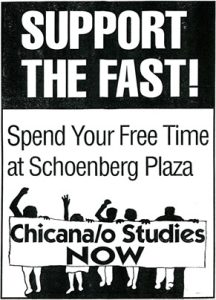
Two months later, in April 1990, the Movimiento Estudiantil Chicano de Aztlán (MEChA) organized UCLA students, faculty and community members, staging a demonstration calling for the program’s elevation to departmental level. Negotiations continued for several years and an official proposal gained support in UCLA’s Academic Senate. Several deadlines were set for announcing a final decision, but each time Chancellor Charles E. Young insisted the matter required additional study. After more than two years of discussion, and considering the proposal in context of the serious budget cuts UCLA faced, Young announced on April 28, 1993 that it would not be implemented. The statement was made on the eve of labor organizer César Chávez’ wake, timing that was subsequently cited for fueling emotions.
On May 11, 1993, protesters – some from UCLA, others from the community – challenged Young’s decision by staging a sit-in at the UCLA Faculty Center, breaking windows and causing total damage estimated at $30,000. Police arrested more than 80 individuals.
The movement continued with peaceful demonstrations, picking up momentum and support from state legislators including Tom Hayden, Art Torres and Xavier Becerra. On May 24, five students, one professor and three community members began a hunger strike to protest Young’s decision and disciplinary action against student protesters days prior. A village of tents and shanties sprang up outside Murphy Hall. The debate raged on campus and in the media, drawing national attention.
After lengthy negotiations, the strike ended when Young and the strikers reached an agreement and signed a proposal for the re-naming and creation of the new center. The chancellor told the Daily Bruin the hunger strike and media attention hadn’t changed his mind, only accelerated a process that was already in motion.
“We have merged elements of our departments and programs into a new Center for Interdisciplinary Instruction which can provide increased stability and autonomy for our disciplinary programs – most immediately for Chicana and Chicano Studies,” Young announced in a June 7 press release.
More than a decade later, in 2005, Chancellor Albert Carnesale approved the departmentalization of the program. In 2007, both the center for interdisciplinary studies and department were merged and officially recognized as the César E. Chávez Department of Chicana and Chicano Studies at UCLA.
Top image: Hunger strikers, including Cindy Montañez (shown in the above Daily Bruin photo), camped outside Murphy Hall in tents until a resolution was announced. One of nine individuals who initially began the 14-day water-only fast, Montañez was the first to require medical attention after collapsing on the fourth day.
Bottom image: Fliers like the one above were distributed en masse along Bruin Walk to raise support for the hunger strikers and the creation of a Chicano studies department.
Jan. 17, 1994 | Northridge quake rattles campus
UCLA students anticipating a long holiday sleep-in were rudely awakened at 4:31 a.m. on Jan. 17, 1994, by a violent earthquake. Centered approximately 17 miles north of Westwood in the San Fernando Valley, the 6.7 Northridge earthquake jolted campus for 30 seconds, knocking out power, unnerving students, and damaging some of UCLA’s most beloved landmarks.
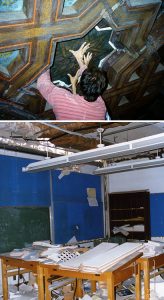
Kerckhoff Hall and Royce Hall each sustained significant structural damage. The four spires atop Kerckhoff rotated six inches during the quake and had to be removed by cranes. Dramatic cracks fractured the familiar brickwork on both of Royce Hall’s towers, and the building was closed and fenced off to avoid injuries from possible falling bricks.
Like many buildings on campus Dykstra Hall suffered cracked ceilings, buckled doorways and broken windows. After evacuating and spending an hour outside, residents received the all clear to return to their rooms, where some talked through their jitters during the many aftershocks while others were content to go back to sleep.
Things at the UCLA Medical Center were more hectic. The facility had sustained damage from the shaking as well as from chemical spills, a problem that plagued several south campus structures. While campus residents remained safe, the earthquake had caused 57 deaths and hundreds of injuries elsewhere. The skeletal holiday staff in the emergency room found themselves with an influx of patients with earthquake-related injuries, ranging from lacerations and stress-related conditions to at least one victim reportedly injured in a looting attempt. Additional staff members were called in to help meet the demands for medical attention.
At the end of the day, UCLA campus architect Charles Oakley had reason to be optimistic. “From the construction site point of view, we did much better than my fears at 4:30 this morning,” he told the Daily Bruin. “We were far from untouched, but it was nothing cataclysmic.”
At the time of the Northridge quake, UCLA was performing seismic reinforcements as part of a two-decade program to make 30 campus buildings more quake-resistant. The quake caused UCLA to accelerate the program, and many structures such as Royce Hall remained closed for months – or even years – for seismic retrofitting and repairs. During that time, students learned to make their way to class through mazes of chain link fence and plywood that surrounded the ongoing construction. The program is credited with saving and preserving some of UCLA’s most cherished icons.
Top image: Powell Library underwent considerable seismic renovations for months to come as a result of the damage sustained from the Northridge temblor. Workers had to replace tiles in the rotunda ceiling that had come loose during the shaking.
Bottom image: Many south campus buildings suffered extensive damage. Due to concerns about hazardous chemical spills, all undergraduate classes were canceled after many university classrooms were deemed unsafe for re-entry.
May 20, 1994 | A presidential occasion
Ten days before the event, the Daily Bruin broke the news: President Bill Clinton had accepted UCLA’s invitation to speak at its 75th anniversary convocation on May 20, 1994, kicking off the university’s yearlong celebration.
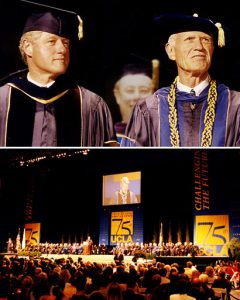
Students, faculty and staff scrambled to secure tickets to the event, held in Pauley Pavilion. All of the more than 9,000 available seats were claimed quickly.
The academic convocation included a cap and gown procession and Chancellor Charles E. Young M.A. ’57, Ph.D. ’60 presenting The UCLA Medal, the university’s highest honor, to Clinton.
In his keynote remarks, Clinton praised the chancellor for his 25 years of service and commitment to UCLA. He noted UCLA’s distinguished history and its culture of achievement and service, then turned his attention directly to the students.
“Americans of my generation have been bombarded by images … about the so-called ‘Generation X’ filled with cynics and slackers,” he said. “Well, what I have seen today is not a generation of slackers, but a generation of seekers. And I am much encouraged.”
The president singled out two exemplary UCLA students, Saru Jayaraman ’95 and Desiree DeSurra ’95, founders of Women in Support of Each Other, a support group for at-risk high school girls, as examples of UCLA’s best.
“Thousands of young people just here on this campus alone have made a decision to make a difference,” Clinton said.
Later in his speech, the president noted UCLA’s role as a barometer for the 21st century. “If you look around you at this incredible campus where minorities make up a majority, something that will be true for whole states in the not-too-distant future, you see the future.”
Top image: President Bill Clinton (left) and UCLA Chancellor Charles E. Young M.A. ’57, Ph.D. ’60 stand before the academic convocation honoring UCLA’s 75th anniversary.
Bottom image: “I’m proud to be here to honor the university’s 75th anniversary, and to honor your chancellor on his 25th anniversary of service,” Clinton told the crowd of more than 9,000 gathered in Pauley Pavilion. “It is the sort of commitment our country could do with more of, and I honor it.”
Aug. 6, 2002 | A miracle separation
All their young lives, 1-year-old conjoined twins Maria Teresa and Maria de Jesús were only able to see each other with mirrors. But after more than 22 hours of unprecedented surgery at UCLA that would change.
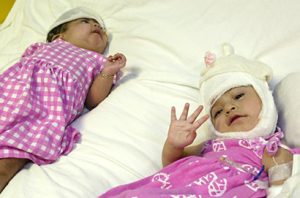
As the world watched through the camera lenses of a throng of international media holding vigil outside UCLA’s Mattel Children’s Hospital, the largest medical team assembled in the university’s history performed a marathon separation surgery so that the Guatemalan girls, born fused at the head, could lead individual lives.
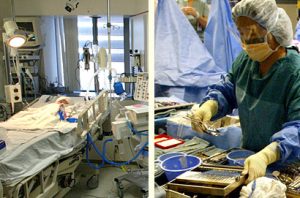
In all, hundreds of doctors, nurses and medical staff of the UCLA Medical Center — many who donated their services — were involved in the twins’ care. The surgical team was led by Jorge Lazareff, director of pediatric neurosurgery, and Henry Kawamoto Jr., surgical director of the UCLA Craniofacial Clinic.
Just over 11 hours after the first incision was made, a doctor announced, “They are separated.” A brief moment later, Lazareff, emphasizing what had been achieved, added: “You are looking at two children, two little girls. There will be two passports, two boyfriends, two weddings.”
But there was no time for celebration. The meticulously planned and complex surgery was far from over. The painstaking process of reconstruction would now begin. Finally, at 5:40 a.m. on Aug. 6, 2002, the girls were wheeled into the pediatric intensive care unit, where after waking from a week-long sedation, they saw each other for the first time.
Visiting his daughters after the surgery, Wenceslao Quiej López, 21, said, “The future looks very bright.” The twins and their mother, Alba Leticia Álvarez, 23, had been flown from Guatemala to UCLA after the charity, Healing the Children, approached Lazareff, one of their volunteer physicians, to take on the procedure.
Doctors said that both girls came out of the surgery with the same chance at life. However, when they went back to their native Guatemala, Maria Teresa contracted E. coli meningitis and has since suffered developmental delays. Maria de Jesús is thriving and attending school. Years later, the twins continue to require significant medical care and physical therapy and live with separate families in Southern California.
Top image: Still recovering weeks after their separation surgery, Maria de Jesús waves while sister Maria Teresa lies next to her. The girls were born as craniopagus twins, joined at the skull – the rarest form of conjoined twins.
Bottom left image: After 22 hours of surgery, the girls were taken to the pediatric intensive care unit where they remained under sedation and slept in separate beds for the first time.
Bottom right image: The medical team assembled was the largest in UCLA’s history.