
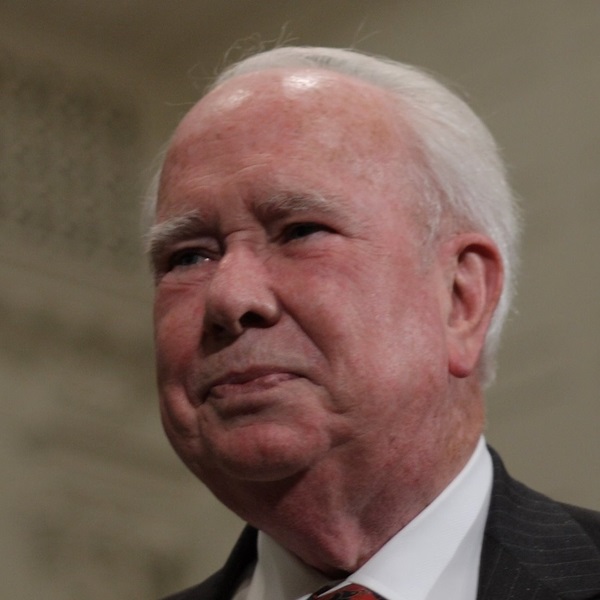
Peter Hamilton Raven, Ph.D. ‘60, a botanist who transformed the Missouri Botanical Garden into a global leader in plant science and became one of the world’s most prominent advocates for biodiversity and conservation, passed away April 25 in St. Louis. He was 89.
Raven served as president of the Missouri Botanical Garden for four decades, guiding the institution from a respected regional garden into an internationally recognized center for research, conservation and education. Over the course of his career, he became a leading voice warning of the rapid loss of plant and animal species and the consequences for the planet.
Born in Shanghai in 1936 to American parents, Raven moved to the United States as a child. He developed an early fascination with plants, collecting specimens and studying the natural world from a young age. That curiosity led to a lifelong career in botany and environmental science.
Raven earned his bachelor’s degree in biology from UC Berkeley and his doctorate in botany. His early academic work focused on plant systematics, the classification and naming of plants, but his research soon expanded to broader questions about evolution and ecology.
In 1964, Raven co-authored a groundbreaking paper with biologist Paul Ehrlich that helped define the concept of coevolution — the idea that species influence each other’s evolutionary development. The work became a cornerstone in modern evolutionary biology and underscored the interconnectedness of life.
Before coming to St. Louis, Raven taught at Stanford University. In 1971, at age 35, he was named director of the Missouri Botanical Garden. He later became president, a role he held until 2011, when he stepped down and was named president emeritus.
Under Raven’s leadership, the Missouri Botanical Garden expanded its scientific reach around the world. He established research programs in regions rich in plant diversity, including Latin America, Africa and Asia, and helped build partnerships with scientists and institutions across dozens of countries.
He also played a key role in major international botanical projects, including efforts to document plant species globally. His work helped advance understanding of the world’s flora while emphasizing the urgency of conserving it.
Raven was widely recognized not only for his scientific contributions but also for his ability to communicate the importance of biodiversity to the public and policymakers. He consistently warned that human activities — including habitat destruction, population growth and unsustainable resource use — were accelerating the loss of species at an unprecedented rate.
He argued that protecting biodiversity was essential not only for environmental health but also for human survival, linking plant science to issues such as food security, medicine and climate stability.
His advocacy earned international recognition. He was named a “Hero for the Planet” by Time magazine and received numerous awards for his contributions to science and conservation, including receiving the National Medal of Science, the highest award for scientific accomplishment in the U.S., from President Bill Clinton in 2000. As a member of the Pontifical Academy of the Sciences, he was an adviser to three popes on environmental issues. He served for more than two decades on the board of the National Geographic Society and was home secretary for the U.S. National Academy of Sciences and a member of science academies in numerous other countries.
Colleagues described Raven as a visionary leader who combined rigorous scientific work with a deep commitment to public engagement. At the Missouri Botanical Garden, he emphasized education as well as research, helping connect scientific knowledge with broader audiences.
Even after stepping down from leadership, Raven remained active in scientific and environmental efforts, continuing to speak and write about the importance of preserving the natural world.
He is survived by his wife, Patricia Duncan Raven; four children, Alice Raven (Sam Stuhlman), Liz Raven McQuinn (Daryl McQuinn), Francis Raven (Carolyn Kousky) and Kate Raven (Katrina Schaffer); and grandchildren Noah, Nate, Louisa and Rosvita.
Read more about Raven on the UCLA Life Sciences site, the Missouri Botanical Garden site and the St. Louis Public Radio site.