Ronald Olch ’72, M.S. ’78
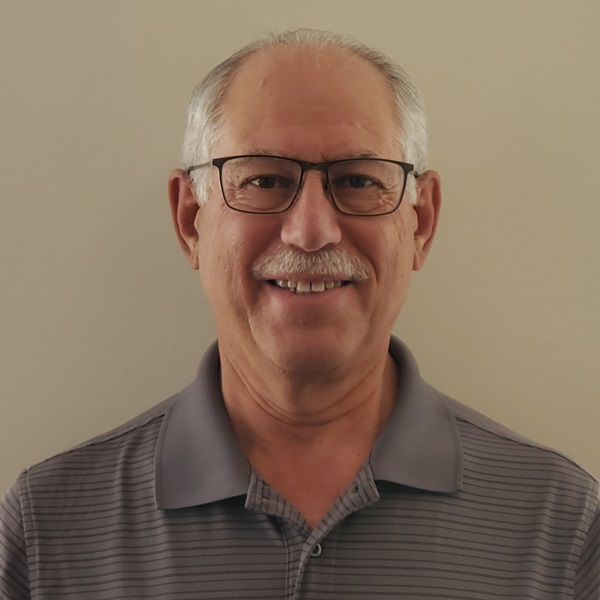 Ronald Olch ’72, M.S. ’78, has spent decades building machines — from early brain-computer interfaces at UCLA to trackless ride systems at Disney. Today, the double Bruin is channeling that same ingenuity into a passion that has followed him since childhood: the scientific study of UAP — Unidentified Aerial (or Anomalous) Phenomena, formerly known as UFOs. His mission is simple but ambitious: give everyday people the tools to collect credible data, rather than rely on anecdotes and blurry photos.
Olch’s interest in engineering, and his curiosity about unexplained aerial sightings, preceded his UCLA years. While still a student at Birmingham High School in Van Nuys, he was granted unusual access to UCLA’s computer science labs — before he had ever taken a class there.
He arrived as a freshman in 1969, the same year UCLA professor Leonard Kleinrock sent the first message over what would become the Internet. Soon after, Olch was given the opportunity to build and maintain a laboratory in the department — an experience that ultimately led to his graduate research on an early Brain-Computer Interface, through which a person could control a machine with their mind.
“I was the architect and hands-on hardware maintainer, installer and programmer for the interface led by Dr. Jacques Vidal,” Olch said. “It was the first time anybody had ever controlled machines by thinking about it. An incredible moment in UCLA history.”
During this period, Olch also joined the Los Angeles UFO Research Group. “Most of the members had nothing to do with UCLA,” he said. “But I managed to secure a room in the computer science department for meetings. I was interested in the instrumentation aspects — how to collect scientifically valid data, not just anecdotes and poorly taken videos.”
A Career in Innovation
After completing his master’s degree, Olch decided not to pursue a Ph.D. Instead, he moved into industry — and into a series of roles marked by invention and creativity. He opened the first computer store on the west side of Los Angeles, helped set up networks for clients including Kleinrock, and later joined aerospace company Teledyne Controls, working on avionics for commercial and military aircraft.
His next move was to his “dream job”: Walt Disney Imagineering in Glendale.
“They were starting Euro Disney and wanted a whole new animatronic control system,” Olch recalled. “I was the principal architect and designer of the next two generations — the systems you see in Pirates of the Caribbean and other rides.” He later led development of onboard audio systems for coasters and vehicles, and created technology enabling trackless ride vehicles — now used at Disney parks worldwide.
One Imagineering project echoed his UFO interests: a proposed attraction at Tokyo DisneySea, which was being developed at the time.
“There was going to be a little green man attraction,” Olch said. “They were going to let you learn how to fly their flying saucer. John Lasseter and all his folks came out to see a demo, and I gave him a ride in that vehicle.
“It would scuttle like a crab in any direction or rotate and move laterally at the same time. He was really thrilled with it. But the Japanese didn't want the attraction, so it didn't happen that time and ultimately, because of the reduction in force, after 16 years I got laid off.”
He shifted into patent work, a job he admits he didn’t enjoy, and eventually to AeroVironment in Simi Valley (another dream job), where he worked on small unmanned aerial vehicles (UAVs) – aka drones. He earned five patents for thermal and waterproofing innovation before another reduction in force ended his time there.
“That’s the nature of engineering,” he said with a shrug.
Building Tools for a Sky-Watchers
Nearing retirement, Olch returned to the question that had sparked his imagination decades earlier: What are people actually seeing in the skies? And could science — not speculation — provide answers?
“The scientific community has come to the realization that the government may have some excellent data,” Olch said. “There are all kinds of stories, some of which are actually true, of collecting hardware and other information, but whatever that may be, they don't share. It is a complete black box.”
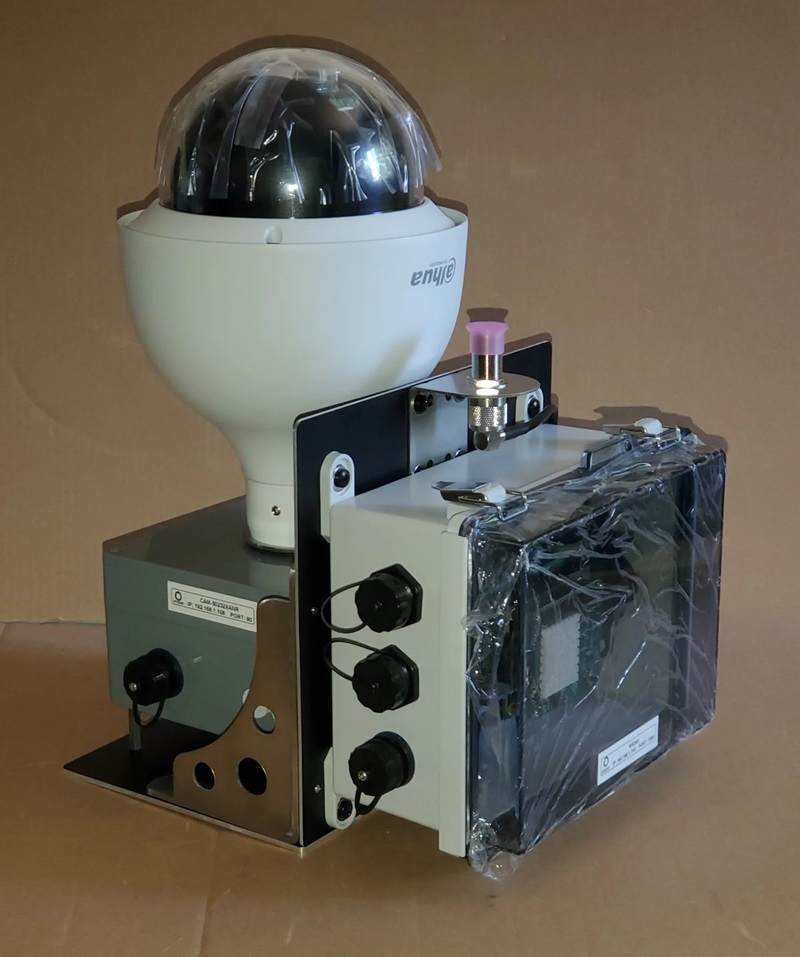 Combination of a 30X optical zoom PTZ camera and the MSDAU on a common tripod mount.
He decided to devote his time and expertise to developing technology to help detect what it was that people were seeing in the skies, since he was pretty sure they weren’t his drones, or anyone else’s. He realized that non-governmental efforts like Avi Loeb’s Galileo Project suffer from having a small number systems collecting the data.
“With very few systems, the odds of collecting something useful are vanishingly small,” he said. “You need a lot of them. And that means they have to be affordable.”
In 2014, Olch began developing a low-cost optical tracking system as a personal research project. In 2016, after meeting Wayne Hollenbeck of the UFO Camera Project, the two launched the UFO Data Acquisition Project (UFODAP), focused on creating accessible, high-quality data-collection tools for citizen scientists.
Olch’s system features high-resolution cameras, thermal sensors and data-acquisition units, along with a user-friendly software suite — all for around $2,500. Through the UFO Data Project, users can contribute footage to a shared global database for scientific analysis.
The goal is to empower citizen-scientists to contribute to an investigation of the topic, rather than the community relying on the government to do that work. And, with the recent attention the subject has received, starting in 2017 with a New York Times article and continuing with congressional hearings, insider revelations and the recent release of the “Age of Disclosure” documentary, the topic has been destigmatized to a significant degree, allowing professional scientists to engage in the research without fear of ridicule or reprisals.
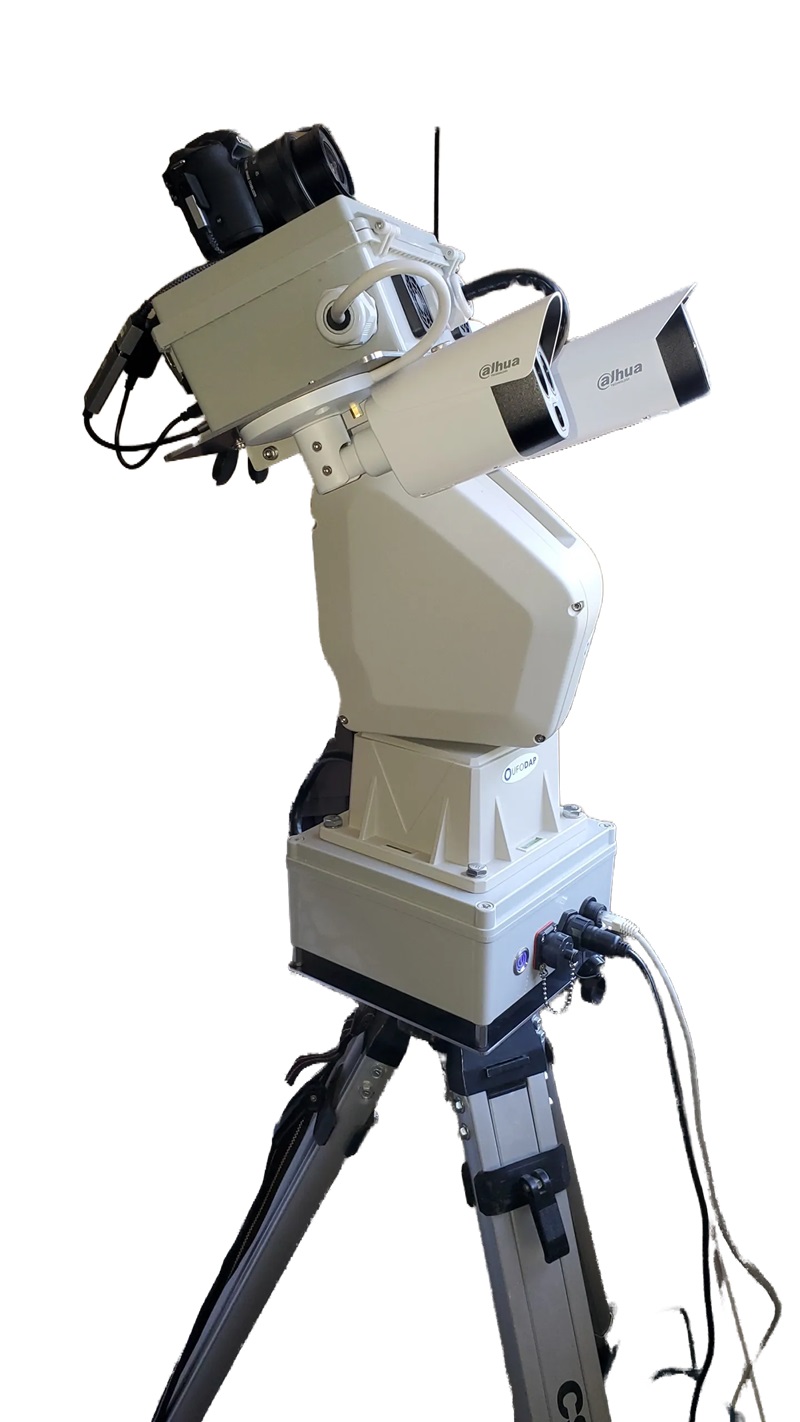 Tripod-mounted pan/tilt positioner with onboard computer carrying a wide-angle fixed-lens camera, a thermal IR camera and a DSLR for simultaneous data collection from all three while tracking.
“In order for a community effort to work, a lot of people have to be involved, and those people can't all be part of academic institutions,” Olch said. “Part of what's happening in UAP, what we used to call ufology, today is citizen science. So I started working on this issue. Could I make some kind of system that could, in an automated way, look up and monitor the sky for something moving and then track it and record it? Relying on cell phone video wouldn’t cut it. I wanted something that you could set up in all weather conditions, any environment, put it on the top of your house, set it on a tripod.”
Today, approximately 170 UFODAP sites operate worldwide. Interest surged after the system appeared on TV programs including “Expedition Unknown” and “Expedition X.” Some of his systems have also been used on “Beyond Skinwalker Ranch.”
Olch, a self-described “nuts-and-bolts guy,” avoids theorizing about what UAP may represent. “Something physical has happened — and has been happening for a very long time,” he said. “The Scientific Coalition for UAP Studies found very high correlations between UAP activity and nuclear installations, for example.”
Asked if the phenomenon could be ours – or that of China or Russia, Olch is dubious.
“The descriptions of some of the objects don't make any sense in that way. People point their camera and all of a sudden the camera fails. Batteries die. You don't see anything. But there's lots of times when they do see something. It's a very curious subject. And science has now come around to saying this is a highly credible thing to study. Ignoring it is crazy because this has been going on for at least 70 years.”
UCLA’s Lasting Imprint
Olch’s ongoing journey has given him the opportunity to use his abilities for the benefit of his fellow humans, and he is very conscious of the role UCLA has played in his.
“Getting an engineering degree at UCLA was a great experience,” he said. “It started in high school, continued in the lab, and included working with people like Dr. Vidal. I remember seeing the first ARPANET node — it was right there. UCLA gave me the background to be a working engineer.”
His connection to UCLA runs through his family as well. His son, Ben ’09, earned a bachelor’s degree in history. His daughter, Rebecca, was diagnosed with Wilson’s disease while at UC Santa Barbara and underwent two liver transplants performed by renowned UCLA surgeon Dr. Ronald Busuttil.
Looking back, Olch feels both grateful and energized by where his path has led.
“I don’t know how I ever did everything I did,” he said. “But I was lucky to pursue what fascinated me, lucky to have my wife, three children and eight grandchildren — and lucky that UCLA made so much possible. My hope is that what I’m doing now will make an impact on the world.”
Our Proud Partners


