Matthew Manos ’10
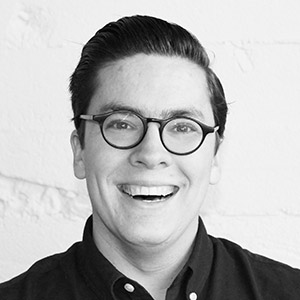
Matthew Manos ’10 originally thought that getting into UCLA would be a longshot, but after being accepted he committed all of his efforts to making the most of his college experience. He was inspired by several professors to pursue a major and career in design and, while excelling in the classroom, also began to work as a freelance designer for UCLA student groups. Manos had always wanted to offer support to philanthropic causes so while doing mostly pro bono work as a student, he conceived of a “give-half model” where he would always do half of his design work free of charge for nonprofits. He went on to found a company, Verynice, write a book and even give two TEDx talks on his philanthropic strategy and how he thinks it can change the world.
How did UCLA prepare you for the professional world?
It prepared me by giving me the skills to use professional design software. However, when I look at what I do today, I don’t actually design much. I work more on creative direction and business management, which is totally unrelated. But when I think about the direction of the work that I do, I think that UCLA Design|Media Arts (D|MA) prepared me well for it. In the D|MA program, you learn a lot about conceptual and critical thinking. At first, I remember thinking, “I’m not the best Photoshop user in the world,” and then I realized that I didn’t really need to be. I really just needed to be that person who could tell a story. To me, that’s really the best thing that I got out of that experience.
How did you decide to start your own company? How were the early years at Verynice?
I launched Verynice out of my freelance practice because I was doing a lot of pro bono work for student groups on the UCLA campus. I actually launched Verynice my sophomore year. I started doing it, kind of, by accident – I didn’t really think it was going to be a business. I had a desire to take what I was learning in the classroom at D|MA and apply it to the real world. It offered a way to validate what I was learning immediately and a practical lens to augment my undergrad education. I worked for about 30 different student groups when I was at UCLA, including Jazz Reggae Festival, Bruins United, Campus Events Commission, and a couple of different student chapters of nonprofits, including Amnesty International.
Did you keep Verynice going during grad school?
I did. I never stopped doing Verynice. In 2010, I started grad school at Art Center College of Design and it was kind of an “oh no” moment because Verynice was getting a lot of traction. We were juggling tons of clients and I was trying my best to make it work. I would get to school at four in the morning, work on Verynice until 10 a.m., then work on grad school stuff, then go to sleep and repeat. I did that for two years. It was terrible, [laughing] but it taught me time management and it taught me that the world is not that complicated.
What was the transition like from grad school into focusing on Verynice exclusively?
It felt simpler, but then in many ways it also got more complicated because after grad school was when we started to grow a team and have offices and things like that. That brought with it a whole lot of other challenges and learning opportunities as well. A growing company is never an easy thing so we went through all kinds of learning experiences.
How has business been for Verynice?
Business is great! We have a relatively small, core team of about 12 people and we’re based in Downtown L.A. Our network of volunteers and contractors is now more than 400 people. It is a robust team and we work with individuals on a per-project basis. In terms of our impact, it has really surpassed all of my goals. We’re at more than $4 million worth of donated services and we’ve worked with more than 430 different nonprofits.
How do you facilitate doing all of that pro bono work?
We call it the “give-half” model. Basically, if we’re working on projects for 20 clients, 10 of those will be pro bono. We keep that balance consistently at all times and never go below 50 percent pro bono. We do often go above 50 percent pro bono [laughing], if we get too excited, but we try to be careful.
How do you decide if a client pays or receives pro bono services?
The only people who qualify for pro bono are 501(c)(3) nonprofit organizations – so organizations that are recognized by the IRS as a charitable organization. Everybody else pays market rate. The nice thing about our model is that we’re not charging our paid clients double market rate. We work with a lot of small businesses and that would be unfair to them.
You gave a TED talk, correct?
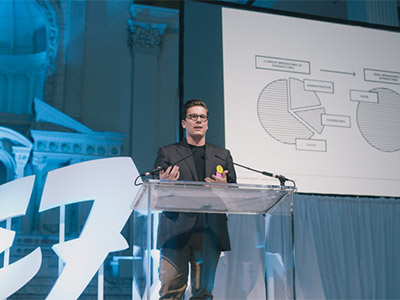
Yeah, I gave two TEDx talks – both on pro bono and the give-half model. The first one was for Carnegie Mellon University and the second was for Johnson & Johnson. Both were really great experiences. The first one was more of your traditional TEDx event, because it was put on by a school, and so that really served as a great platform to refine my story and the story of Verynice. The second one was really interesting because it was for a company. People can be critical of TED talks sometimes because they don’t actually result in something, they’re more storytelling. But with Johnson & Johnson it actually did inspire the acceleration of their own pro bono program.
Where do you see Verynice going in the future?
We want to become a company that helps other companies and individuals make an impact. We’ve been able to pioneer this movement in pro bono by inventing our give-half model and spreading the word. We want to continue that sort of advocacy work, but we’ve also been moving more into the space of consulting businesses on how to invent their own “model of impact.” In terms of our impact, we’re trying to get to a $10 million pro bono donation mark in the next few years. So we’re trying to create more programs and initiatives that allow us to accelerate that kind of giving.
What inspired you to start a company that gives back?
Nonprofits spend close to $8 billion every year on design and marketing professionals, agencies and so on. What really motivates me to give-half, do pro bono in general, or convince other people to do pro bono, is this idea that by not charging them we’re taking a chunk out of that $8 billion. I love the idea that by doing pro bono work, we’re helping these organizations reallocate their money towards their cause.
What do you enjoy about working in the creative and nonprofit sectors?
I love being in both the nonprofit and social sector, and the private sector because I can use experiences from both to influence each of them. If I’m working with a nonprofit I can give them the kind of tactics and mentality that a for-profit would use. Then vice versa, if I’m working with a for-profit I can hopefully teach them how to have the kind of impactful ethos and vision that a nonprofit has.
What is the biggest challenge in your work and how do you overcome it?
The biggest is the challenge of running a business. There are a lot of things that you can’t be prepared for and that you have to deal with. I didn’t go to business school or anything like that, so I’ve had to learn how to do accounting, make financial projections and deal with taxes. I feel like us D|MA students became designers because we didn’t want to do that stuff [laughing].
What was the process like writing your book, “How to Give Half of Your Work Away for Free?”
It was a really rewarding experience and it really represented a turning point in the mission of Verynice. We wanted to move from being seen as this unique model of giving half, to making it the standard model. Basically, we open-sourced our business plan and all of our business secrets to show how we can give half and survive. Launching that book was one of the most rewarding things I’ve ever done because it has helped to inspire thousands of practitioners to engage in pro bono work. There are now a couple dozen give-half companies all around the world. It has replicated what we do and has helped to develop the legacy of this kind of work.
How has the UCLA network helped you since graduating?
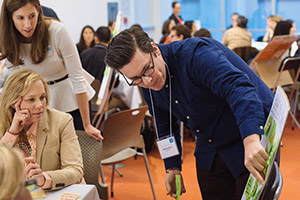
A lot of my clients that I have today stem from those initial student groups that I worked with at UCLA. As people graduated, they got other jobs and those companies hired Verynice to do projects. That has been huge. Also, UCLA has been a great benefit in finding interns, specifically D|MA students because they understand our way of thinking.
If you could give one piece of advice to someone who wants to pursue a similar career to yours what would it be?
I came into this business with this naïve idea. I launched Verynice when I was 19 because I was trying to change the world, and that was a very naïve goal to think that I could do that. But, being naïve kept me open and excited about all kinds of things and I think it helped me not be so skeptical of what I could accomplish with Verynice. So that’s one thing: don’t be afraid to be a little bit naïve when you’re going out on your own or when you’re trying to do something really new. The other thing is, if people are giving you negative feedback on your idea or think that you’re kind of crazy, I’ve always seen that as just validation that you’re onto something very different. So don’t give in to the haters [laughing].
To learn more about Matt and Verynice visit verynice.co
To learn more about Matt’s “Models of Impact” project visit modelsofimpact.co
Download Matt’s book for free at givehalf.co
Watch Matt’s TEDx talk at Carnegie Mellon University
Read the transcript of Matt’s TEDx talk for Johnson and Johnson
Our Proud Partners


