Eileen Levine ‘66, M.P.H. ‘69
Even though she’s not a doctor or a nurse, in 1973, Eileen Levine ‘66, M.P.H. ‘69, revolutionized student health care at UCLA and across the nation. Known by every resident of on-campus housing, student health advocates provide a neighborhood link to the Student Health Center, now called the Ashe Center, granting access to health services made possible by one alumna’s concern for the health of fellow Bruins. Ironically, until a recent meeting with the SHAs of today, Eileen had no idea just what a difference she had made.
This story may have been lost if not for a chance meeting on a UCLA Alumni Travel tour of Europe. While on board a ship to Germany, Eileen connected with Professor Fred Burwick and the conversation turned to Eileen’s UCLA memories and involvement. Eileen mentioned her job at the Student Health Center and as a current Faculty in Residence of Hedrick Hall, Fred knew he had just discovered the founder of one of UCLA’s most successful programs.
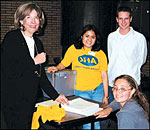
Last October, Professor Burwick sponsored a Fireside Chat with Eileen and current SHAs called “Student Health Advocacy, Then and Now.” The forum reviewed the issues and needs of the mid-1970s in relation to today’s major concerns, and Eileen learned just how much her program had become an integral part of UCLA dorm life.
Basic Building Blocks
Eileen applied to be the UCLA health educator in 1973, despite her interviewer Mack Osbourne Jr.’s warning her that the new position was on a one-year trial basis. “I gave up a career with the California State Health Department to come to UCLA,” says Eileen, who soon became one of the only health educators in California, a revolutionary position Osbourne had created.
“ He was the one with the courage and the foresight,” Eileen says of her boss, who she later approached with another revolutionary idea. Eileen soon took on a new task when a student in Dr. Paul Torrens’ Public Health 44 class approached her. Michele Habibi ‘75 and a group of fellow students had written a paper on student health advocacy, and “she came to me and asked if there was any way to actually do it here.
“ Michele and I wrote up the proposal and went to see Mack, who was the director of student health,” she says. The SHA program seemed a viable way to cut down on visits to Student Health Center for minor concerns, so the health advocacy was approved.
“ We just got funding through student health and it came out of student fees,” says Eileen. “Teaching the class was part of my job.”
Students were selected from the Greek system and dorms to become peer health counselors. Receiving a stipend for their time, the first 19 SHAs each worked with a Student Health Center mentor, and were trained in basic health remedies, throat cultures and peer counseling. They followed strict protocols to cut down on liability issues, and put on self-help cold and acne clinics in Pauley Pavilion. Students held office hours in Kerckhoff, which received a poor turnout. Thus, the main focus was in dorms and sorority and fraternity housing, the latter of which continued until 2001.
Making House Calls
Marked by a sign on their door and a case full of non-prescription medications, SHAs not only still fulfill the need Eileen saw in the 1970s, but has exceeded it. “I think it’s amazing to meet students that are health advocates who take the time and are so passionate about what they’re doing. It just really gives you faith in humanity,” Eileen is impressed by the SHAs’ devotion to the program.
In addition to working as volunteers, the current students have expanded their role as liaisons between the health center and dorms to include aspects of health beyond physical concerns. Leading more outreach programming and events, including blood drives and open health forums, SHAs have helped with mobile Student Health Center clinics that travel around the campus.
Most impressively, they have started a student-based website, to give students instant access to health information tailored to their needs. The Web site has helped the SHAs reach numerous residents.
Case loads have increased along with the number of dorm residents. In the spring quarter 1976, 19 SHAs saw 1,360 students; in the 2001-02 school year, around 72 SHAs made 30,072 contacts.
Since Eileen’s days as an inaugural resident of Hedrick Hall, many Hedrick rooms have been converted into “triples” in order to accommodate the growing number of students. After the forum, Eileen toured a Hedrick SHA’s room, and was astounded by the concept of housing three students in a room meant for one or two.
With so many people in such close quarters, SHA is even more important to UCLA student health than in the 1970s. Although Levine’s program began with one or two students working per residence hall, there are now one or two SHAs per floor. This year, there are 81 UCLA SHAs, including 66 in on-campus housing.
“ They don’t seem to have any trouble recruiting people,” Eileen noted after learning that students now participate on a volunteer basis. Like in Eileen’s years, the SHAs are mostly pre-med and pre-dental students, and gain tremendous insight into potential careers from their experiences.
Educating Experiences
Before becoming a representative of the Ashe Center, SHAs are trained for a year in relevant health issues. The Public Health 44 class requirement of Eileen’s years is now Community Health Sciences 19, but the instruction is similar. During the four-unit course, SHAs are trained in first aid, vital signs, upper respiratory care, gastrointestinal problems, exercise and fitness, nutrition and healthy eating, stress management, contraception, and counseling using developmental and psychological theory.
Working with health professionals and clients, the students have the rare benefit of learning professional skills in the medical field first-hand. “We see what it’s like to see strangers,” said senior Jonathan Webb, Hedrick SHA and resident assistant.
Just how much SHAs benefit from the program only SHA alumni can answer. “I’m curious about how many of them really did pursue careers in public health or medicine,” Eileen says. She would love to hear from past SHAs from all years, and encourages past advocates to contact her by email.
Our Proud Partners


