Jim Brandon ’07 and Brian Singleton ’06

Jim Brandon ’07 and Brian Singleton ’06 met through the Spring Sing comedy troupe Company as writers and performers. Eight years after their first Spring Sing, they’re still writing partners. Their successful web series “Dorm Life” kicked off illustrious writing careers that include “Surviving Jack” and “Arrested Development.”
Q: Tell me a little bit about your involvement on campus as a student?
Jim: When I started at UCLA, I had a general interest in a lot of things but didn’t know what I wanted to do. Communications seemed to cover a lot of what I was interested in but general enough that it gave me flexibility. Writing for Spring Sing helped me realize that this is what I love to do, and it was such a great feeling to be able to write specifically for UCLA students and also to hang out with a bunch of funny, creative people. My parents joke that I majored in Spring Sing because it became such a springboard for my career after college.
Brian: I started at UCLA as a math major, thinking I would go into engineering or architecture. I ended up switching to Communications, which was extremely fulfilling. Participating in Spring Sing was a very transformative experience for me and made me realize that I have this giant creative bug. I lived in the dorms for three years and worked as an RA, and my involvement with residential life had a huge impact on my career, especially when we started writing “Dorm Life.” From that point on, Jim and I were chasing our dreams, writing comedies and entertaining people.
Q: How did you know that there was chemistry?
Jim: Brian was one of those guys I was very comfortable about presenting a budding idea to and asking him what he thought about it. When we started doing “Dorm Life,” there were seven of us who had all been on Company at various times. We were working for a real company, managing a budget, understanding the process of the business. “Dorm Life” was such a fun growing experience since we wore every hat: we were writers, actors, producers. We decided to become writing partners after the second season. Brian and I have always liked working with other people and being a part of a team, whether it was Spring Sing or just collaborating with creative people.
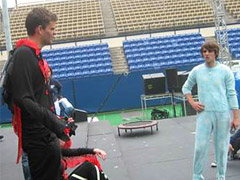 Brian: For a while we were living together, so the bond definitely developed.
Jim: Brian was very nice to let me sleep on his couch and the floor of his room for a while after I graduated. I figured that he must be a nice guy and much nicer than I am to put him with me.
Q: Have you always known or wanted to be a writer?
Brian: Similar to Jim’s experience, after “Dorm Life,” I realized that I wanted to pursue writing. From that point on, we started to write our own TV scripts and spec scripts (sample scripts for TV shows that already exist). We were admitted into the NBC Writing Program, which happens once a year and takes 8-10 people.
Q: What are some difficulties you encountered through your triumphs?
Jim: We were lucky to graduate in 2006 and 2007, when the web series world was taking off. “Dorm Life” was in the first wave of web series that ended up on Hulu and it was huge for our career, helping our names gain traction. The internet is still an amazing place to launch stuff and there are a lot of ways to get discovered, but you can’t take it lightly. We viewed “Dorm Life” as an opportunity to do a TV show. It wasn’t something we just threw together — it was definitely a labor of love. After people got off their day jobs (6 p.m. to 2 a.m.), we would intensely write to get it down and then we had this crazy shooting schedule. We were fortunate enough to have a tiny budget, but it was not an easy process. The first time around, there were a lot of sacrifices in time and relationships. We were getting in fights with some of our best friends over a small web series and then wondering if it was worth it. We had a joke that “Dorm Life” would either ruin our friendships or make us friends forever. For a little while it felt like it would ruin relationships, but things worked out for the better and we are all friends for life.
Q: You mentioned the sacrifices you had to make in order to get a project off the ground. How do you balance a demanding career and your personal life?
Brian: I think it’s a challenge that everyone faces. Luckily, Jim and I are partners and friends. It’s nice to have someone to toss an idea to, but more importantly, it’s nice to have someone to have a reality check with. Career stress can be resolved when you are able to talk it out with someone.
Jim: Having someone to chat with takes some of the edge off. It’s so important to have a personal life. I got married when our career was just starting, and there was a brief moment when I thought I had to cancel my honeymoon. The Netflix folks called us about “Arrested Development” at my rehearsal dinner, right before my wedding, letting us know we got the job. We’ve found that for big life plans, people are normally fine with saying, “Sure, go ahead and live your life and we’ll see you when you get back from your honeymoon.” Brian was good enough to start without me and keep me posted via email. You’re going to have to make some sacrifices to achieve success, but you can’t completely detach yourself from your personal life. You’ll get burnt out and you’ll lose all your creative juices. Burning the midnight oil every day is going to fry your brain. When you are in the creative industry like we are, you need to have days where you exercise and sleep.
Brian: Part of a writer’s job is to experience life and meet new people. For us, getting out of the office is a huge part of the job. It helps fuel our creative spark. See cool things, meet new people. These are the things that help us keep writing and creating.
Q: What was your interest with working on “Arrested Development” and “Surviving Jack”?
Brian: “Arrested Development” was the show that inspired us when we were in college writing for Spring Sing. We were lucky enough to be offered a role working on it once it came back to Netflix.
Jim: We got to see a pilot for “Surviving Jack” before meeting with the creators. It felt very real, and I think it’s partly because the stories are based on a lot of the experiences of the co-creator (Justin Halpern) and his dad. That’s something we look for in every show — is this person real / relatable?

Q: How do you handle situations where there are creative differences?
Brian: A TV writing staff has 10 people in a room, who are all creative and smart in their own ways. Creative differences are bound to happen, especially when you’re emotionally invested in your project. When you’re wrapped up in something you care about, it be can be difficult and frustrating if your point doesn’t get through. It’s a very collaborative job and you have to learn how to respectfully disagree and reach a solution.
Jim: With “Dorm Life,” we all had an equal say and we would talk something to death and then vote. Now when we’re on writing staffs, there is a clear show runner and it feels like our job is to make their job easier, to deliver their vision. At the end of the day, our job is to deliver the joke or the episode idea or the story point idea that they like the most.
Q: How do you stay connected to UCLA?
Jim: The “Dorm Life” group had such a difficult and personal journey that the group still makes an effort to stay in touch with one another. Old Company folks still try and get together and go to Spring Sing. It’s a great element of the UCLA community that we’ve gotten to keep.
Brian: We love going back for Entertainment Networking Night. We’ve gone back to be guest speakers at film classes or speak about online content. We love doing talks and sharing our journey. Not so long ago, we were on the other side staring at guest lecturers who motivated and encouraged us. It’s our way of repaying UCLA for the amazing experience we had.
Our Proud Partners


