Judy Chicago ’62, M.A. ’64
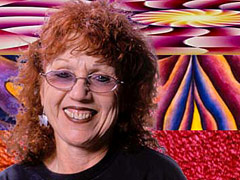
She was born Judy Cohen in Chicago, Ill. in 1939. By age eight she was taking art lessons, and today she is one of the world’s most widely known feminist artists. Chicago’s childhood love of art led Judy Cohen to UCLA, where she enrolled in the undergraduate art program. With her burgeoning feminist social and artistic sensibilities, she endured the sexist bureaucracy of the art department and completed her education in 1964. Re-christened “Judy Chicago” by a gallery owner because of her Windy City accent, she soon established a name for herself as a contemporary artist, showing her work at various local exhibits. Chicago also began teaching at the California Institute for the Arts, where she helped established the Feminist Art Program, out of which grew 1971’s “Womanhouse.” The first installation demonstrating an openly female point of view in art, “Womanhouse” consists of an old Los Angeles house transformed into a metaphor for women’s captivity within the home.
Chicago continued her collaborative efforts in the ’70s, founding a feminist studio workshop at the Women's Building in Los Angeles and beginning work on the world-renowned group project “The Dinner Party.” The ambitious project, which Chicago humorously called a “reinterpretation of The Last Supper from the point of view of those who’ve done the cooking throughout history,” consists of a triangular table, 48 feet long on each side, with complete place-settings for 39 women who have been “forgotten by history.” During its 15 exhibitions in six countries, “The Dinner Party” was seen by a million people, and has since spawned a documentary and three books.
Over the last three decades, Chicago has continued to produce provocative feminist and socially conscious works of art, including “The Birth Project” and “The Holocaust Project,” the latter of which grew out of her and her husband’s exploration of their Jewish heritage. In 2000-01, Chicago’s exhibit, “Resolutions: A Stitch in Time” was shown at the Skirball Cultural Center in Los Angeles. The project was a collaborative effort, combining the painting and needlework of several artists to create a series of images that reinterpret traditional proverbs and wisdom.
For many decades, Chicago has produced works on paper, both monumental and intimate. These were the subject of an extensive retrospective "Trials and Tributes" which opened in early 1999 at the Florida State University Art Museum in Tallahassee, Florida, organized by Dr. Viki Thompson Wylder, who is a scholar on the subject of Chicago's oeuvre. In October 2002, a major exhibition surveying Chicago's career was presented at the National Museum of Women in the Arts. The show was accompanied by a catalog edited by Dr. Elizabeth A. Sackler with essays by Lucy Lippard and Dr. Viki Thompson Wylder and an Introduction by Edward Lucie-Smith.
In 2009, the Textile Museum of Canada in Toronto mounted "If Women Ruled the World," the first major survey of Chicago's work in the needle and textile arts. This exhibition included Chicago's monumental textile works and was accompanied by an extensive catalog with essays by Allyson Mitchell and Jenni Sorkin, both young feminist scholars.
In addition to a life of prodigious art making, Chicago is the author of numerous books, many based on the themes and histories of her wealth of major installations, and about women in art.
Chicago's book, Kitty City: A Feline Book of Hours (Harper Design International), was based on a series of watercolors chronicling the life and activities of Chicago, her husband, photographer Donald Woodman, and their bevy of cats. In conjunction with the publication of the book, exhibitions, book signings and cat adoption were held around the country. Since 2003, Chicago has been working in fused, etched, cast and painted glass, and in 2010, she will have four glass exhibitions in both the US and Canada.
Chicago has received numerous awards including an honorary doctorates from Russell Sage College, Smith College, Lehigh University and Duke University; 1999 UCLA Alumni Professional Achievement Award; and a 2004 Visionary Woman Award from Moore College of Art and Design; and the 2004 Lion of Judah Award.
Many films have been produced about her work including "Right Out of History: The Making of Judy Chicago's Dinner Party by Johanna Demetrakas; documentaries on Womanhouse, the Birth Project, the Holocaust Project and Resolutions; and two films produced by the Canadian Broadcast Corporation, Under Wraps and The Other Side of the Picture. E Entertainment Television included Chicago in its three-part program, World's Most Intriguing Women. Recently, she was named one of the Eight Jewish Women Who Changed the World in the magazine published by the Union for Reform Judaism.
For over five decades, Chicago has remained steadfast in her commitment to the power of art as a vehicle for intellectual transformation and social change and to women's right to engage in the highest level of art production. As a result, she has become a symbol for people everywhere, known and respected as an artist, writer, teacher, and humanist whose work and life are models for an enlarged definition of art, an expanded role for the artist, and women's right to freedom of expression.
Throughout her various projects, Chicago continues to act as head of the non-profit arts organization “Through the Flower,” which seeks to preserve and perpetuate the feminist consciousness of her art.
Our Proud Partners


