Kelly Persons ’05, Ed.M. ’06
Seventh Grade Science Teacher, John Muir Middle School
After speeding her way through UCLA’s two-year teaching program, Kelly Persons ’05, Ed.M. ’06, is working to make an impact on inner-city students — one science experiment at a time.

1. Why did you go into teaching, and why specifically in the inner city?
I have wanted to be a teacher since I was in the fifth grade when I started tutoring second-graders in reading. I always liked helping people learn, and I really like working with kids, so teaching seemed like a perfect fit. Initially, I did not intend to teach in the inner city, but the Teacher Education Program at UCLA aims to place qualified teachers in these particular areas. The school I am working at now is a four-track school, grades six to eight, located about 20 blocks south of USC. As far as demographics go, it is approximately 75% Latino and 25% African-American.
2. Have you discovered any misconceptions you had about the inner city?
When I told people I would be teaching in the inner city, the most common response was “But, you’re so young and blonde.” I was nervous because everyone kept telling me horror stories and making references to the movie Dangerous Minds. I stand out like a sore thumb, and my mom (along with everyone else) warned me a million times how dangerous the inner city was and how I had to be careful, not look at anyone, not walk outside, and the list goes on. But once I was able to spend time with the kids and work in their environment, I became really comfortable and really enjoyed working with my students. It is an extremely rare occasion when I feel unsafe at school. Our school is probably the safest place in the neighborhood, and while it’s true that the neighborhood I work in is not a perfect one, I think that people tend to exaggerate its negative aspects instead of emphasizing its positive ones.
3. Describe the transition from full-time student to full-time teacher responsible for 150 kids.
It was a very difficult transition. I had always been involved in working with kids at summer camps and tutoring programs, but actually being the person responsible for their education was overwhelming. I had trouble accepting that I was going to make mistakes and that those mistakes, plentiful as they were, weren’t going to ruin the kids for life. Once I got over trying to be a perfect teacher and realized that all I could do was my best, it was a lot easier to go to work every day. I have also made some really good friends in our science department and it is helpful to have a group of people that could relate to my experiences and help me when I need it.
4. What are some of your greatest joys in teaching?
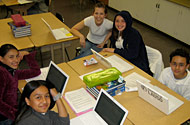
One of the greatest joys of teaching in the inner city is getting students excited about science, and learning in general. Most of my students have not had teachers who are comfortable enough with their science knowledge to do experiments and activities that make learning about science fun. I love when they tell me that I make learning exciting for them, because I know they will remember the experiment we did in class much longer than they will remember something they copied out of a book.
5. Do you feel like you’re having an impact?
I feel my greatest impact is felt among my students because I see them on a daily basis. I am also looking forward to further developing our GATE (Gifted and Talented Education) program at Muir so that our high-achieving students have more opportunities outside of the classroom. In the future, I would like to involve my students in community service in the area, and work toward having greater parental involvement at our school.
6. Do your students face any barriers to learning?
My students face a lot of different issues that I have never had to deal with, and it often distracts them in the classroom. Most of the students are from single-parent families, and we also have a large population of students living in foster care. Some of our students have family members involved in gangs, some are involved in gangs themselves, and others have lost family due to gang violence. The students are exposed to drugs and alcohol at a very young age. For many students, school is an escape from all of these negative pressures. School is a constant in their lives and their friends and teachers support them.
7. Is it easy to forget about the problems your students face?
I truly feel like each of my students, even the ones that test my patience, is one of my own children. I don’t think that I could ever become apathetic toward their problems. They have to deal with more as seventh graders than I have probably dealt with in my entire life, and many of them do not have positive support systems in their lives. I care about their well-being and I want them to feel that they can trust me when they ask for advice or when they simply want to vent. I am lucky enough to have a positive group of people in my life supporting me, and I want to provide the same for my students.
8. Is there a particular student who has inspired you?
It is difficult to pick one student because I have so many who are making such great efforts to be successful despite issues they may be encountering outside of the classroom. For example, one of these students recently lost his older brother to gang violence. Only a few months before that, this student had been expelled from his previous school for participating in gang activity himself. When I spoke with him, he told me that he never wants to be involved in gangs again because he doesn’t want to end up like his brother. This student is extremely bright and has such great potential as a leader and an example to his peers. It was humbling to see that he had matured so quickly in response to his family tragedy and was able to reflect upon his own life and make the changes he felt necessary to ensure his future. I am proud of how hard he works in class and of the positive influence he has on his peers.

9. Do you think the educational system is serving your students well?
I think the educational system in every district has its flaws. What is important is how you deal with them as a teacher. Teachers are the people that students see on a daily basis and who are in a position to most positively impact them. Our school often lacks supplies and resources that are easily found in more affluent schools, and it is easy for teachers to be frustrated with buying their own supplies and having to teach with limited resources. However, if you have a creative attitude and the students see you maintain a positive outlook despite those conditions, they are more likely to do the same.
Our Proud Partners


