Michael Espe ’07
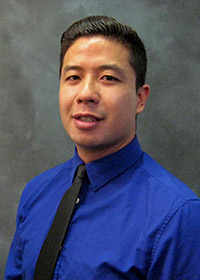
Michael Espe is a dual degree holder at UCLA. His journey of self-discovery and self-awareness increased his involvement with cultural groups on campus and ignited his passion for service: both in counseling students and helping the needy through the L.A. Regional Food Bank.
Why did you choose UCLA?
To be honest, it has always been a lifelong dream. I’ve had uncles, aunts and older cousins who attended UCLA. The last time a family member attended UCLA was in the 90s. I grew up hearing about UCLA and what an amazing university it is. I applied to many schools, but I was thrilled for the opportunity to be the next Bruin in my family.
What did you take away from your time at UCLA?
Well, I graduated with two Bachelor of Arts degrees in history and Asian American Studies. Of course the curriculum was challenging, but the professors taught me how to open my mind and challenged me to think in new ways.
Like so many other Bruins, my experience as a student was a winding path of self-discovery and self-awareness. As a high school student, I was shy, reserved. I never fully acknowledged the fact that I am Pilipino or the fact that I am a gay Asian man. To be completely frank, I hated those pieces of my identity at that time. It was a journey to learn about myself and develop my self-worth from my identity. I learned to be comfortable with being uncomfortable.
Through that journey of self-discovery, what passions did you discover you had?
I joined Samahang Pilipino during my second year at UCLA. I wasn’t too involved, but this served as the point of departure for my journey. Samahang Pilipino is a student organization that addresses the needs of the Pilipino and Pilipino-American community at UCLA and in the greater Los Angeles area. There are many facets of the group from cultural night, to education, to a peer retention program. As I advanced through UCLA, I also became progressively more involved with the Pilipino community on campus. In my second year, I performed on stage at Samahang’s Pilipino Culture Night. Then I served in a leadership position my third year, helping with recruitment and activities. In my fourth year, I became a peer counselor through Samahang Pilipino Education and Retention (SPEAR).
What made motivated you to become more involved?
My peer counselor during my second year asked me what I wanted to do and what I wanted to gain from my time at UCLA. It dawned on me that I only have four years, what am I going to do with it? I wanted to make an impact, and I wanted to leave my mark. I didn’t want to go through four years of UCLA just partying and going to classes. There had to be more to college. I wanted there to be more to college. I also wanted to inspire others to want more from college in the same way my peer counselor inspired me.
What are your favorite memories of UCLA?
My first year, I loved attending football and basketball games with my floor mates. I loved the flood of Bruin spirit that rushes through you when you’re cheering on your team. I learned what it meant to have pride and to be proud of UCLA. My second year, I performed in Samahang Pilipino Culture Night. I developed a love for being in the limelight, so this was a key experience. During my third year, I was involved with USAC elections and I got to see the politics of a university, the university’s needs and the students’ needs. This was one sphere where students can leave an impact on their school. I had the amazing opportunity to do the Asian American Studies travel study program to the University of Hawaii my fourth year. This was another pivotal moment in my learning about self-identity. My family’s origins came from Hawaii. My great-grandparents were the original plantation workers back when Hawaii still had plantations. The classes I took while I was in the travel study program illuminated more about my Pilipino heritage and roots. My experience in self-identity came full circle at that point.
What was life like after graduation?
I finished the travel study program the summer after graduation. I came back from Hawaii with no job, no friends (since they left for jobs or graduate school) and a lot of bills. It was a confusing time since your support system is no longer next door. Luckily, I got a part time job in the UCLA Neurosurgery department, and I had this job for six months. It was a great experience, but I knew I wanted to work in the nonprofit sector.
I met one of my best friends at UCLA. She helped me find my next job at the Los Angeles Regional Food Bank. I never knew the Food Bank existed before this job search. It’s a big shock since I grew up in Los Angeles. I worked there for six and a half years.
What did you learn while working at the Los Angeles Regional Food Bank?
I learned so much. Starting with the basics, I learned all the ins and outs of Microsoft Office. It helped me lay down foundational administrative skills. I learned how to deal with different types of people from different backgrounds. We had to deal with everyone from CEOs to high school students. The ability to connect with someone on their level went a long way.
What do you want people to know about the Los Angeles Regional Food Bank?
It’s not just a place where people go to get food. Of course there are individuals and families who rely on the Food Bank to put food on the table, but it is so much more than that. There are educational components for this underserved community. We teach them how to prepare food and what to eat so that parents and their children can get the most nourishment out of their food. It’s about the community and how we can make it better. I never knew about the Food Bank until I discovered the open position, but I hope this will change for Bruins who get a chance to volunteer with the Food Bank. I hope they spread the word about the Food Bank.
Being there six and a half years, you must have seen a lot of volunteers come through the doors. How did you feel when UCLA volunteers came to the Food Bank?
At first there wasn’t very many. There were a few student groups that would send volunteers every year. Then the Volunteer Center began to connect us with a wider audience and a larger volunteer base from the Westside. UCLA staff started to come more frequently, people from Alumni Affairs or External Affairs. Over the years, I even was in touch with offices like the UCLA Department of Statistics. To see the UCLA community giving back this way, it made me so proud to be a Bruin. It just confirmed that I made the right choice to attend UCLA.
How did you feel when you heard about the Tackle Hunger Challenge between UCLA and USC?
I was thrilled! I love the idea of utilizing the rivalry to benefit an organization that is outside of the two universities. The Food Bank is such a worthy cause, and in this situation, everyone wins. Both schools exist in the Los Angeles community, as much as we like to not acknowledge the other school. The Food Bank supports the Los Angeles community. If the Los Angeles community benefits, then both UCLA and USC benefit. However, I do hope that Bruins come out on top in the Tackle Hunger Challenge.
So what’s next for you? What is your next goal?
After working at the Food Bank, I came to realize that the type of work I was doing wasn’t going to be enough to fulfill me. I thought back to my days as a peer counselor and how rewarding that was. I had friends who are counselors and went through student affairs graduate programs. Three weeks ago, I started a position at Southwestern Law School as a Student Affairs Coordinator. This is really my first foray into the world of student affairs, to see if this is what I want to do as a lifelong career. I plan to apply for a Master’s program in Student Affairs by 2016.
How did UCLA help mold you into the person you are today?
I mentioned self-identity a little earlier. If it wasn’t for UCLA, I don’t think I would have been able to form that awareness in the healthy and nurturing way that I did. I had people, from professors to peer mentors, teach me how to make a difference. I also loved seeing other people make a difference. I like to think that I did make a difference at UCLA.
Our Proud Partners


