Nora Hakkakzadeh ’10, M.A. ’13
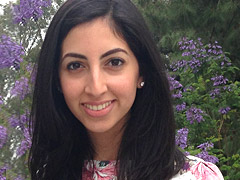
One would be hard pressed to find a Bruin as committed and passionate about the environment as Nora Hakkakzadeh. With degrees in environmental science and urban planning, she shared with us the role that UCLA played in inspiring her to follow her professional calling.
Q: When and why did you develop a passion for the environment?
I’ve always had an affinity for the sciences. When I first came into UCLA, I thought I wanted to pursue science so I became a biological sciences major. Like many other south campus students, I started to take the science and math series, but it was hard to find relevancy to what I was learning in my everyday life.
During my second year, I enrolled in an environmental introductory course. This was around the same time the Global Warming Solutions Act was passed, which restricted the emission of greenhouse gas emissions. I completely fell in love with the class and it filled that gap in my education that I felt was missing. I also learned that sustainability was not just about living a green lifestyle - it’s about your actions today having a very real consequence tomorrow and for others. This message resonated with me. You have to act responsible and you have to take responsibility for your actions.
By week 5 of the class, I had changed my major. I didn’t just want to learn about the environment – I wanted to be immersed in the subject. By nature, I am someone who likes to plan out their options and choices before making a decision, but I just felt a calling and I went with it.
Q: How did you cultivate or pursue your love for the environment in college?
Student groups
I wanted to be able to incorporate what I was learning into what I was doing in my life, and I wanted to share what I was learning. I got involved with USAC, and became the Sustainability Manager for the Facilities Commission. We worked with various computer labs on campus to switch their default printer settings to print double sided documents. We also educated them about the funding that was available for them to purchase green products.
Extracurricular work
Almost everyone knows UCLA is a research-based institution, renowned for its discoveries and innovations. I was one of those students who kept thinking that I have to do research. I had the opportunity to do academic research with geography professor Larry Smith. At the time, he was writing the now published book, “The World in 2050.” It looked at the impact of climate change and how it is going to affect those individuals in the future. I worked on a few small research projects that were included in his books. It was an amazing experience of which I’m truly grateful.
I also did an internship that I found through UCLA with a consulting company that was looking at how to incorporate low energy light bulbs in different parts of the world. This was a turning point in my career pursuits. I had a great experience, but it made me realize that I didn’t want to just do research.
UCLA education
Environmental science is very interdisciplinary, which gave me a wider academic breadth. One very memorable course I took in environmental economics, taught by Professor Matthew Kahn, allowed me to see sustainability issues beyond the physical effects but also its economic impact globally and in our everyday lives. As a Los Angeles resident, I was able to understand how making small changes and commitments to living a greener lifestyle could result in a financial change as well, such as switching to low energy light bulbs. You don’t have to be a tree hugger to live a more sustainable life.
UCLA has a big, important impact in Los Angeles. Our participation in initiatives like the Grand Challenges Initiative sends the message that this is an important topic and makes the issues clearer. It made me proud to call UCLA my alma mater.
Q: What were some of your memories from your time as a UCLA student?
To be honest, I don’t think I could ever describe my time at UCLA without mentioning those long, endless sessions at Night Powell. There was just this feeling of camaraderie that you weren’t alone in the craziness of finals and exams.
Another memory is from my senior capstone project where my environmental science team did a research project on quantifying the trash debris in the Topanga Canyon watershed. I remember on our first field study, we drove down PCH in the pouring rain, parked the car on Topanga Canyon and literally jumped the highway. Then we found a makeshift path to the creek to pick up trash. Everyone was holding umbrellas for each other as we portioned off our work site and started collecting the debris we found in the creek. Even is such awful conditions, the entire team was charged and ready to do the job because we knew our work would help the larger effort of strengthening Los Angeles’ water quality.
Q: Describe what you do in your career now.
I like to say that I build bridges. In Environmental Outreach Strategies we work with private, public and nonprofit sectors engaged in environmental projects and communicate their work to the community they are a part of or affecting. As a program manager, a lot of my work includes outreach plans, stakeholder plans, government and community work, coalitions to gain support, legislation, etc.
Q: What advice or suggestions do you have for other alumni who live in urban environments like Los Angeles about living a sustainable lifestyle?
There are a lot of luxuries with living in an urban environment. Living a sustainable life is a work in progress, it doesn’t happen overnight. The city of Los Angeles itself is working on better forms of public transportation and getting the word out there about using it.
For our alumni, I encourage them to live mindfully. I get it – living in Los Angeles with constant stimulation, stress from work or personal lives, we tend to live mindlessly. You really don’t always have to jump in your car. There are opportunities to walk to your local grocery store or restaurant. The weather in Los Angeles is beautiful most days and nights, so we should enjoy it. We have to break away from this norm and see what transit opportunities are out there.
Q: How do you stay connected to UCLA?
A: I’m a double Bruin, and my older sister is a Bruin. I also worked for UCLA. It is a second home for me. It has always been a part of my life, directly and indirectly, and I am so appreciative of having gone to UCLA and the significant role it’s played in my career. I’m extremely proud to be a Bruin, and it’s one of the reasons why I joined the Young Alumni Development Council and the Alumni council on urban planning.
Q: As a member of the Young Alumni Development Council, why is it important to give back?
A: I want students to have the same opportunities that I did. We aren’t receiving as much funding from of the state anymore. I could never imagine UCLA without staples like Night Powell, which was once at risk of being shut down. It’s disheartening to think that a student could choose another university over UCLA because of the lack of funding.
Q: What message do you want to get out to other young alumni who are considering giving back to UCLA?
Giving back helps maintain the UCLA legacy and your own. I recently learned that only 10% of UCLA alumni give back to the school. I have to admit, I was shocked and embarrassed. As an institution, we strive to be the best at everything we do: research, athletics, student programming, etc., but our alumni giving numbers fall behind our competitors.
When I say “give back,” I don’t mean just financially. Yes, UCLA does need financial support, but people can give back with time and energy as well. UCLA is known for being the best, so this is another reason to give back so we can stay the best.
It’s important to stay involved. As a student, you were a part of the Bruin community several years. You don’t leave the Bruin community just because you graduate. Staying engaged and involved means you get a chance to pay it forward, ensuring that the next generation of Bruins have just as great of an experience if not better.
Our Proud Partners


