Simmi Gandhi M.S.N. ’99 & Delia Herrera ’01
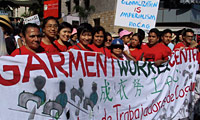
Los Angeles sweatshops have received a great deal of coverage for their hazardous and unjust working conditions. Simmi Gandhi M.S.N. '99 and Delia Herrera '01 are worker organizers at the Garment Worker Center (GWC) in Los Angeles, which empowers workers in the garment industry to fight for suitable work conditions and wages.
Explaining why they chose their line of work, Simmi and Delia refer to a statement written by a garment worker, José, who is affiliated with the GWC.
“The garment industry is one of the most important in Los Angeles,” he writes. “It generates millions of dollars in sales every year. But this is different for the workers because their salaries are miserable compared to the profit the manufacturers and retailers obtain. This is why it’s important that those who labor in this industry unite to find ways to improve the poverty situation we suffer in the richest country in the world. In order to do this, we have to talk to our coworkers to decide if our salary is fair, our treatment is just, our living conditions are just, the time we dedicate to our families is fair, our workplace is safe, and our nutrition is healthy. You know this is not right, so start building relationships with your fellow workers. Unity will let the workers live with dignity, respect and social wealth in a country where justice and democracy is practiced.”
Simmi and Delia give an insider’s view on the efforts being made to improve worker conditions in Los Angeles’ garment industry.
1. What is a sweatshop and how does it facilitate exploitation?
We define a sweatshop as a workplace where workers are subject to extreme exploitation, including the absence of a living wage or benefits, poor working conditions and arbitrary discipline.
Workers work 10 to 12 hours a day, six to seven days a week without overtime pay. Most do not receive minimum wage; the average workers’ wage is only $3.80 an hour. Most are denied breaks and lunch hours. Workers have no health care and when they are injured, often get fired. They endure verbal, physical and sexual harassment on a daily basis.
The Department of Labor reports that two out of every three factories violate wage and hour laws. Three out of every four violate health and safety laws, with more than half of those violations being serious enough that workers could die or be hospitalized.
2. What constitutes workers’ rights?
We understand the limitations of challenging the current garment industry structure. But we believe there are steps that could help expand the discussion around retailer accountability. Instead of relying on the companies to hold themselves accountable and offer codes of conduct as their solutions, we believe that workers should be given power in the factories to monitor and negotiate changes to their working conditions. We advocate allowing workers to organize, giving workers a role in monitoring changes, providing training and benefits for contractors and workers, and making retailers and manufacturers accountable for proper working conditions.
We encourage discussions with monitors to see how workers can be directly connected and involved. Strategies should include building worker power and supporting worker participation in the fight to hold retailers accountable. We should not simply rely on laws and policies. We need to support real worker participation.
3. What is the Garment Worker Center?
Over the past five years, the GWC has established itself as one of the leaders in low-wage worker organizing and the fight against worker exploitation. We are one of the only multi-ethnic, multilingual centers organizing low-wage workers in the country. We have helped workers reclaim over $2.5 million in owed wages and penalties. We helped settle a national boycott against a retailer after a three-year campaign. We’ve trained more than 100 workers in organizing and leadership skills.
We also have helped local and state labor law enforcement to better respond to worker needs. Since our formation, the Department of Labor Standards Enforcement has reported better compliance of labor laws in Los Angeles factories.
4. How did you get your position at the Garment Worker Center?
Delia: When I was a student at UCLA, I participated in different protests and boycotts. Being involved really shaped what I wanted to do with my life. It shaped how I saw the world and what I wanted to take on as a responsibility. My involvement showed me that I wanted to work towards change through this type of organization. As a student, I saw the conditions that people were living in and the politics involved. This experience really opened my eyes and heart, and forced me to question the way things are happening. When a position opened up, I came to the GWC.
I started asking, what is the purpose of an advocacy organization and how does this organization, in particular, reflect the type of society we want to have? It's not hierarchical; instead, it’s a place where there is open communication, where we're not afraid of asking questions and working together. We're invested in this, and we want to be part of this change.
5. What does this job mean to you?
Delia: We love what we do and it’s always exciting and challenging. Everyday when I wake up, I want to come into work. I love it! We are working collectively to organize workers and develop curriculum to encourage workers to take action. We also encourage workers to create change and realize that change is possible.
6. How does it go beyond the regular nine-to-five?
Delia: I wouldn’t fit in at a nine-to-five job. I have a passion for learning and sharing with other people, and it's exciting to work with people who also have the same passion and commitment to better society; we have a responsibility to do so and we want to do so. We believe a workplace needs to be healthy. While we do work long hours, it's compensated by the change we make and the lives we save.
7. The Los Angeles garment district has been featured prominently in the fight for workers’ rights, more so than many other metropolitan areas. What distinguishes Los Angeles on this issue?
Simmi: Los Angeles is the sweatshop capital of the United States. We have more garment workers and factories than any other city in the country. Most of the factories in Los Angeles can be considered sweatshops.
8. How does the Garment Worker Center advocate for these rights?
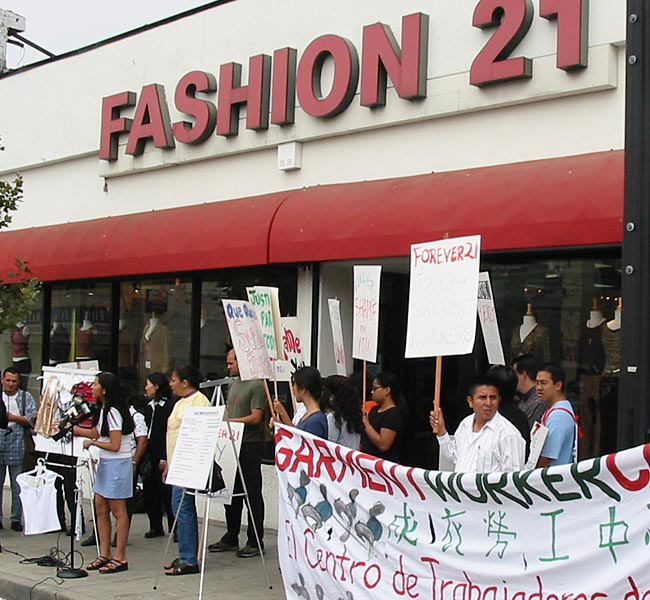
Simmi: We do direct organizing among workers to build strength and put pressure on owners, manufacturers and retailers so that workers have a collective voice to demand the needed changes to improve their conditions. Garment workers learn about their rights and teach each other. They develop themselves as leaders and organizers of their coworkers and build their own committees, networks and organizations so that they may have the strength and force to ensure that manufacturers will have to provide fair and just work conditions.
Another key part of our mission is to work in solidarity with other low-wage immigrant workers and disenfranchised communities in the struggle for social, economic and environmental justice. The GWC’s focus is worker organizing. As a worker center, we sharply focus our energy on building the strength and power of the workers themselves.
9. What are some of the best and worst aspects of working for a grassroots advocacy group?
Delia: The best things have been the different relationships that I build with my co-workers, and meeting really powerful workers who have worked in the garment industry for many years. They have so many ideas and so much passion to change the way their lives are.
There aren’t really any down-sides. If anything, it's exciting to change the working environment; it really gives us strength in what we’re doing.
10. Why should the general public care about your cause?
Simmi: If you are a person who believes we should live in a humane society, then preserving peoples’ humanity with dignified wages and working conditions that do not put their physical and mental health at risk is the humane thing to do. If you are a patriot and you take to heart one of the founding statements of the U.S. – the right to life, liberty and the pursuit of happiness – then you should support workers having workplaces that allow dignity and power to negotiate their conditions.
Those who hold a grossly distorted version of Darwin’s theory of evolution, and who defend the massive exploitation of the economic system by saying, “It’s just the way it is, only the strong survive” are denying their own humanity and the reality that there is enough wealth and resources in the world to have all people live well and eat well. It is simply about the decisions being made on how wealth should be distributed.

11. What can we consumers do?
Simmi: Everyone wears clothes. Unless consumers are part of the community that demands better conditions for workers, retailers will not change their ways. People need to be more outspoken. Everyone should think about where and how things that we use are made. We need to tell companies and the stores that we do business with that we care how the workers are treated. We need to support worker-owned cooperatives and union shops, places where workers have a voice in their workplace. If people are doing or creating businesses, they should be making sure that workers are paid living wages and given benefits, security and a meaningful voice to shape their work conditions and support cooperatives and union shops.
We have to support workers when they struggle against unjust corporate practices, and send letters or boycott a brand.
12. Any advice for people who are interested in being involved with nonprofit advocacy organizations?
Simmi: Develop your own vision of the kind of society you want to live in. Learn, study, explore and experience the many different ways, historically and currently, that people are fighting for a better society. Ask lots of questions to find organizations which match your ideals. Otherwise, go into an organization prepared to struggle to create change on the issues you care about.
Our Proud Partners


