
UCLA Library Film & Television Archive: Bruce Lee, " The Way of the Intercepting Fist"
Date and Time
- Saturday, Feb. 25, 2023, 7:30 p.m. PDT
Location
- The Hammer Museum
-
10899 Wilshire Blvd.
Los Angeles, CA 90024 - + Google Map
The profound legacy of Bruce Lee extends far beyond the immortal icon's seemingly unmatched physical talents. Globally admired for his incomparable martial arts skills earned through arduous study and training, Lee's advanced philosophies of self-actualization equally inspire the artist's legion of fans, further defining his lasting influence.
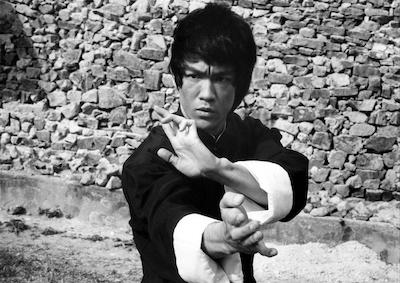
An avid reader with a personal library numbering thousands of volumes, Lee was a dedicated philosophy student in college (he attended the University of Washington, where he also studied drama) and was a prolific author. In his extensive writings, which include fighting manuals and poetry, Lee expressed his core philosophy as "using no way as way; having no limitation as limitation." Lee saw this tenet as having application not only to physical combat (where he railed against rigid forms of traditional martial arts) but in a humanist sense as to how one might approach overcoming life’s challenges to meet their full potential. The transformative martial arts Lee developed, which he called Jeet Kune Do (translated from Cantonese as "the way of the intercepting fist"), was the distillation of his beliefs, in which he stressed the honest self-expression of the individual over any organized style or way of thought.
As an actor, Lee's considerable artistic contributions to his screen projects led to the organic intertwining of his persona and philosophies with those of the fictional characters he portrayed. Among the most illustrative examples, the premiere episode of the ABC television series Longstreet (1971) co-stars Lee as a martial artist and life coach who mentors a blind detective (James Franciscus) in self-defense and the teachings of Jeet Kune Do. Likewise, the cult-classic feature film Enter the Dragon (1973) includes memorable quiet scenes that foreground Lee’s intellectual approach to conflict, which is central to the audience's understanding of his character. These small and big screen gems illuminate Lee's heft as a thinker and instructor, providing entertaining and evocative supplements to his philosophical writings, a number of which have been published posthumously since his tragic passing in 1973.
Following the screening, there will be a Q&A with Shannon Lee, author of Be Water, My Friend: The Teachings of Bruce Lee.
Special thanks to our community partner: The Bruce Lee Foundation.
Program notes by Mark Quigley, John H. Mitchell Television Curator.
Check out our full list of everything happening at UCLA by visiting the UCLA Community Calendar
Our Proud Partners


