Adam Sterling ’06
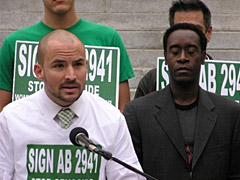
Adam Sterling ’06 founded the Sudan Divestment Task Force to help seek justice for the victims of the ongoing genocide in Darfur. Adam’s efforts are featured in the newly released Darfur Now, a film capturing the achievements and struggles of six individuals fighting to bring an end to the genocide.
1. Explain the current situation in Darfur.
Sudan has been in turmoil because of a two-decades-long civil war between the north and south. There was a peace agreement between the two sides from 2003 to 2005, during which representative power and wealth was shared. Darfur was left out of the agreement completely. As a result, a small rebel group attacked the government, and the government in turn, launched a counter-insurgency, carried out by local militias, known as Janjaweed. Instead of attacking the rebels, Janjaweed, with the support of the Sudanese government, are attacking Darfur civilians.
The Sudanese government denies that there is genocide. This is the first time in history that the U.S. government has labeled an occurring crisis “genocide” (since September 2004).
2. Why have no other countries made this declaration?
There is no precedence for this recognition. The United Nations has labeled this the world’s worst humanitarian crisis. Responsibilities come with this declaration. Countries would be compelled to take action they aren’t capable of or willing to do.
In our own government, both branches of Congress and the President have declared it “genocide,” and there are reasonable measures we can take to end this crisis that we just haven’t taken. The perception is we either do nothing or send in troops, but there is so much more we could be doing, such as enforcing a no-fly zone, making this crisis a greater foreign policy priority and engaging with neighboring countries.
3. How did you first become interested in the Darfur genocide?
I took a course during my undergrad that studied the Rwandan genocide in 2004. Prior to this class, my main understanding of genocide was the Holocaust in which over 6 million people were murdered. This class was the first time I purchased both the required and recommended reading. I was inspired by Speak Rwanda, written by Julian Pierce. The format of the book is so similar to Darfur Now. The book takes an in-depth look at the Rwandan genocide and follows 10 individuals involved before, during and after the genocide. It examines their personal stories instead of statistics, which helps to personalize the issue.
4. What is the main goal of Darfur Now?
There are two primary goals: to connect and personalize this issue, and to document and inspire an end to this crisis. I hope that our stories show people the difference they can make. The film shows a different side to the conflict. It isn’t just a sob story. It provides inspiration and shows an upside of the issue. You have to give people hope to be part of something successful.
5. How did you become featured in the film?
I had just finished my undergrad at UCLA. I was working five days a week in a restaurant and flying up to Sacramento for the remaining two days to lobby for a Sudan divestment bill that we had written for the California legislature. I met Ted Braun, the director of Darfur Now, and had no idea what he had in mind for the project. I just told him my story and he decided to feature my efforts in the movie.
It was weird to have the cameras follow me around 24/7. At first, I kept getting in trouble for talking to the cameras and it took me a while to get used to it.
6. What is divestment, and why did you see the need to create the Sudan Divestment Task Force?
Targeted divestment calls for the expedited engagement of companies that are directly or indirectly helping the Sudanese government perpetuate genocide. Only if a company refuses to change its behavior in response to shareholder engagement does the targeted divestment model call for divestment from that company. Since the ultimate intent of Sudan divestment is to protect the victims of genocide, it is important to tailor divestment to have maximal impact on the government of Sudan's behavior and minimal harm to innocent Sudanese (and to the financial health of institutional portfolios).
When an institution divests from these types of companies (so-called "worst offenders"), demand for offending companies' stocks falls and share prices decline. Share price is further reduced by the presence of additional Sudan divestment campaigns, many of which are already in progress. To protect the value of shareholder investments, offending company executives would convey to the Sudanese government that perpetuation of genocide in Darfur is making the country an undesirable place to do business. As a result, either government behavior would change (in order to keep businesses in Sudan) or offending companies would leave Sudan, thereby withdrawing money that had been used to purchase military equipment for the genocide. Withdrawal of business investments from Sudan would simultaneously create an economic penalty for genocide and reduce Khartoum's ability to fund the campaign.
We created the targeted Sudan divestment policy for the University of California and then were asked to turn it into legislation for the state of California and during this period we began receiving inquires from across the globe. This was the impetus to create the Sudan Divestment Task Force, which serves as the coordinating entity for the global Sudan divestment movement. The task force was incorporated into the Genocide Intervention Network, a nonprofit based in Washington, D.C., in October 2006.
7. What challenges did you face in getting the issue to be recognized by the state legislature?
We just assumed we would put public pressure on the government, then a government official would write the law, and it would be passed. But, we had to write the law ourselves, lobby for it and do our own publicity. I never knew we had the access to do that sort of thing. I was shocked at how involved in the process we really were.
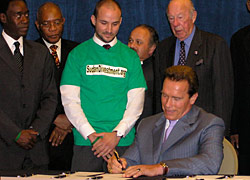
In my case, I think ignorance is bliss. I didn’t have much experience with advocacy. I didn’t stop to think about how big the bureaucracy really was. We moved so quickly with such a sense of urgency for the crisis. Folks are surprised that young people are so involved in policy development, but being young is not an excuse to not be involved. On a federal level, we’re mostly dealing with legislative staff, the majority of whom are around my age. There is a myth we’re dispelling. College students have been at the forefront of ending the genocide. We’re using nontraditional resources to get there, as visual protests are becoming less prevalent.
8. Who are the largest foreign investors in the Sudanese government?
The largest foreign investors are within the oil industry: China – Petro China, India – ONGC and Malaysia – Petronas. They are the primary targets of the divestment campaign.
9. What are the main efforts directed to pressuring China to withdraw its support of the Sudanese government?
There are two major tools of activism we’re currently focused on: divestment and the Dream for Darfur campaign, which is using the 2008 Summer Olympics to bring to light China’s support of Sudan’s economic activities and its role in the genocide.
10. What concrete steps can one take in efforts to end the genocide?
There are three active goals of the Genocide Intervention Network: educate, advocate and donate.
- Educate: General awareness of this issue is so important. This is the first genocide of the 21 st century. To be informed, you have to seek out the information.
- Advocate: Know that when there’s a will, there’s a way. Political opportunities open with willpower. People need a push to think creatively. The Genocide Intervention Network set up a hotline at (800)-GENOCIDE, which gets you in contact with elected officials.
- Donate: We are actively collecting funds to support civilian protection projects.
11. In your three years of advocacy, have you ever been discouraged?
While at UCLA, we first started the divestment campaign within the University of California system. We spent several months researching and putting together several reports for a divestment policy proposal. While we were gaining momentum and started communicating with other schools in the UC system, a professor who had been a strong supporter of our efforts pulled us aside and told us not to get our hopes up. He mentioned his experience with the Board of Regents and told us we would face resistance. Generally, we expected cynicism, but his reaction in particular really surprised and discouraged us because he was our supporter.
Oftentimes, you get involved and you look for instant gratification. We have been successful in our divestment efforts, but we haven’t achieved our ultimate goal, which is to end the genocide. There have been moments in time where I’ve made personal decisions to make this crisis a main priority. I was going to continue onto graduate school after UCLA. Instead, I came to Washington, D.C., to do this full-time for the past year. In hindsight, it wasn’t as big of a decision as I thought. It’s just something I’ve had to do. There’s nothing I would rather be doing. While we’ve faced challenges, I can’t imagine a greater group of people that I could be working with. We’ve passed legislation and worked with people from many states and countries. I’ve made a commitment to stay on this until the conflict is resolved or until someone is hired that can do a better job. For now, graduate school is on the back burner, but this whole experience, starting with my work at UCLA, has really helped me to fall in love with school academia.
12. Have you visited Darfur?
It would very difficult for me to attain a visa in order to visit Darfur because of my role with the Sudan Divestment Task Force. However, I feel my comparative advantage is here in the U.S. working our political system.
13. Where will the proceeds from Darfur Now go?
A portion of the proceeds will go to a Darfur victims fund associated with the International Criminal Court. Additionally, one of the film’s production companies, Participant Productions (they also did Inconvenient Truth), has launched a social action campaign in support of the cause, which can be found at this website.
Our Proud Partners


