Dean Poulakidas ’91
 UCLA has often been “on top of the world” – in academics, athletics, as the nation’s #1 public university for eight years in a row – but this spring, for the first time, the UCLA flag was literally at the top of the world — the summit of Mount Everest, 29,031 feet above sea level — carried there by Dean Poulakidas ’91, who has climbed many mountains in his life and career.
Poulakidas’ Bruin story started at about that same time that his sister Jennifer’s did: on a family visit to campus when Jennifer was applying to the University of California. At the time, students could only apply to one UC campus, and the family took a road trip to help determine which one that would be for Jennifer, two years older than Dean.
“My parents drove us to almost every UC campus, and they said to me, 'We're not doing this again in two years, so keep your eyes open,'” Dean Poulakidas said. “I have a very vivid memory of arriving at UCLA and walking onto the quad and saying, 'This is where I'm going. Wow, this is the UC I like the most.'”
“And that wound up being the UC that my sister applied to. We both wound up at UCLA.”
The family’s UCLA connection is still extremely strong; while Dean was waving the flag for UCLA at the top of the world, Jennifer was completing five years of advocating for UCLA as associate vice chancellor, UCLA Government and Community Relations (GCR), overseeing local, state and federal government affairs. In addition to a shared affinity for UCLA, the siblings shared a love of the outdoors and a thirst for adventure; Jennifer joined Dean on a hiking trip to Mount Everest base camp in 2011, one that, in some ways, paved the way for Dean’s assault on the summit.
Student Trek
Before scaling the heights of the business world and the climbing world, Dean Poulakidas was an accomplished undergraduate who had his own leadership role at UCLA: undergraduate student body president.
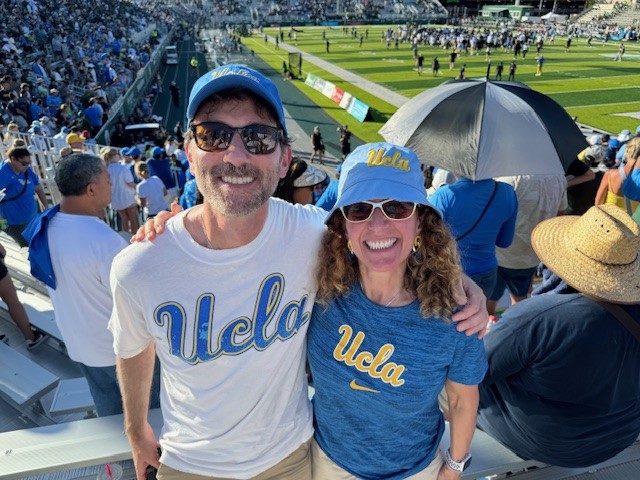 Dean and Jennifer Poulakidas, UCLA Football at Hawaii, 2024
He had entered as a political science major but switched to a double major in Spanish and linguistics.
“There's just a lot of students in political science,” Poulakidas said. “And I'd always loved languages, loved Spanish and I remember my counselor saying, ‘If that's what you like, why aren't you just majoring in it?’
“I loved the Spanish major at UCLA and linguistics was exceptional at UCLA, too. That made the academic part of my experience really, really great.”
After graduating, with California facing a critical shortage of teachers who spoke Spanish, Poulakidas was hired to teach first grade at Felton Elementary School in the Lenox School District, near LAX.
“It was fantastic experience,” Poulakidas said. “Also, very, very challenging. At any given time, I had somewhere between 30 and 35 students — students who kind of come in and out of the school system. They were great kids, but they were all living under kind of difficult circumstances. Either they were recent immigrants themselves or their whole family was, and it was a difficult time. It was also when the Rodney King riots happened, and there was just lots of violence, a lot of destruction in the neighborhood, in the area.
“But I enjoyed the kids and their families and teaching first grade was incredibly rewarding. None of the students knew how to read when they got to first grade, and some of them didn't even know the alphabet yet. None of them spoke English. And so just teaching things that were fundamental was incredibly rewarding. It was a really, really great experience. And I feel like I got there through experiences that I had at UCLA that encouraged me to do it and gave me insights into teaching. I had been student welfare commissioner and that that kind of gave me some insight that was quite helpful, and also the Community Service Commission at UCLA was just incredible — all the outreach they did and opportunities they gave students.”
Career Climb
Poulakidas had intended to teach for at least two years, but California budget constraints and bureaucratic issues meant he could not continue past that one year, so he decided to enter law school at UC Hastings (now UC Law San Francisco).
“I think about my year of teaching all the time,” he said. “Those are some of my most vivid memories. It gave me good perspective for going into law school; it was probably better than going straight from undergrad. I think if I had done that, I might not have that same perspective.”
Concurrently with law school, Poulakidas earned a master's degree at Columbia in international affairs.
“I always had this love for international affairs, whether it's private or public, international aspects always really interest me,” Poulakidas said. “So I went to Columbia and I finished the joint degree, came back to San Francisco and went to work at what then was the largest law firm in San Francisco, Pillsbury, Madison and Sutro. I joined their international law practice, which was what I really wanted to do.
“I was not just in the international law practice or international transactions practice, but I was in the practice that focused on cross-border transactions. And there was so much investment going on between the United States and Mexico in particular; NAFTA had just been signed a year before I got there. I spent lots of time in Mexico City on mergers and acquisitions and joint ventures. I did that for basically seven years, and then I went in-house, at a company in Los Angeles that was actually founded by a Bruin. At the time, it was the world’s largest commercial aircraft leasing company — a business I didn't know anything about. But I'd always obviously had a love for international law and international transactions and international aviation. And that's what this business was very much in the thick of — it bought and sold Boeing and Airbus aircraft and leased them to airlines all over the world.
“I was there for six years, and then I came back to the Bay area, back home, and I joined a company called Willis Lease Finance Corporation, which is the largest independent aircraft engine lessor. I've been in aviation now for 20 years. And I really love that side of aviation and that part of the aviation business. It's been very interesting. It's been very eye opening and good to me.”
Other Mountains to Scale
Poulakidas clearly likes the view from above — whether literally from a plane or figuratively in the business world. And he figured out another way to get it.
“I've been into mountaineering now for at least 15 years,” Poulakidas said. “I started off with mostly team climbs and have just kind of grown from there. And I had a couple good friends, old friends that were climbing Everest and encouraging me to join them.
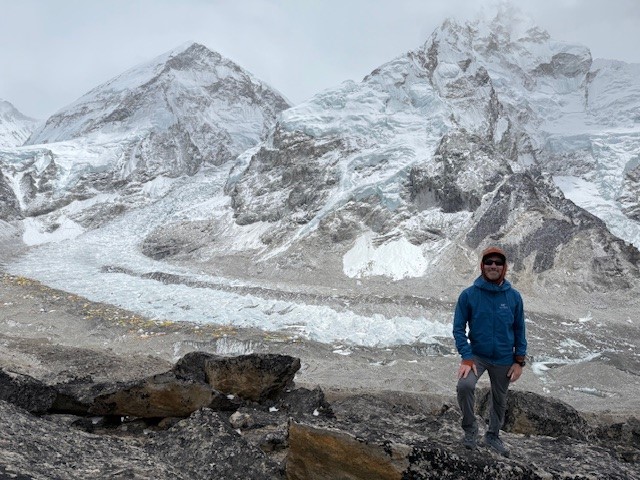 Acclimatization hike above basecamp
“I had been to Nepal one time before. That time, with my sister Jennifer, we had done the Everest base camp trek, which takes about two weeks, and I thought to myself, you know, maybe one day I'll come back.”
Getting to the summit was a completely different challenge.
“It was an incredible experience,” he said. “It was certainly the most challenging climb I've done. Just the amount of time it takes to acclimatize and to prepare and be ready to actually make a summit push. You can't start training for it a couple weeks in advance. It's something that you have to get ready for months and months in advance, climb other mountains and do other things to help acclimatize and get yourself ready.
“There were lots of challenging days out there, but I would say there wasn't a single day where you weren't surrounded by just otherworldly beauty and just awesome scenery. It felt like a different planet.”
Just getting to base camp, as the siblings had done 14 years earlier, takes significant time and effort, Poulakidas explained.
“You fly from Kathmandu to probably one of the more notorious airports in the world called Lukla. It has a very unique runway. You land going basically straight into the mountain. So you've got to stop or the mountain will stop you and you take off by going off a cliff, basically. When I went with my sister, we landed in a small plane. This time we went by helicopter, which they now say is probably safer. So you helicopter to Lukla and then from Lukla, you take about 10 days to trek to base camp.”
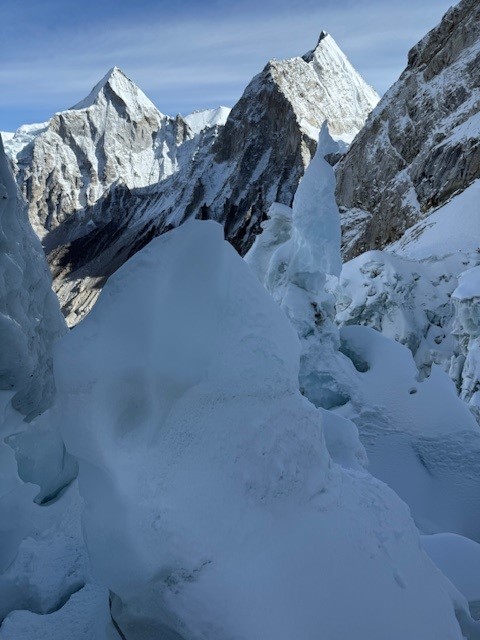 Khumbu icefall
Once there, at about 17,500 feet, those going on to the summit take about three weeks to acclimatize to the altitude by climbing nearby Lobuche and doing climbs to higher camps at over 20,000 feet, each time returning to base camp.
“We did our acclimatization rotations without oxygen and it was incredibly challenging,” Poulakidas said. “But once you do your summit push, you start on oxygen at Camp 3.
“The oxygen is necessary when you get to Camp 4 because you're just below what's called the death zone, where the body cannot survive without supplemental oxygen.”
Poulakidas quickly learned the importance of carrying a breathing apparatus when aiming for the summit.
“I knew that lots of people have died on Everest, but I didn’t realize that most of the bodies that you see are not people that have fallen,” he said. “People that fall off Everest, unfortunately, are often never seen again. Because they fall so far down or they fall into crevasse, someplace where no one can find them. Whereas the people that you see that have died and are still on the mountain, almost always it seemed like the story was that they either didn't have oxygen, ran out of oxygen or were trying to climb without oxygen.
“You're on oxygen for the second half of the climb and once you get above the high camp, you see a number of bodies across the mountain. The Nepali government is making an effort to bring bodies down. But some are in places where it's difficult. And then, unfortunately, some are from this year, so they just happened recently. Seeing that was a very emotional and psychologically challenging part of this.
“I didn't really want to look out of respect for the people that had died on the mountain. And then also because it was just one more thing that I think was going to be very difficult to overcome climbing up the mountain. It's not everywhere, but it's unavoidable.”
Climbers need five or six days of oxygen to get to the summit, but then they need it to get back down, meaning that they’re using oxygen for a total of eight to 10 days — and they’re using it even when sleeping.
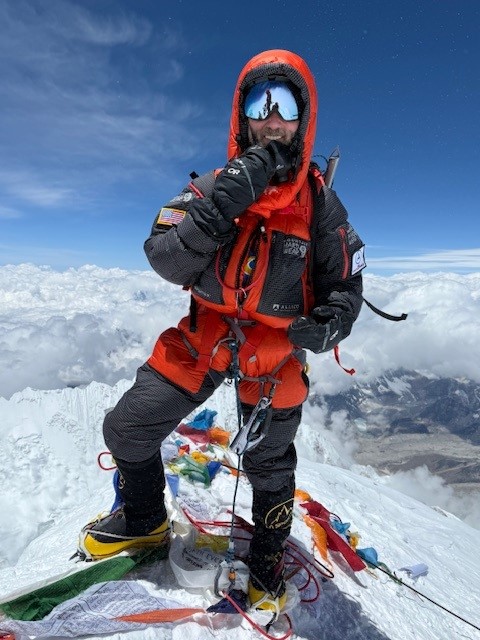 A smiling Poulakidas at summit of Mount Everest
“At Camp 3 or 4, I did wake up in the middle of the night once,” Poulakidas said. “My tent mate — my friend — and I were on a shared oxygen bottle, and we realized that our oxygen had run out and we needed it. We both were gasping a bit and realized we needed to replace our oxygen bottle. So we did that very quickly.”
It wasn’t just the altitude that presented a challenge.
“There are definitely parts where you think to yourself, this is some of the harder climbing I've done,” Poulakidas said. “The Hillary step and the Summit Ridge are kind of notorious. They've earned their reputation. You're probably at your most tired and it's quite narrow. You have to just try and maintain your focus and, fortunately, most people do maintain their focus as you're going to the summit, because you've got adrenaline pumping. The end goal, after six weeks, is in sight.
“Where people mostly die, falling off Everest, is descending, because they're trying to go fast. They're getting careless. They've reached their goal. You hear so many stories and there's a memorial much, much lower down the mountain to people that have died on Everest; always the story seems to be ‘died descending.’”
Why would Poulakidas put himself through such a dangerous, potentially fatal, ordeal? Was it simply, as George Mallory, who died climbing Everest, said, “Because it’s there”?
“I've loved the mountains for a long time,” said Poulakidas. “They’re so beautiful. And there's just something different about the view from the top of a mountain. It's something that can be so spectacular and rewarding if you get to the top; you're usually going to get a pretty great reward up there. It's usually some spectacular view that you just couldn't otherwise have.
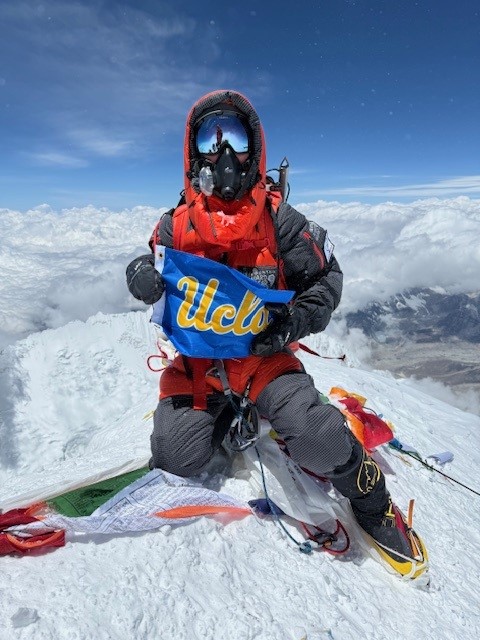 Poulakidas with UCLA banner at summit of Mount Everest
“I never set off climbing mountains thinking I would climb Everest, but the more you talk to people, the more you share experiences and the more books you read, it becomes, maybe subconsciously at first and then consciously, like a dream you want to come true.
“When I got to the summit, that's exactly what I said to the lead guide. I said, ‘This is a dream come true.’”
After seven weeks — including two nights in Katmandu coming and going — on the mountain a little over six weeks (coming down is much faster because you don’t have to do the intermediate trips), the group helicoptered back to the airport, having achieved something that many dream about, but few actually realize.
A total of around 7,200 people have made it to the summit, 29,031 feet in altitude, since Edmund Hillary and his sherpa guide, Tenzing Norgay, first achieved the feat in 1953. At least two other Bruins have done it – a student and a faculty member — but, as far as we know, this is the first time a Bruin banner has been unfurled at the top of the world. And it probably won’t be the last time it makes an appearance, grasped by Poulakidas, in exotic and hard-to-access locations.
“I don't intend to climb Everest again. In my mind, that was a great, once-in-a-lifetime experience. There are so many other mountains out there that would be wonderful to climb.”
Our Proud Partners


