Jason Chiu ’05
Airline Pilot
What skills do you need to be a pilot? Do you have to be an engineer?
Pilots come from a wide variety of backgrounds and skill sets. Analytical and problem-solving skills are necessary because they allow pilots to evaluate various situations and deal with them appropriately. You certainly don't need to be an engineer to be a pilot. In fact, most pilots have degrees in other disciplines besides engineering.
What kinds of career opportunities are available in the airline industry?
Each airline requires a broad spectrum of skills and occupations to ensure a well-run company and seamless operations. Besides flight operations, most airlines have departments similar to any other company including safety, security, operational planning, finance, corporate communications, customer service, marketing, human resources and legal. There are plenty of airline opportunities for people who are not interested in engineering or flight operations.
What does the general public take for granted about pilots? The airline industry?
Often times, the public assumes we know everything and have control over every situation - not always true! Any frequent flyer knows that delays are merely a part of airline travel. However, passengers may operate under the false assumption that the pilots know all the answers and have the ability to create miracles. Many times, we don't know more than the passengers, and I assure you that we immediately pass along any information. Pilots are working for the customers, to help them reach the destination safely and in a timely manner. But there is only so much we can do to affect changes in weather, air traffic and other matters. Coordinating thousands of flights, airplanes and crews on a daily basis is quite a feat. Passengers should be patient and understanding regarding delays, crew changes, equipment changes and other issues.
What excites you about being a pilot?
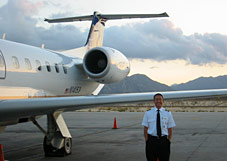
First and foremost, the act of flying. There is nothing more thrilling than descending through a cloud layer at 500 miles per hour or breaking out of the clouds just 200 feet above the ground to see the runway lights ahead. This job guarantees a sunny day, every day. Regardless of weather conditions on the ground, we always climb above the clouds and can work a tan at 35,000 feet. Beyond the flying, I really enjoy meeting people. Whether it's other pilots, flight attendants, gate agents, fuelers, baggage handlers or the 5-year-old who wants to see the cockpit, I have met more people in this job than I could ever imagine. It's the people that define the experience. Finally, the travel benefits are amazing. Not only do I travel for free with my airline, but as a U.S. airline pilot, we have a professional courtesy of extending that free travel to pilots of other airlines. I often can fly on other air carriers for free. I'm based in Houston but on several occasions, I'll fly home to the Bay Area for dinner and then return the next day. My parents, future spouse and children also receive similar benefits. I just treated my parents to a two-week vacation in Tokyo, and we enjoyed the pleasures of dirt-cheap business class fares! This job is so dynamic and the flying, people and travel opportunities keep me excited everyday.
What was it like on the first flight you piloted?
Scary! I was so nervous on my first revenue passenger flight. I still remember the day like it was yesterday. We had a fairly light load of passengers from Houston to Wichita. I was full of excitement, nervousness, anxiety and so many other emotions. The captain and I were preparing the aircraft for departure and then, the passengers started boarding. That's when it hit me: people are actually getting on this plane? Thankfully, they had absolutely no idea that it was my first passenger flight. The captain did most of the work, and I sat in the right seat like a fly on the wall. Everything was moving so quickly, and I was struggling to keep up with the captain's procedures and requests. By the end of that first day, I was starting to understand the daily operations and felt more comfortable with the airplane. My first few landings were anything but smooth but everyone survived. Overall, it was an amazing day and quite possibly, the most memorable day in my life.
How would you characterize the typical pilot? Do you think you fit that stereotype?
I've flown with many people and there isn't a typical pilot. Some pilots are friendly, outgoing and amiable while others are quiet and reserved. Some guys are young kids straight out of college while most of the captains I've met are middle-aged men with families. Many pilots enjoy traveling and sports. I think I fit comfortably somewhere within all of that.
What would you tell people with an intense fear of flying?
I've spoken with many people who fear flying. Often it's a fear of the unknown and not being in control. I try to keep the passengers well-informed and teach them as much as possible. From my experience, knowledge is power; the more they know about airplanes and flight operations, the easier their fears are to overcome. I once had a passenger mention the dangers of flying too closely to other aircrafts. I educated him about our aircraft's systems that are specifically designed to alert us to other aircraft in the area and also assured him that we watch for other planes. Hopefully, such conversations address passengers' concerns and empower them with the knowledge to understand that air travel is an extremely safe means of transportation.
How has being a pilot changed since Sept. 11, 2001?
Sept. 11 has permanently scarred the airline industry; security is always on our mind. From the moment I arrive at the airport, I am reminded of the new world we live in. Whether it's the security screening process or displaying my company ID at every critical point in the airport, the fear and anxiety will never leave this business completely. In the plane, I have to think twice before using the bathroom because that requires the opening of the cockpit door. Besides such operational challenges, 9/11 plunged the airline industry into deep financial problems. Since 2001, most of the major airlines have declared bankruptcy, reduced wages, furloughed (airline lingo for "laid off") countless employees, eliminated pension plans and reduced flights. The full effect is immeasurable. Conversely, 9/11 also strengthened the spirit of the airline industry. It has brought all airline pilots together in a brother/sisterhood that is stronger now. The next time you see a pilot walking through an airport terminal, look closely at the bags. Often, they are adorned with commemorative 9/11 stickers for the flight crews that lost their lives on that fateful day. It's just another reminder of how pilots have unified in the post-9/11 world.
Do you think planes will be flown by autopilot within the next 10 years?
Today, nearly all commercial airliners are flown with autopilot. The real issues concern the amount of autopilot authority and how frequently it's used. Automation has increased to where I can engage the autopilot 100 feet above the ground after takeoff and disconnect it just 50 feet above the ground before landing. Despite the seemingly complete authority of today's autopilot systems, nothing will ever replace the decision-making skills that pilots exercise each day. When thinking about the decisions I make during each flight, I realize that even computers have a limited ability. The autopilot is not capable of deciding how to deviate around a large thunderstorm or how to request a different altitude when encountering turbulence. Such decisions are in the hands of the pilots who exercise sound judgment and discretion on a daily basis. With that in mind, I cannot foresee a time when pilots are eliminated from the cockpits of commercial airliners.
What was the scariest thing that ever happened to you on a flight?
So far, I haven't experienced anything too alarming. We get the occasional caution message for minor system errors but nothing major. The scariest experience while flying occurred while I was flight instructing in Florida. I was in flight with a student when the aircraft's primary communications system failed. We lost contact with air traffic control for about 10 minutes and naturally, the student relied on me to take the appropriate action. I spotted a nearby airport and instructed my student to start circling the airfield while I tried to establish contact with air traffic control. Finally, I switched to the backup communications system and thankfully was able to contact the air traffic controller. Honestly, that was a nerve-wracking experience, especially with my student who was relying upon me to make the decisions. After speaking with air traffic control, we continued to our destination without incident but our nerves were shaken!
What would you do if you lost an engine during the middle of a flight?
Losing an engine is a serious problem but it is certainly a manageable situation, and all airliners are designed to fly with an inoperative engine. Pilots train long and hard for such situations. The overwhelming majority of my initial training centered upon single-engine operations (loss of one engine). Passengers should take comfort in knowing that we train for these situations and are often prepared for even more serious problems.
Our Proud Partners


