Jason Poulos, M.S. ’07, Ph.D. ’09
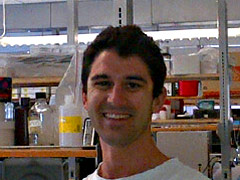
Bioengineer Jason Poulos M.S. ’07, Ph.D.’09 set out to create something different. Working in the UCLA California NanoSystems Institute entrepreneurial incubator program, he and his partners began creating mobile bio testing devices with the ideals of making healthcare accessible for everybody and not just a select few. They launched the business, Librede, and with the help of the Office of Intellectual Development, patented the new technology with relative ease. Here he describes his journey in turning ideas into life saving devices.
Q: Why did you decide to pursue your graduate studies at UCLA?
When I graduated college I was a mechanical engineer and I didn’t really want to build another plane. Right now, we’re sitting at the front of the bio-tech revolution. As a mechanical engineer, I wanted to build machines. Now, instead of building machines for planes, I build machines for biology. I started to get into the land of microfluidics and there were people at UCLA doing that work – people I wanted to work with. Being from Southern California – I kind of grew up here. I decided I was only going to go to UCLA if I could have Professor Jacob Schmidt as an advisor. He offered me a chance to “come on board,” and that’s how that kind of happened.
Q: Was there a unique research opportunity with Professor Schmidt?
Yeah, he was a physicist and he was coming at his projects with this mentality of physics, engineering and biology. I’m not a big fan of biology actually, that’s not really what I want to do. But this seemed like a good place to go and he was doing the stuff that I was interested in doing. He was open to doing new things. A lot of times professors will come at you saying, “You have to do Project A, Project B or Project C.” Whereas he was open to ideas.
Q: Your company, Librede, does “ion channel screening.” Can you explain that process?
Yes. So Librede has morphed all over the place, but we began with just a platform technology. Platform technologies, they don’t do anything on their own. For example, the iPhone is a platform technology. You talk on the phone, you write emails from it. You can have all these apps, but it’s just a bunch of circuitry inside of it. We had this idea to make a platform technology that was on artificial cell membranes. So we developed the ability to create artificial cell membranes in high throughput – that’s basically what my graduate study was all about. We developed a membrane formation technology and one of the things we were going to do with it was screen drugs.
Basically all drugs that are made by pharmaceutical companies have to go through a safety screening process. You don’t want to take Tylenol and find out that it shuts your brain down. We’re also getting into some sensor design now, too. With the platform technology, we’ve kind of branched into these two areas that are pretty hot areas right now. The membranes are the least sexiest part of the work but that’s the core of our technology. That’s how Librede kind of morphed into the ion channel screening and nanospore sensing.
Q: How does the entrepreneurial incubator work as the California NanoSystems Institute (CNSI)?
CNSI and the incubator program happened basically right when I started graduate school. I wanted to just do something that kind of no one else has done. I built something that was kind of an interesting technology, and asked what can we do with it? How far can we take this?
I would say, if CNSI wasn’t around it would have been a lot more difficult. There are barriers of entry when you’re starting a company. You have to find a place to work and all this equipment, especially when you’re doing biotech. CNSI and the incubator was right here, so we were going to license technology from UCLA to start the company. I didn’t even know if we were going to last longer than six months. We just dove right in.
Q: Who are your clients?
Who do we want our clients to be? [Laughs.] The target customer for the pharmaceutical screening stuff is pharmaceutical companies. The sensor design is a little more interesting. We’re looking to get into molecular diagnostics basically and so the customer there would the insurance, they would pay for the test. UCLA has a great medical center where you can do some of the most cutting edge research in the world, but what is there for people who don’t have access to UCLA. A lot of times you can get these machines that are only available at research centers, just because they cost a lot of money. One of the things we’re trying to do is increase accessibility. Accessibility can make healthcare better for everybody and not just a select few people. That’s the power of technology.
Q: I understand that you are interested in global healthcare. How did you develop that interest?
Both of my parents are professors so I’ve been around science a lot. You look at the world around you and if you want to create something you should have the mentality of making things better for people. I’ve been given a lot of opportunities, and recognize those opportunities, and I think it’s a responsibility – almost like a civic duty – to give back as best you can. If that ends up making some fundamentally drastic change in technology that saves tons of people, that’s great. Or if it means painting over graffiti someplace, that’s also great – just do something. It’s part of your social responsibility.
Q: Has UCLA helped you patent your technology?
When we invented the technology, it was me and there was another graduate student, Tae-Joon Jeon, and Professor Schmidt. We were all inventing this technology together and when we were doing that the UCLA Office of Intellectual Property (UCLA OIP) did the patenting. I still interact with them for licensing, because we’re a licensie. Other than that, we’re our own company and have to do our own thing. They have helped along the way and they are continuing to do stuff. They are really reasonable with all of the deals and it’s all relatively straightforward.
Q: How did UCLA prepare you to excel and succeed in the private sector?
I think that you need a community surrounding you that gives you opportunities to go do stuff. Having a support structure is important. The community exposed us to different things until we realized that starting a company really wasn’t such a big deal. Legal Zoom and a couple hundred bucks, boom, you’re in business. I think a lot of people get scared because they think of starting companies, or going out on their own as something that’s very difficult to do. I think everybody has done a lot harder things already. So give it a shot.
Q: How do you feel that UCLA supported you in pursing something that is meaningful to you?
UCLA has set up the systems to allow this to happen. Being hands-free is also an important thing. Letting people do what they want to do even if they mess things up is also OK. It’s important to allow the university to create situations, even if it can be wishy-washy about what students and researchers are going to do. A failed experiment is useful information. UCLA helps create this space opportunity - educational opportunities and letting people choose what they want to do with them. I have access to great doctors around, great engineers, great business people because they’re all in a centralized location.
Our Proud Partners


