John Cameron, M.S. ’65, Ph.D. ’67
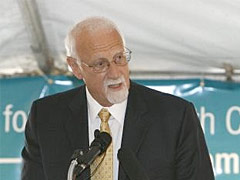
John Cameron M.S. ’65, Ph.D. ’67, and his company, ProCure Treatment Centers, Inc., are focused on advancing technology within the world of cancer treatment. After a distinguished career in academia, Cameron founded his company in 2005 with a mission of making proton therapy an affordable reality by building a number of proton therapy centers in the United States. ProCure’s most recent project is a $100 million facility in Oklahoma City.
Cameron, a native of Ireland, came to the U.S. after gaining acceptance to UCLA’s prestigious doctorate program in physics. He says the physics program and the beautiful California weather attracted him.
Initially a nuclear physicist, Cameron eventually developed his interests to medical physics. “I had no idea what I wanted to do. I was in my 20s. If you think you know what you want to be when you’re that age, the only thing I can tell you is, you’re wrong. I had no idea or dream that I would be doing what I’m doing now.”
Joining the faculty of Indiana University in 1987, Cameron says he received great support for his research. Cameron served as director of the Indiana University Cyclotron Facility, and is credited with helping conceive the Midwest Proton Radiotherapy Institute (MPRI). Cameron has spent some 20 years directing major multidisciplinary research and development institutes and has received more than $200 million in grants and contracts.
While at Indiana University, Cameron worked extensively with proton radiation therapy, and eventually, “It was time to move radiation therapy into the marketplace and make it available.”
Proton therapy, Cameron explains, targets cancer, which is well-delineated in a solid tumor. Using ionizing radiation, the procedure causes less damage to normal tissue than expected with other forms of external beam radiation. The ProCure Web site further explains, “Proton therapy offers the ability to deliver an increased dose of radiation to the tumor with reduced toxicity to normal tissue, resulting in better therapeutic outcomes.”
ProCure’s proton therapy facility in Oklahoma, a 55,000-square-foot facility slated to open in summer 2009 will be the seventh such facility in the United States. Currently, some 40,000 patients worldwide have received proton therapy; limited treatment slots remain an obstacle to making the procedure available to more people. Cameron’s company plans to combat this shortage of resources by offering FDA-cleared technology for use in private practice or hospital outpatient settings.
As Cameron continues his work to make proton therapy more available and affordable, he reflects on his own lifetime of lessons learned: “Follow where life takes you,” Cameron advises. “You never know… but whatever you do, it’ll probably be lots of fun.”
Our Proud Partners


