Julie Sina Reflects on a Career of Building Community
 As the passage goes, “Where your treasure is, there your heart will be also.” For Julie Sina, this treasure has been in building relationships in higher education for over 50 years. If you’ve attended an alumni event or read your UCLA emails in the last 12 years, chances are you’ve seen her face, read her name or heard her unmistakable laugh. She has been an ever-present force that has helped shape the Alumni Association today. Last month, it was announced that Julie, the associate vice chancellor for Alumni Affairs and Advancement Services and the COO and CFO for The UCLA Foundation and UCLA Investment Company, would transition to become the interim chief of staff for newly inaugurated Chancellor Julio Frenk.
This marks the end of an era for UCLA Alumni — one that’s taking place in the midst of a change in leadership, an organizational rebrand and year three of implementing its strategic plan. Ironically, the start of the “Julie era” in 2013 had a similar theme under different circumstances — a change in leadership, a directive to implement the recommendations of an outside consulting firm (the GG+A Report) and an organizational restructuring. Julie was asked to lead, transform and grow the Alumni Association just as UCLA was preparing to launch its $4.2 billion Centennial Campaign in 2014.
Back in 2013, the Alumni Association was near last in social media engagement among similar-sized universities. There was one dedicated staff member for all its alumni networks worldwide. Financially, it was operating in a multi-year deficit. Within a few months everything changed. Through Julie’s leadership, the Association adopted an engagement model which grew its social media following and the alumni networks branched out and increased staffing in four key areas: regional networks (now alumni communities), diversity networks, affinity networks and professional networks. Alumni volunteers grew by the hundreds, programs ballooned to over 1,300 per year and emails were regularly filling up inboxes with invitations to attend career events, social mixers and sports tailgates, along with other promotions and announcements. The Association’s staff size has increased by nearly 50% since 2013 and numerous programs and publications created or elevated during her tenure have been recognized with CASE Circle of Excellence awards.
A Burgeoning Career in Higher Ed
The skills Julie uses to navigate challenging situations and develop organizations were honed throughout her career in higher education. Beginning in her undergrad years as an intern for a radio station at the University of Wisconsin, she learned a life lesson she would never forget. A colleague had lied to her coworkers that Julie had quit her weekly show so she could take Julie’s spot. Julie spoke to her manager, who gave her the best advice. He said, “If you choose to go into this field, it's very cutthroat. The only way you're going to get ahead is if you're willing to step over other people to get a job.”
Disillusioned by this experience, she set her sights in another direction. As a resident advisor, who was also active in yearbook, orientation and student government, her hall director said to her, “You love being an R.A. You love doing all this stuff. Why don't you go into higher education? Go work in student affairs." And Julie responded, "Oh, you get paid for that?”
After graduating with a bachelor’s in communications and media studies, eventually she was hired to be the university spokesperson. She said, “I love doing that work. Even now, I love those opportunities to learn about people and help tell their stories.” This newfound passion led her to pursue her master’s in college student counseling and personnel services at Iowa State University and then her doctorate at Virginia Tech.
Julie embarked on a career in student affairs holding various positions at Virginia Tech, then serving as dean of students at the University of Florida and vice president for student affairs at the University of the Pacific. At UOP, her career took a slight pivot when she was asked to be the chief of staff for the president and board of regents. She said, “At a small school, you do everything, so I learned a lot. But I also quickly learned that I'm more of a large-school person. I really love the vibe of a large public school.”
Fast forward a few years to 2007 and there came an opportunity to come to UCLA and serve as the chief of staff for the College of Letters and Science. This entailed working with all the deans, the faculty and chairs, and managing the infrastructure for the College, which was the largest academic unit in the UC system. It was during this period that Julie learned how UCLA worked, its administrative and academic networks, and campus culture. She developed strong and lasting relationships, and built bridges among the people she worked with. She said, “One time I did a day-long retreat for all the infrastructure staff. I'll never forget one of the individuals, who had been there 30 years, said to me, ‘You know, Julie, I wish the deans knew our names.’ And I learned from them that the deans of the college didn't know the names of the people who supported them.”
Determined to change this, she put together a picture directory and told the deans, “I'm going to challenge us to get to know the people that work here. I've got this directory. The next meeting, we're going to start our meeting with each of you telling me at least one person you've talked to and what you've learned about them. They thought it was really funny until I kind of made them do it.”
Julie’s flare for having fun on the job didn’t end there. They would have themed holiday parties — one year crowning a prom king and queen who were paraded around on roller chairs; another year a "Love Boat" theme with pictures of the deans as portholes. Whether it was because of the monthly barbecue picnics on the front lawn of Murphy Hall or the Friday afternoon happy hours, she earned the nickname “Julie in the College” (a spin-off of “Jenny from the Block”).
The UCLA Alumni Experience
Eventually, Julie was recruited by Rhea Turteltaub, vice chancellor for UCLA External Affairs, to oversee Alumni Affairs, Advancement Services and The UCLA Foundation. At first it was just on a one-year interim basis to help implement the GG+A Report recommendations. But the search committee for the associate vice chancellor position determined she would be the best person for the job so it became official in December of 2013. She said, “I thought it would be a year. And then two things happened. One, I really fell in love with the work because it's so much like student affairs work in terms of the relationship building, but without the student discipline. Second, I loved working with the Foundation board; it’s so similar.”
Julie also attributes her success to being surrounded by really good people. In particular, she points to how Lea Rasmusson, CFO of Alumni Affairs and CAO for External Affairs, runs the show at Advancement Services, and how Christina Chase, J.D. ʼ18 (currently the CFO and COO for UC San Diego Foundation), helped build the infrastructure for the UCLA Foundation’s financial system.
Working with UCLA alumni had a special place in her heart. Julie showed up to work daily, including for night and weekend events that she said often didn’t feel like work. “A lot of stuff I would come to anyway, because I love going. It wasn’t because it was part of my job. I just think [UCLA] is such a fascinating place.”
She continued, “When you walk this campus, there are incredible things that are happening here. I find people here to be really accessible. I reach out to alumni and am rarely told no, because you get a lot of folks that say, ‘I've been waiting for somebody to ask.’ But I think there's a really deep love for this institution. Not that we don't have our problems, but I also think that in the fabric of this place, there's such a sense of community.”
However, when the community isn’t pleased with what’s happening at UCLA, they will often complain to its leadership. Julie understands the root of this anger, because no one loves UCLA as much as its alumni. She said, “Oftentimes when I pick up the phone and I call someone who's complaining, first they didn't expect me to call back so they’re already surprised. I tell them that I'm happy to listen to them and I say, ‘I'm going to assume, unless you correct me, that the anger that you express is out of love.’” She said this often changes the tone of the conversation.
One of the most challenging periods of doing alumni engagement work was during the pandemic. The staff had to learn how to build community in a virtual space using new technology. Beginning in March of 2020, the Association shifted into high gear, assembling experts and resources that were quickly disseminated to alumni who needed it. Whether it was webinars on how to acquire a PPP Small Business loan or sharing scientifically backed health and safety information, keeping the alumni community engaged with relevant opportunities was the priority.
While her staff conducted their work remotely, Julie continued to come in to the office daily. She would water the plants, open the mail, and as she tells it, “Talked the ears off of the mailmen. Finally, human beings!” Being a people-centered person, Julie found ways to build community among the staff, whether it was through daily check-ins, Coffee Chats on Zoom or inspiring email messages before signing off for the weekend. She started a series of virtual staff experience sharing sessions, where one volunteer would share about their passion project or hobby. All this had little to do with work, but everything to do with connecting on a human level.
The pandemic changed alumni work in many ways. She explained, “I think we created ways and identified alumni who really stepped up for each other. It also transformed how we do our work because we didn't rely on people showing up and being in the same room together, even though people still liked that. It gave us a chance to broaden our reach and what we have as a global community. I think it took us a little while to find our way. But we were intentional about letting both staff and alumni know that, hey, we still see you.”
Julie was most appreciative of how the staff continued to be nimble and open. She said, “When you're talking about a community of 670,000 people around the world, I think the challenge is the connection and that has really evolved. I know it's not easy, constantly asking, ‘Are we relevant? Are we nimble enough to do that?’ One of the big challenges is if you have a great new idea, how do you create the space to do it?”
She acknowledged that it’s not possible to reach everybody. But she said some of those who choose not to participate may still like knowing what’s going on. It’s a passive participation that makes storytelling even more important. She said, “It makes people feel like they’re still part of the community.”
At the end of the day, she said she feels extremely proud of the work and the team, whether it’s the staff embracing bold ideas or their fearlessness in tackling new challenges. She looks forward to seeing it continue to evolve under her successor, to whom she offered this bit of advice: “Make it your own. Build relationships in your own way.”
Career Reflections
If Julie could speak to her younger self, she would advise, “Don’t take it personally.” She understands the difficulty in those words, because in challenging times, she says, “We do take our work personally because we devote so much of our personal time and passion into it. It's hard not to because, in a way, that's what makes you beloved in a workplace; when they know you're not just a cold business; that you actually are human.”
In her new interim role as the Chancellor’s chief of staff there will be no shortage of challenges. As a new leader coming on board during a time of immense internal and external pressure for UCLA and higher education, it will put all of Julie’s organizational acumen and relationship-building skills to the test. She noted, “I love a challenge. When my boss asks me to take something on, I accept it because I’m old school. But it’s also a wonderful opportunity for me. UCLA really did save my heart and soul so it’s a little payback.”
Despite her best attempts to not take it personally, there is an emotional toll in taking a step away from a community you love. She said, “I will miss the people the most. The community. The amazing alumni I’ve been able to meet. I’m going to miss their stories.”
But as she reflected back to what brought her to this work in higher ed in the first place, she recalled, “When I was in the College, anytime a student came into the dean's office who was upset or in crisis, they found me. I know I'll continue to find ways to do that work that I love.”
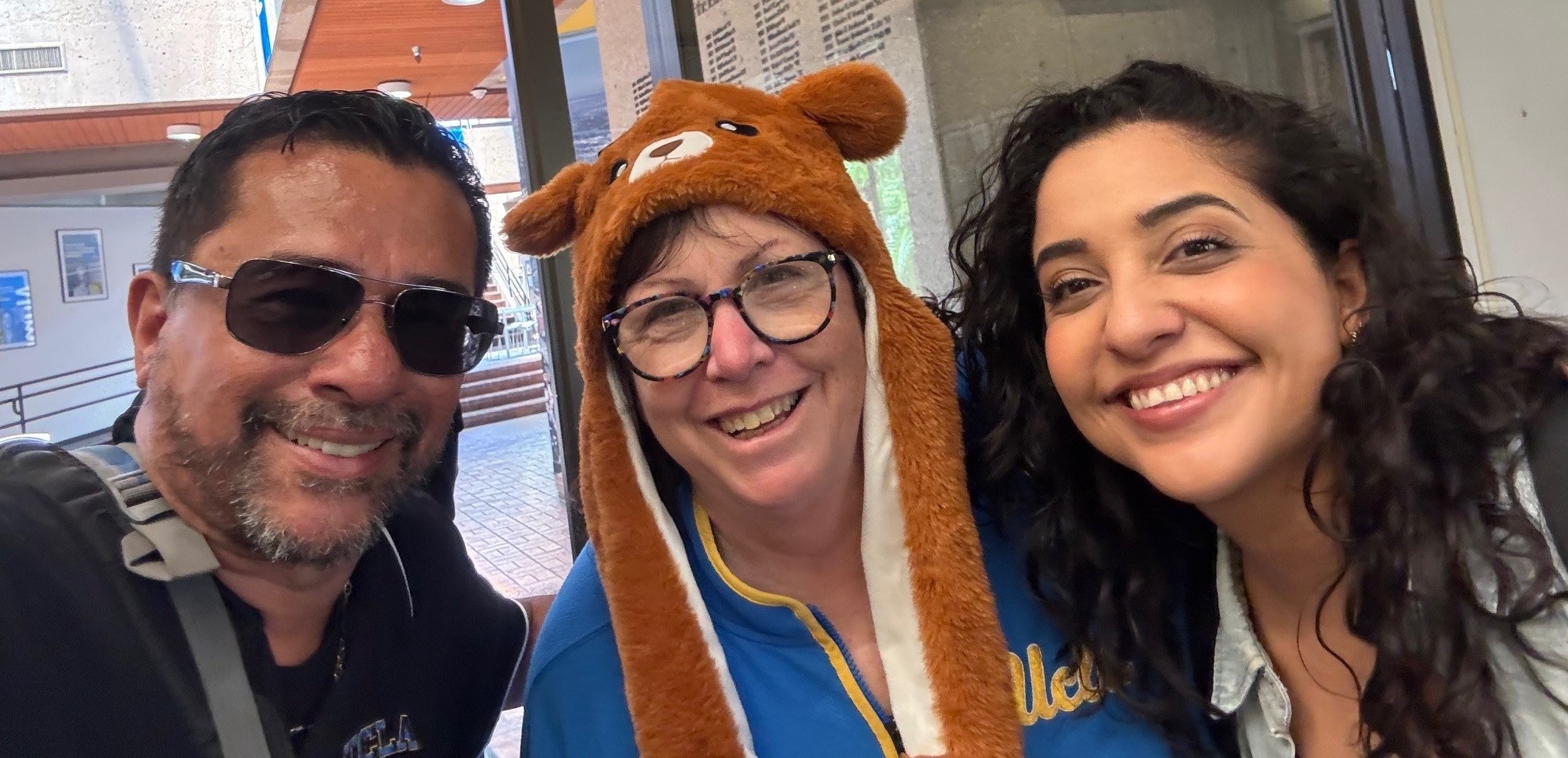 From left: Alumni President Paco Retana ʼ87, M.S.W. ʼ90, Julie Sina, Alumni President-Elect Cinthia Flores ʼ10
Our Proud Partners


