Ken Mukai ’92
The basketball tradition at UCLA is defined by Wooden’s greatness as a coach. But when he put his system down on paper and called it the “Pyramid of Success,” he thought of it as a model people could apply to their own lives.
Meet Ken Mukai ’92, a high school science teacher at the Sherman Oaks Center for Enriched Studies in Los Angeles. Mukai has basketball in his blood and grew up dreaming of someday playing in Pauley Pavilion, although the closest he got was cheering from the student section. After graduation, Mukai followed in Wooden’s footsteps as a basketball coach, but he also took to heart the Wizard’s famous pyramid and felt he could make a difference in the lives of others. With this inspiration, Mukai built his own basketball court in a project to bring the sport to a rural region of the province of KwaZulu-Natal, South Africa.
The Los Angeles native went to South Africa in January 2004 to teach science at Nsalamanga High School on the Fulbright Teacher Exchange program. The challenges were great as the region is very poor and lacks services Americans take for granted, such as ambulances and indoor plumbing. In an age of computers, a major challenge to teaching there is that the school does not even have electricity. In addition, the AIDS pandemic is a part of everyday life where Mukai spent most of the year 2004.
Wherever Mukai goes, basketball goes with him. Since college, he has built up 15 years of experience coaching in youth recreation leagues in Los Angeles. As a participant on the Japan Exchange and Teaching Program, Mukai coached kids after giving them English lessons on Oki, a tiny island off the coast of Japan. After returning home, he helped to set up Yonsei Basketball, a cultural exchange program that allows fourth-generation Japanese-American junior high school students and their families to visit Japan on a goodwill basketball tour every summer. So it was only natural that when Mukai arrived at KwaZulu-Natal, basketball was in his thoughts.
Students at Nsalamanga High are offered limited after-school options. School is always open, and students without desks at home come back at night with candles to study. The Student Christian Organization offered some extracurricular activities, Mukai says, but the response was poor. “Hardly anyone participated in any after school activities,” he says. “The soccer and karate only occurred on a few occasions.” In basketball, Mukai saw an opportunity to attract more students and contribute something to the community.
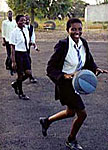 “Basketball is the game I grew up playing and enjoying,” Mukai wrote in an e-mail to friends while he was in Africa. “I’ve also coached it for many years. There was definitely a need for resources here, but with basketball I figured I could also get support from my friends in the U.S. and Japan to contribute to the community.”
Mukai had a vision for giving the community basketball, but he had no place to play. He enlisted the aid of friends to raise money to build a court. They responded warmly, doing everything from copying and mailing out fundraising letters to building a Web site with pictures and stories from South Africa. Others collected shoes and athletic wear to ship to the impoverished region. He even got support from Oki Island, where former students contributed much-needed funds. In a fortuitous donation, the National Basketball Association sent over basketballs and hoops for the future Nsalamanga court. Help arrived from other, unexpected sources, too.
Explains Mukai, now back in the U.S., ”The State Department gave me all sorts of support, including contacts for buying materials like hoops and poles, hiring contractors and $2,000!”
With the help of his friends, both old and new, the court was completed in June 2004. Mukai and some student volunteers finished the job by painting the lines together. The paint was barely dry before he started the first drill. After all Mukai knew he would only be in South Africa another six months, so he wanted to start coaching right away. From the start, response from the new players was tremendous, he says. “More than 100 students signed up to be part of this program.”
“We built the first and only basketball court within hundreds of miles in the region,” Mukai explains. “The area was very neglected during the apartheid years. My hope is basketball will grow to neighboring areas. Funds will be used to build more basketball courts, and assist with collection and shipment of shoes, shirts and shorts.”
Mukai points out that the spirit is certainly there among the new players. Not even Mother Nature could stop the program. “After a tornado hit on Nov. 21,” he says, describing his final few weeks in Africa, “the school buildings were torn down and are now being rebuilt. A second basketball court is being built with lowered rims next to the primary school across from Nsalamanga High with some funds I left.”
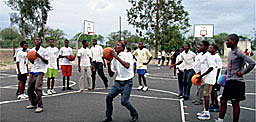 Despite arduous work and technical challenges, the students again pitched in to rebuild the main court. “For several days Zuluhoops leaders removed the poles and replanted them.
With no sophisticated tools like jackhammers, each pole required between an hour and two hours to remove. Replanting each pole also took about the same amount of time. The court was finally pieced together back to its fully functional form – with six baskets – on Dec. 9, four days after I left Nsalamanga.
“Zuluhoops leadership students are active and continue to play basketball and teach newcomers to the sport. The school continues to run with classes held in the open and under trees.”
Though Mukai left in December and now is teaching in Los Angeles, the students and the community in South Africa continue to benefit from the spark of his imagination. On occasion coaches from Playing for Peace, a basketball project based in the city of Durban four and a half hours away, will provide instruction.
When asked about what’s common among the kids who play basketball, Mukai says, “I’ve found a genuine love for the game with kids in Japan and California. I am anticipating the response will continue on in these kids in South Africa.”
The great UCLA basketball tradition continues, even half-a-world away from Pauley.
Our Proud Partners


