Marco Firebaugh J.D. ’97
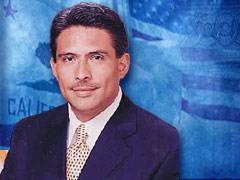
Born into a single-parent home in Tijuana, Mexico, Marco Firebaugh J.D. ’97 quickly learned the value of hard work and determination. Firebaugh’s family immigrated to Southern California when he was still an infant.
Marco struggled through middle and high school and nearly dropped out. After high school, he attended Citrus Community College, where his journalism professor inspired him to keep working. Firebaugh’s determination paid off in 1987 when he entered the UC Berkeley. His social consciousness and passion for justice led him to the Movimiento Estudiantil Chicano de Aztlan (MEChA) and future role in California politics.
With a political science degree in hand and a renewed desire to change the world, Firebaugh moved his sights to Sacramento. He was selected as a fellow by the California Latino Legislative Caucus and interned with state senator Richard Polanco. Polanco became a mentor, inspiration, role model and surrogate father.
After graduating from UCLA School of Law, Firebaugh was elected to the California State Assembly. Representing the 50 th Assembly District in southeast Los Angeles County from 1998 to 2004, Firebaugh was recognized for an impressive legislative record and advocacy on behalf of California’s working families and immigrants.
From 2002 to 2004, Firebaugh served as chair of the California Latino Legislative Caucus. Under his stewardship the Latino Caucus grew from 22 to 27 members, becoming the largest and most influential caucus in the legislature. He also led the effort to appoint more qualified Latinos and Latinas to high-level positions in state government, including the appointment of the second Latino to serve on the California Supreme Court.
Because of his effectiveness both as a policy maker and a political leader, Firebaugh was appointed majority floor leader in 2002 – making him the highest-ranking Latino in the California State Assembly.
Firebaugh authored landmark legislation to permit California high school students to pursue a college education regardless of their immigration status. Additionally, he authored air-quality legislation that provides funding for the state’s most important air emissions reductions programs and ensures that state funding be targeted to low-income communities that are most severely impacted by air pollution.
Although Firebaugh’s professional life revolved around the political arena, he remained a devoted supporter of UCLA as visiting professor and policy fellow at the UCLA School of Medicine, Center for the Study of Latino Health and Culture.
Firebaugh’s life of public service was cut short on March 21, 2006, when he died from influenza and liver failure.
Our Proud Partners


