Natalie Bonjoc ’02
Natalie Bonjoc ’02 knows how to mix business with pleasure. Her love for travel and interest in international civic education has brought her all around the world to partner with dignitaries in the promotion of democracy. As a program manager for the Center for Civic Education, Natalie currently is heading off to Pakistan for her latest assignment.
1. Who is waiting for you in Pakistan?
I’m meeting with a Pakistani colleague who heads a local NGO (non-governmental organization) on civic education development in Pakistan. I will also attend an event that he is organizing, which will showcase the work of students who have been involved in citizenship programs. He is very involved in education reform in Pakistan, and I will be joining him and other local NGO representatives in a working meeting on this topic.

2. What is civic education and how is your organization involved in promoting it?
The Center for Civic Education specializes in civic/citizenship education, law-related education and international educational exchange programs for developing democracies.
The principal goals of the center's programs are to help students develop an increased understanding of constitutional democracy and to provide them with the skills necessary to participate as effective and responsible citizens.
3. Describe your international working partners.
My international colleagues come from diverse backgrounds, such as the media, academia, government and private sectors. But they share a desire to strengthen education for democracy in their countries. Many of them have to work against adverse conditions (both politically and otherwise), and I admire their courage and commitment to the advancement of their causes. Some of them literally risk their personal safety when they involve themselves in activities that do not follow the status quo. Democracy is a controversial idea in certain parts of the world.
4. How do international dignitaries react when they meet you?
Many dignitaries are surprised because of my age and gender, but most of them are open-minded. Some of them are reluctant to speak with me as an equal. When they realize that I am there as a representative of my organization and mean business, then it's usually fine. Though, it does get intimidating at times, especially when all eyes are on you, like during a live television interview. But it's all about taking the right approach. With each interaction that I have, I learn how to deal with peoples’ reactions more effectively and take it all in stride. Confidence, the right attitude and cultural sensitivity go a long way in these interactions.
5. What does your typical day look like?
I don’t really have a typical day. My colleagues and I juggle many responsibilities, and our days revolve around whatever events, trips, meetings and administrative issues are currently on the table or are coming up on our calendars. We are constantly writing, whether it’s e-mails, memos or grant proposals. Communicating with our international and American colleagues to touch base with them on programming and budgetary issues also takes up a large portion of our time.
6. As program manager for Asia, you’re constantly traveling. Can you discuss the realities of a traveling lifestyle?
When I travel for work, I am on 24/7. There are no off-hours when I’m on a business trip. The travel can be demanding, physically and mentally. During this recent trip to Pakistan, the hotel where I was staying was bombed. Fortunately, no one I know was hurt, and I was not at the scene when it happened.
But even when events like this do not occur, I still come home utterly exhausted. Although I still love to travel, there is definitely an unglamorous side to traveling far and often. Jet lag, for example, is not pleasant. Airports are always a pain to deal with – long lines, irate people, red tape, bureaucracy. A plus side is that I’ve turned packing into an art form.
7. What is the biggest similarity between the countries you visit and the United States?
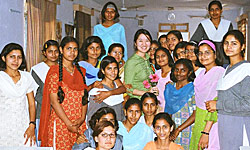
Each country I visit is unique, but I work a lot with kids, and they are the same everywhere. Kids in all places are interested in similar things – having fun, resisting homework, getting the most out of their free time and finding out what kids in other places are doing, wearing, watching or listening to.
8. Of the many countries you've visited, which one has the best food? Describe a dish that took you by surprise.
I don't have one favorite, but I would say my top three food places are Japan, Argentina and Vietnam. In Cambodia, deep-fried spiders are a common snack sold by street vendors – big, black spiders with shiny bodies and thick legs. I will try anything once, but I do put my foot down when it comes to insects.
I love going to food markets in each of the places I visit. It is sensory overload, but most of the time, in a good way. You can learn a lot about a region’s culture by experiencing the food markets and observing the interactions between the people and the vendors.
9. Tell us a memorable story about working with other organizations or directly with international citizens.
When I was working for Youth for Understanding in Norway, my office mates pulled a prank on me and called the Norwegian Candid Camera to record the whole thing. A man with his 3-year-old daughter came to our office to discuss the possibility of sending his daughter on an exchange. I assumed that he was referring to another daughter who was high school-aged and was interested in doing the program, but couldn't be at the meeting. He talked about how his daughter was mature for her age and was interested in international relations and foreign affairs. He said he was grooming her to be an ambassador for Norway and that he wanted her to be fluent in five languages by the time she started school. I asked him if he meant college, and he said, “No, school as in kindergarten.”
It was then that I realized that he wanted to send his 3-year-old, who, at that moment, was running around the office in circles with her pigtail in her mouth, singing to herself. I kind of freaked out. I excused myself and left the room to pull myself together and figure out what to do. I went back into the room and explained that it was against our policy to allow anyone under the age of 15 to participate in our international exchange program. The discussion escalated into an argument as he insisted that an exception be made for his little daughter because she was so advanced and mature for her age. Finally, I was ready to call the police to get this crazy man out of the office. That's when they uncovered the hidden camera and told me that I had been set up.
Our Proud Partners


