Rowena Ocampo '02
Gamble on Yourself
What attracted you about running your own business?
Running my own business allows me to have a direct impact on my success and failure, owning my potential but also accepting things if I fall short. I don't depend on decisions made without my input, decisions that consequently affect my work and my life. I also value my place in this business as both a woman and a minority. I am able to run a business the way I think a business should be run, based on my life experiences.
What is your business?
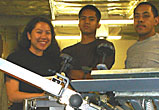 Nextdoor Neighbor is a screen-printing, heat transfer and embroidery company. We recently picked up business in offset printing, producing fliers and business cards in addition to our normal T-shirts, sweatshirts, athletic uniforms and so on. We are fully owned and operated by three people, all younger than 25 and all of whom graduated from college with a business-related degree.
How did you develop your idea into a business?
Research! Whether it was reading books, talking with people already in the industry or searching on the Internet, gathering information was really important to understanding how to start our business. Funding came next – saving money and learning about our options is how we were able to execute the plan based on our research. After buying equipment, materials and space, it was all planning – we refined our business plan, figured out daily operations, focused on sales and so on. When I think about it, we are still doing these same three things everyday.
Describe how your business plan works in your daily business?
We concentrate lots of our energy on building relationships with our clients. It is through these relationships that our business has grown – 95% of our clients since day one return for repeat business with us, and nine times out of 10, a new client is referred to us by an existing one.
We also value an alternate perspective within our industry. We are all Pilipino-American college graduates, children of immigrant professionals, who grew up with a variety of social, financial and environmental influences. Because of this, I feel we bring a fresh outlook to business practices and market styles in our industry. Our interests in music and sports, our connection with college students, our business degrees, our Pilipino-American backgrounds, even our ages have linked us with many different clients and given us an advantage over competing companies.
 How did you identify your unique market?
We didn't sit down one day and figure, “There is this market out there that we can all get rich off of – let's go out and make some money!” Instead, there was something we had an interest in and resources around us that would enable us to pursue that interest.
We did have to figure out how to excel within an already established market. By using our alternate perspectives, our personal interests and our associations with clients, we are able to distinguish ourselves from the hundreds of other companies in our industry.
How did you develop start-up funds? What did you learn from that process?
First and foremost, saving money. All of us had to buy our way into Nextdoor Neighbor, so the company is truly built on the money, time and hard work of its owners. We also used our connections to friends who work for financial institutions. They shared their knowledge and experience, and led us to various funding options.
I learned two very important things from funding this company. First, your credit is key! That credit score is like your SAT or GMAT score – it paves the way for opportunities and can hold you back from just as many.
The second thing I learned is that it is truly worth it to invest your money rather than spend it. Instead of saving for a big trip or fancy car, which I know in the end will have required more money out of me, I'm glad I put my savings into something that has given me a return on my investment. You hear people talk about credit scores and investing all the time, but you don't really understand until your own money is involved.
Have you had any difficulties? What kept you going?
I try to remember that the first few years of running a business are inherently difficult – if they were easy, we would all be CEOs of our own companies. Once I accept that there are going to be drawbacks, it is much easier to attack them and get over them.
One of my partners always says, “If you're going to gamble on something, it might as well be yourself.” By taking the risk, I know I am in control of my own success and not at the whim of some executive who has no idea of my daily successes and failures. Understanding that helps me realize that there is no one else to depend on; if I don't do it, then it will not get done, and there will be no client, no income, no rent, no food and so on. Consequences always are a big motivating factor, but in this case, no money to pay bills is a lot more real than an F on an assignment.
 What were your primary risks and how did you manage them?
The financial risk is the most obvious. In addition to our own money, we also took out a line of credit to cover bigger expenses.
Another big risk is choosing whom to work and do business with. You are depending on others – whether they are your partners, your vendors or your clients – for your personal well-being. If you don't have a solid basis of trust and confidence in their abilities, you are putting yourself in danger. Therefore, understanding your industry, being upfront and communicating clearly, and valuing the balance between business and personal relationships is crucial.
How did your background prepare you for your career path?
I graduated from UCLA with a major in mass communications and a specialization in business administration. Many of my classes were directly applicable to what I do every day – econ classes help me keep our books and prepare tax returns – I still refer to my heavy accounting books when I have questions. The critical thinking I practiced in communication studies classes, especially those relating to marketing and advertising, large institutions and interpersonal skills, assist me when planning our sales and marketing strategies and communicating with clients.
 Additionally, my involvement with organizations such as the Student Alumni Association and Samahang Pilipinio taught me a lot about event planning and perspective. Multitasking, planning ahead, budgeting, working with a variety of personalities, getting things done no matter how little time or energy you have are challenges I face every day.
Being a minority woman influences my understanding of the businessworld. My partners and I recognize the differences and similarities of our history and potential and work within our industry accordingly.
UCLA offers a tremendous learning environment, and afforded me opportunities to interact with a wide range of students, teachers and professionals.
Do you have any advice for aspiring entrepreneurs who are looking to create a business plan?
I'm still learning myself but it is important to remember that the business plan is never final. Don't expect to finish one completely before starting your business; understand that you don't need to have every single detail figured out before starting operations.
Where do you expect your business will be in 10 years?
In 10 years, we expect to be doing business with the same customers we are currently serving, with stronger relationships and a more meaningful understanding of their preferences.
We also hope we know 10 times more about our services and products, and have expanded the range of services as well. A clothing line with retail sales is a goal for us. In 10 years, we hope that we will have a line branded, marketed and selling like hot cakes! At that point, we would like to focus more of our energy on sales, marketing and development.
Our Proud Partners


