

Earliest Known Pilipino Bruins at UCLA
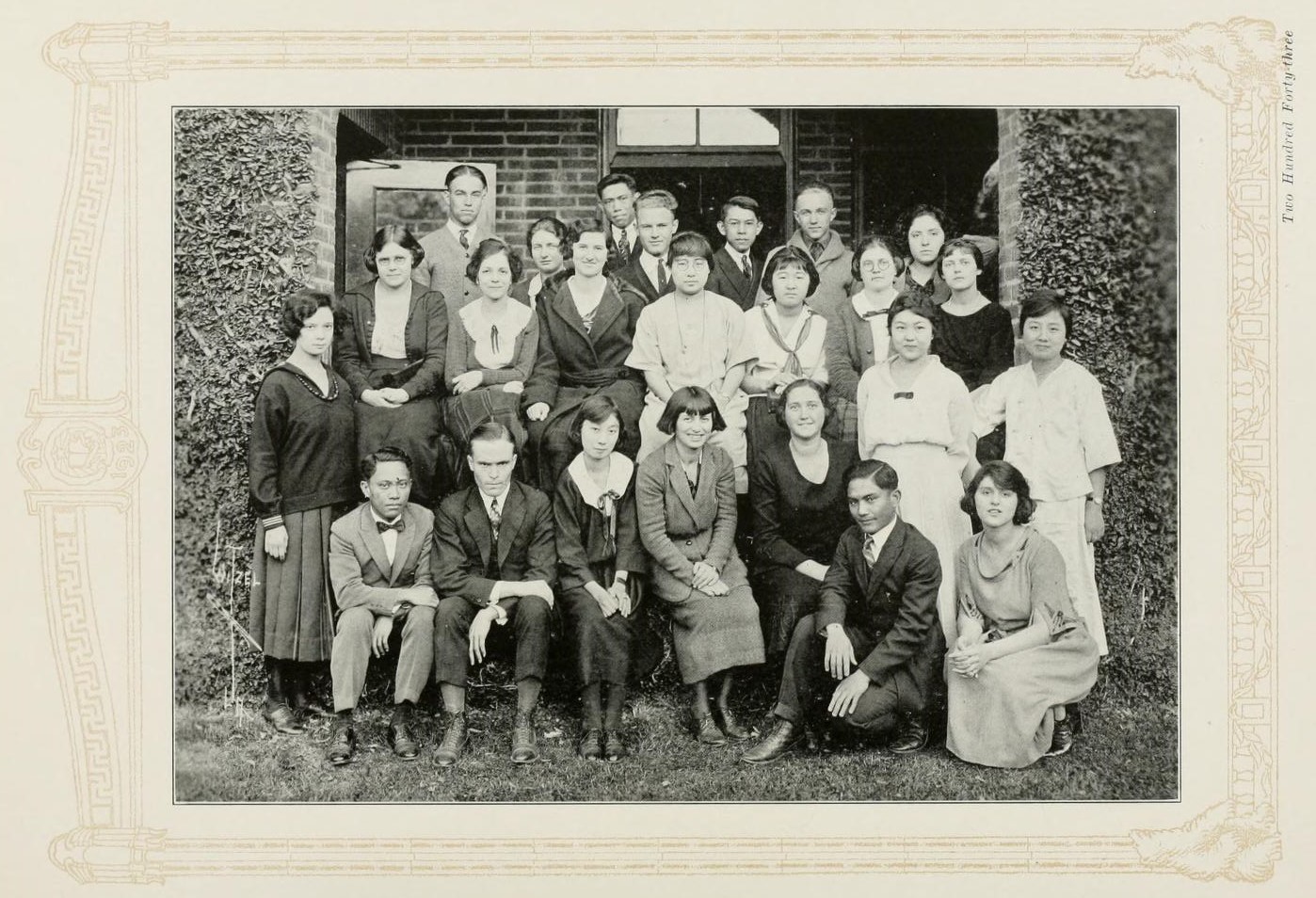
Cosmopolitan Club 1922-23
(Note: Pilipino and Filipino are used interchangeably in this article and mean the same thing. Philippine locals use Pilipino because there is no phonetic equivalent to the letter “F” in the Philippine Islands’ indigenous languages.)
In honor of Filipino American History Month, we’re following up on an article published in the October 2023 issue of UCLA Alumni Connect documenting the history and impact of UCLA’s Pilipino community. Our story began with the “Filipino Students Association” in the 1927 UCLA yearbook (then called the University of California, Southern Branch). At that time, the Philippines were an American colony and many of these students were part of the pensionado program, a scholarship program for Pilipinos to attend college in the United States.
After our story was published, we heard from Joshua Dean Abad Valerio, MBA candidate at UCLA Anderson and marketing committee chair for the UCLA Pilipino Alumni Association Board of Directors. He had discovered proof of Pilipino students at UCLA as early as 1921.
As part of the pensionado program, the Bureau of Insular Affairs War Department published a “Directory of Filipino Students in the United States.” The 1922 edition lists three students at the University of California, Southern Branch: Eugene C. Alonzo, Emil (Emilian) D. Menzen and Cesario Cabatingan. Because not all records of the school’s graduates have survived, this list may be incomplete.
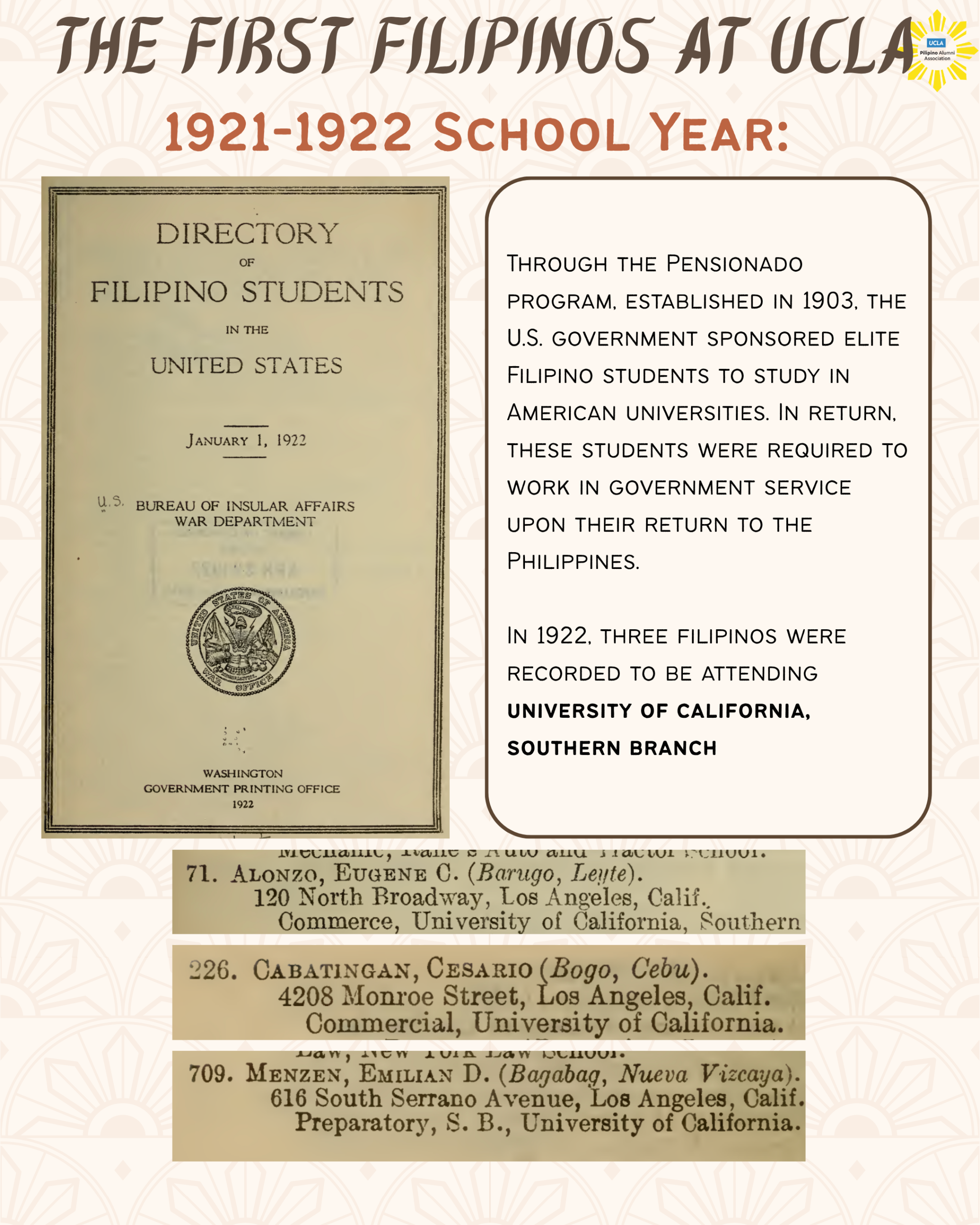
Their stories encapsulate the experience of many young men and women who left their homeland and traveled on a nearly month-long journey by ship across the ocean to attend college in America.
Eugene C. Alonzo is listed as part of the Federal Class, a program that provided vocational training and education for injured WWI veterans. According to military records, Alonzo received the Distinguished Service Cross for extraordinary heroism in action while serving with Machine-Gun Company, 364th Infantry Regiment, 91st Division, A.E.F., near Eclisfontaine, France, Sept. 27 – Oct. 4, 1918. The 91st was known as the “Wild West” division, since most of the young men came from the western United States.
While attending the Southern Branch, Alonzo lived at 120 North Broadway in downtown L.A. The area was known as “Little Manila,” a precursor to today’s Historic Filipinotown, and home to Pilipino-run barber shops, pool halls and restaurants.
Emil (Emilian) D. Menzen is listed in the 1922, 1923, 1924 and 1925 yearbooks as the Sergeant-at-arms for the Agora Club, a political society club dedicated to service and siblinghood; a member of Club Espanol; and, in his senior year, the Pre-Legal Association. He was also a member of the Cosmopolitan Club, founded at the Southern Branch in 1922.
Justo Leano is mentioned in the 1923, ’24, ’25 and ’26 yearbooks as a member of the Cosmopolitan Club as well as the Filipino Club. He can also be found in the San Pedro News Pilot as a graduate of the San Pedro High School class of 1920. During the 1920s, the Los Angeles Harbor area had a large Pilipino community. Many Pilipinos who had served in WWI settled near Navy ports and worked in the shipyards. It appears that after leaving UCLA, Leano may have returned to the Philippines where he was killed during the Japanese occupation of WWII.
The Cosmopolitan Club at the time had a number of Pilipino members and other foreign students. The UCLA chapter of the club hosted social events and was part of a larger international movement known as Cosmopolitan International. Its president at the time, Chinese American Daisy L. Law, invited students to join in the Daily Bruin, “Loyal Californians, come and show your American spirit by supporting the Cosmopolitan Club. Foreign students, come and show your fellow students how proud you are of your own nationalities. Tell us by your words and actions.” Dr. Ernest Moore, director of the Southern Branch, wrote in the same article, “I shall be delighted to have you organize a Cosmopolitan Club. It is most necessary. I hope you will call upon me for any assistance which I can give you.”
Cesario Cabatingan also appears in the 1922 directory of Filipinos in the U.S., but he does not appear in the Southern Branch yearbook. However, there is a record of him as the president of the Bogo Redeemers in 1922-23, a group based in Cebu province in the Philippines that works to help local youth overcome the burden of poverty.
Jesus Zafra Valenzuela is in the 1922 directory as a journalism student at USC, yet he appears in the 1923 UCLA yearbook as the Cosmopolitan Club recording secretary. Valenzuela went on to become editor of the Stockton, California, newspaper The Philippine Informer. He became an instructor in English and journalism at the University of the Philippines and wrote the “History of Journalism in the Philippine Islands” in 1933.
By 1924, there were enough Pilipino students to form the Filipino Club, which became the Filipino Student Association. The yearbook lists nine students, though there may have been more, each with their own background and story, and each an integral part of building the history of UCLA.
Bruin news
View All
Connect Newsletter
The Beat Goes On
Life can be very unpredictable. Such is the story of G’bari “GQ” Gilliam ʼ16, a hip-hop dancer/choreographer at the height of professional success when a health trauma earlier this year…
Connect Newsletter
Why Not Westwood?
Connect Newsletter