Category Archives: Connect

When I Was at UCLA Archive

A collection of UCLA memories from generations of Bruins

A B C D E F G H I J K L M N O P Q R S T U V W X Y Z


A

Dr. Jonpatrick Anderson ’79 

When I was at UCLA, I learned so much in the Army ROTC program. I thought that I knew so much because I was already a Vietnam Veteran when I enrolled in the program. I learned about accepting responsibility for my actions and not blaming others. My UCLA experience helped me a lot in my career as an educator. Thank you UCLA for all you have done for me and in the community as well as the world to make a difference. 

Sean Anglon ’96 

When I was at UCLA, I clearly remember the filming of John Singleton's "Higher Learning" on campus. Since this was the early '90s, UCLA was still a major tourist destination for many people from around the globe. At least five times while strolling down Bruin Walk, I was stopped by random strangers either asking for my autograph or inquiring my opinion about filming on the UCLA campus. Nevermind the fact that I was carrying my book satchel or talking to some friends. 


B

Reuben Bending ’81 

When I was at UCLA as a beginning student in September 1976, I remember seeing a fellow student ride his skateboard down the path of Bruin Walk from the dorms to the Student Union building. 

Dina Berg ’98 

When I was at UCLA I took the Big Blue Bus to school from my rent-controlled apartment in Santa Monica. Studied to and from school. BTW, my rent was $400!! 

Jim Birge '76, M.A. '81

When I was at UCLA, I received my bachelor's and master's in theater arts.  Then I became the undergraduate counselor in theater, and at the same time I moved into Dykstra Hall, covering the faculty-in-residence position of Professor Tom Wheatley, while he was on sabbatical.  It was in Dykstra where I created the UCLA Comedy Club, made up of student comedians, and headlined by professionals such as Garry Shandling and Bob Saget, to name a few. Some of our amazing student comedians were Shane Black (who went on to write the “Lethal Weapon“ movie), Jim Herzfeld, later the scribe of both “Meet the Parents” and “Meet the Fockers" and Ed Solomon, who penned “Men in Black.” Ed was also half of a comedy duo, along with Chris Matheson, calling themselves Bill and Ted. They later wrote the scripts for that series of movies. Yeah, really great and fun times at UCLA.

Beth Blok ’95 

When I was at UCLA, the Northridge quake hit, Men’s Basketball won the title (I lost my voice for most of February ’95), and I was in Sports Illustrated (crowd shot at the Arizona game). 

Glenda Braxton-Brown ʼ98 

When I was at UCLA, I met my future husband. We've been married for almost 24 years! Go Bruins! 

Margaret Brittingham ’66 

When I began my journey through UCLA in the summer of 1963, I had the privilege of studying modern dance with Merce Cunningham.  One evening I walked up the unlighted hill from the student union to Royce Hall to see Cunningham's performance at the end of his residency. A young man, an engineering student, joined me, and, as we chatted, he agreed to go to the performance as well. He was new to modern dance but sat through the evening with interest. 

That path up the hill has been illuminated for many years now. I reminisce about that dark, safe time on campus when I met a stranger and introduced him to my future major. 

Chelle Brown ’62 

When I was at UCLA, I heard future president John Kennedy speak, saw the new student union open and took a bowling class in it. Rafer Johnson was my hero. Besides winning the gold medal in the 1960 Olympics, he rescued me at the Coliseum when UCLA beat USC. A USC band member was driving his car into UCLA students rallying in the tunnel. Rafer lifted me up and moved me away from the fender of the car that trapped me against the wall. 

Ed Bush ’59 

When I was a freshman, Westwood Boulevard went through to Sunset Boulevard and I parked in front of the Men’s Gym. Joe E. Brown baseball diamond was where Pauley Pavilion now stands. Ducky Drake track and field stadium was Parking lot #10 after Westwood Boulevard was closed. The then new Chemistry Building was the furthest south building on campus.  Addendum: my first semester cost was $64. 


C

Mike Carrillo  

Campus Cuts! 

Alan Chan ’89, M.D. ’94 

When I was at UCLA, there were two memorable earthquakes (Whittier and Northridge), one citywide riot followed by a weeklong curfew, heat wave and power outages before finals week, a measles outbreak before the UCLA-USC football game, a loss to Wisconsin in the Rose Bowl and Mardi Gras was still a thing. Those were some of the best years of my life though. 

KJ Chang 

When I was at UCLA, I lived in the best dorm on earth, Mira Hershey Hall. 

Ellen Cohen ’68 

When I went to UCLA, we read the most diverse literature as English majors in 1965-1969. No politician interfered and censored the books to be covered. Tuition was $75 per quarter. Go UCLA and CALIFORNIA! 

Paul Cooley ’58 

There was an organization named the UCLA Bruin Mountaineers, a part of the University Recreation Association, then housed in Kerckhoff Hall. I was part of it for the five years I was there, and its president for three of those years. The Mountaineers taught me so very much about the mountains and deserts of California and led to membership after graduation in many conservation organizations. It was also a wonderful social organization for this commuter. 

The Mountaineers eventually became an Angeles Chapter Sierra Club Section and finally faded. I remember our sponsor, Dr. Leon Knopoff of the School of Geology. 

Henderson Cooper ’73 

When I was at UCLA… 

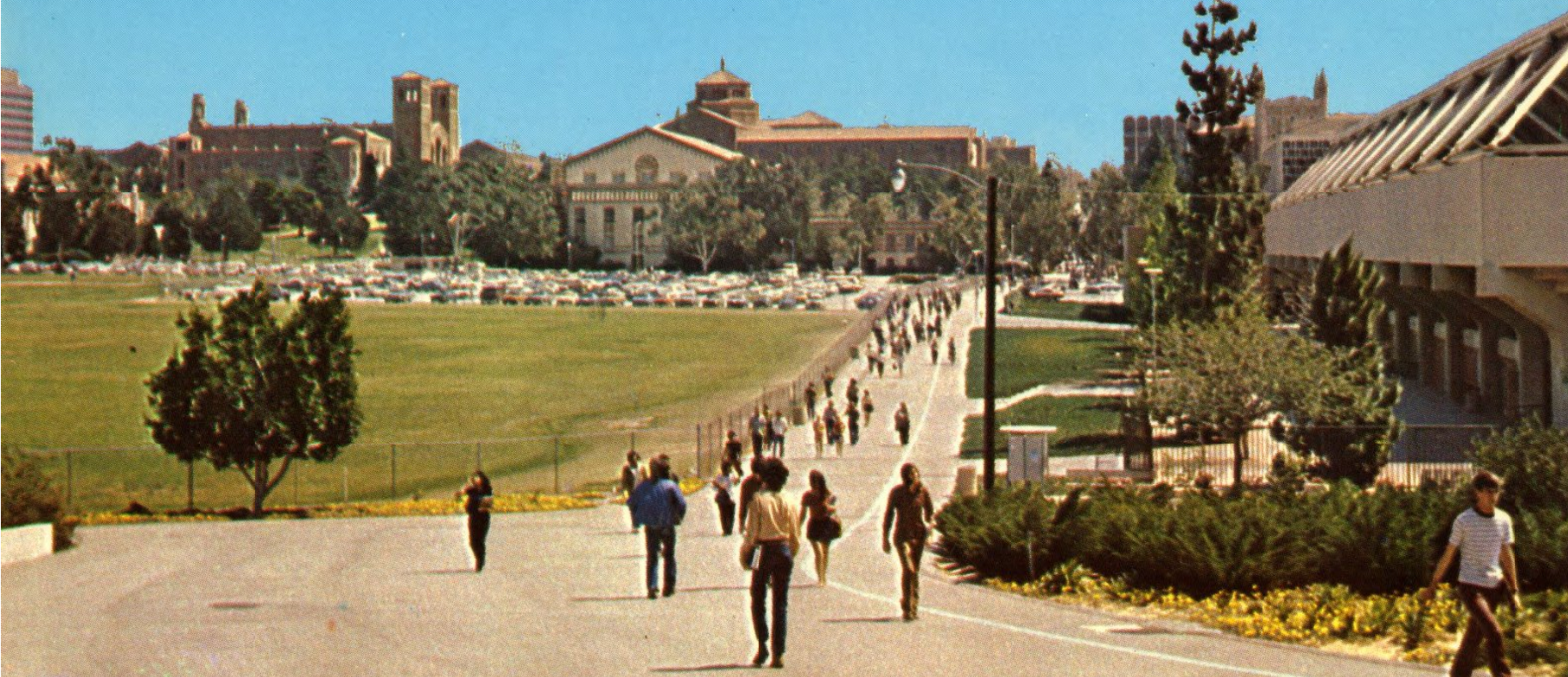
As shown in the photo there was the “big field” as we called it on the Track team. We did our warm up jogs there. It was huge. We then ran up the Sunset hill to Veteran and continued around the perimeter of the campus for a roughly four-mile warm up. There was the “parking thing!” Or lack thereof. I never got a parking permit each quarter…so I paid on the back end with parking tickets. And the ultimate penalty…the police! I’ll leave it at that! 

And then there was the Vietnam War and related campus unrest, Black unrest demonstrations and the campus murder (leave it at that too)! 

And yet I do have fond memories of education, fun, our great BB and track teams and friends. 

Bear with me for another memory… I recall being in Dykstra Hall, on the upper floors, which were female only, visiting a lady friend. While “socializing” we were shocked to reality by the fire alarm. My first response was “Oh Shiite!” My moment of panic at possibly being caught in violation of rules. But happily the next thing I heard was several male voices exclaiming “#&$%” multiple spicy profanities as they too were caught with their pants down. I survived! Got caught and reported, but I survived to tell numerous variations of that story. Not sure which one is closer to the truth. Ah, youth! 

Brian Craig ’71 

When I was at UCLA, I had an interesting part-time job as a driver for the University. The University had a pool of cars that could be checked out by authorized people, but often people just needed someone to drive them to their meeting. I was their driver, using a University vehicle.  

A common task was picking up visiting professors and lecturers at LAX. But I had a couple of interesting people who would ask for me as their driver.  

One was Chancellor Charles Young. He had a team of five or six of us and would rotate us, asking us to drive him to his off-campus appointments. In reality, we were a traveling focus group, as he peppered me with questions about campus life, academics, whatever was on his mind. The other drivers got the same battery. Our conversations were quite interesting and I can quote a number of things he said to me, still to this day. He was in the process of closing down the B.A. level programs in a number of departments. He said “An undergraduate education should teach you how to think and reason. Learn that and you can go do anything you want.” Those are close to his exact words, more than 50 years later. A benefit was that if the trip were early in the morning, I would pick him up at the Youngs’ home on the north edge of campus, and the Youngs’ cook would feed me while I waited for the chancellor.  

My other regular was Mr. Edwin Pauley. He was CEO of Pauley Petroleum and a UC Regent. He often had business on the campus or other University business. I would go to his home in Holmby Hills and his butler would greet me and seat me in the library to wait for Mr. Pauley. Again, I was peppered with questions about campus life, as he felt (understandably) detached from campus. I was one pair of eyes for him in terms of student life. He was quite conservative politically, and let me know it, but at the same time, he was quite generous. He gave substantially for the Pavilion and gave his time as a Regent, among other things. 

I was at UCLA for four years and lots happened during that time. Meeting and getting to know these two men was a special part of it. I was honored that they asked for me to drive them. 

Steve Cristiani, M.S. ’74 

When I was at UCLA, I remember the premiere of “The Exorcist” at the National Theatre in late 1973 with a bedroom window mounted on the wall and the crowds down the block waiting to buy tickets.  I also remember the McDonald’s giving away free French fries when the Bruin Basketball team scored 100 points and seeing Bill Walton ride his 10-speed around campus. I remember my queuing theory classes in Boelter Hall taught by Professor Leonard Kleinrock and his excellent discussions of how the material was being used in the design of the ARPANET. 


D

Cheryl Davies ’78 

When I was at UCLA, I loved every moment of my psychology classes, took the Santa Monica bus to the beach every afternoon during spring quarter, loved being a waitress at Bon Appetit in Westwood (tips helped pay for tuition and housing) and absolutely loved my sisters at Alpha Chi. I graduated in 1978, but it seems like just a few years ago. 

Susan DePace Shaikh, M.A. ’93 

When I was on campus, people still had free speech. 

Paul Downing ’92 

When I was at UCLA, Sinead O'Connor came to speak, answer questions from the students and even sing a short tune a capella. 

Maria Dungo ’90 

Winter quarter, freshman year, January 1986. Walking to south campus, it was eerily empty on campus mid-morning. I remember passing the snack machines near Boelter Hall when I heard the broadcast from a transistor radio of a janitorial staff announcing the Space Shuttle explosion shortly after takeoff. 

Frozen in my tracks, breathless, silent, my heart broke to pieces. Arrived late to class, in tears and completely distracted. 

Dudley Dunlavey ’79 

My most lasting memories of life as a UCLA Bruin involve massive, crowded lecture halls, class waiting lists, limited on-campus parking, never-ending remodeling projects and feeling like a washer in a barrel of 40,000 of 'em.  I wouldn't recommend it to anybody. 

(I should have graduated in '78, but had to wait for the classes I needed to complete my major.) 


E

Ron Eaton ’82 

During the entire time I was at UCLA, I worked a full-time job and frequently one or two paid consulting gigs on the side. Los Angeles is somewhat expensive, but fortunately my employers paid for all my tuition and books. It was a good time of life and now I even get decent retirement money. 

Ron Enfield ’66 

As a film student at UCLA in 1965, I attended class sometimes in MacGowan Hall, sometimes in the wooden bungalows next to it. For our cinematography class one semester, Academy Award winner Haskell Wexler parked his Rolls Royce Silver Cloud in the nearby lot and taught us lighting and scenes. One of the graduate students, Bill Kerby, later went on to write and produce “The Rose." Me? I got a job in computers... 

I was leaving an acting class at MacGowan Hall (it was 1966) with Donna De Verona, the Olympic Gold Medalist swimmer who came to UCLA. She and I were among the worst actors in the class, but inspiration struck her as we walked across the green south of MacGowan, next to a library with an outdoor deck. She pulled out a starter's pistol she had from her swimming, and when I saw it, I feigned backing away in terror, as she screamed “You [expletive]!” and discharged a blank round. I fell to the ground as if shot, and she stood over me in triumph, then walked away. 

The graduate students who were on the outside deck looked on in disbelief and horror, until I stood up and walked away with her. 

Robert Ewing ’57 

When I was at UCLA, many of us were commuters. Three of us commuted from Montebello, where we all lived and had attended different high schools. Timing was crucial for getting a parking place, and I frequently parked off campus after dropping off my two ride-sharers. In those early 1950s I could drive right up to the flag pole near Haines Hall and drop off two people who had 8 a.m. classes, then cruise around for a parking spot and get to my 9 a.m. class. One of my passengers dropped out after one semester, but the other stayed with me, shared the ride and we married before the start of our last semester in 1957. We shared 60 years of marriage until her death in 2017. So, I love UCLA because just getting there every day led to the best thing in my life. 


F

Jay Fam  

When I was at UCLA, parking permit for a quarter was $300, Diddy Riese was the happening place for dessert and Hedrick Hall was not yet a summit. 

Norma Flores ʼ98 

When I was at UCLA, the Men's Basketball team won the national title and a little riot broke out in Westwood because of all the celebrations. 

Michael Givens ’83 

When I was at UCLA, in the Dykstra Hall dorm, I met the RA of my floor… and I married her. We had 34 amazing years together, and two children. It was a wonderful life — until I lost her to breast cancer. 


G

Jerry Glass ’68 

When I was at UCLA the all dormitory football team defeated the all fraternity football team for the first time ever. The year was 1967. The dorm team was coached by Norm Dow, the UCLA varsity team’s backup quarterback. When the Daily Bruin totally ignored the story, Norman Dow wrote a scathing editorial to the Daily Bruin, which, to their credit, they published in full. To those of us who lived in the dorms, it was a big deal - like David slaying Goliath. 

Rona Browne Gordon ’70 

When I was at UCLA (1966-1970) I worked the entire time – in the Dykstra Hall cafeteria, the student store, an office in the chemistry department and in the little town of Westwood Village. I learned about music, concerts, basketball, history, people, standing up for what you believe and life. I didn’t realize then how lucky I was to be there but I am grateful for all of it now. 

Jenny Grossgold ’93 

When I was at UCLA, I was part of the first freshman class to select classes via telephone enrollment (yes, telephone!). 

Steve Grubman ʼ71 

When I was at UCLA, there were anti-war protests and classes were cancelled during my junior year. Angela Davis was a big deal. The Bruins won the NCAA Basketball championship all four years. 

Daniel Gutierrez ’78 

When I was at UCLA, I got my start with teaching. As an incoming freshman, I found the UCLA Computer Club located in 3514 Boelter Hall (the club no longer exists). I volunteered to teach one of the free computer classes the club offered in the evenings. I found that I loved to teach. I taught classes through the club nearly every quarter I was a student. After graduating, I started to teach for UCLA Extension where I still teach to this day. And I still love teaching! 

Ismael Gutierrez ’73 

When I was at UCLA, social revolution was in the air and things had to be “relevant.” 


H

Gary Hahn ʼ70 

I became president of Rieber Hall for 1968. We won four national championships, and only lost two regular season games.  

Wouldn't trade this for anything else. Go Bruins! 

Joe Hilberman ’70, J.D. ’73 

When I was at UCLA for college and law school, the basketball team won seven consecutive national championships. I feel guilty for leaving…. 


J

Angela Linares Jacobson ʼ97 

When I was at UCLA, we all stood in long lines at the computer labs to check email! Oh, and also when I was at UCLA, the Men's Basketball team won the NCAA championship! Go Bruins! 

Janet Jones, Ph.D. ’89 

When I was at UCLA, my favorite place on campus was in the stacks below Powell Library. It took my breath away the day I discovered it as a first-year graduate student from a tiny college of 700 souls. There, in an enormous deep basement, were hundreds of thousands of books on shelves placed about 18 inches apart and ranging for what felt like a half mile. You could sit down on the floor and literally immerse yourself in your chosen discipline, with books on that topic surrounding you. Was I supposed to be down there? I'm not sure, but there were no signs forbidding it and the unmarked doors were not locked. During my time at UCLA, books in the stacks were moved to warehouses all over Los Angeles, for earthquake safety. But what sheer heaven it was to disappear at midday down into the silent dungeon of knowledge and read the afternoon away. 


K

Ann Kelsey, M.L.S. ’69 

It was the summer of 1968 when I started graduate school at UCLA at what was then the School of Library Services located in the College Library, now Powell Library.  Martin Luther King Jr. and Bobby Kennedy had just been assassinated. 

While working at my summer job at the Reserve Book Room, we watched the war zone that was the 1968 Chicago Democratic Convention.  Kareem Abdul-Jabbar, then known as Lew Alcindor, one of the stars of John Wooden’s legendary Bruin Basketball team, often appeared at the small window to pick up reserve materials for his classes. He had to bend over double for me to see his face. 

I was a commuter student.  As I walked from the parking lot along Bruin Walk to the library, very loud members of the Students for a Democratic Society (SDS) shouted their disapproval of the Vietnam War and exhibited significant hostility toward anyone they identified as military or a veteran.  It was a daily gauntlet that was very upsetting as I had several friends and family in the military, including some fighting in Vietnam. 

In the spring of 1970, a few months before receiving my M.L.S., recruiters from the Army Library program visited the library school.  They were not in the military. They were civilian civil service employees of Army Special Services, the Army’s morale and recreation agency.  After almost a year of witnessing the hostile behavior of anti-war protestors toward soldiers, I saw a way to put my training as a librarian to work to support these soldiers. I went to work for Army Libraries as an administrative librarian managing recreational libraries for the soldiers in base camps in Vietnam.  That year changed my life and my world view forever.  It made me a better librarian and a better person. What I learned at UCLA about libraries librarianship, and life skills helped me succeed in job responsibilities that just-graduated librarians normally don’t encounter for years. In very real ways, UCLA helped to shape the rest of my life as a librarian and as a person.  I won’t ever forget that. 

Michael H. Keslin ’63, M.D. ’67 

Nov. 2, 1959, was the end of my third week at UCLA. I was walking toward the main library when I saw students lining both sides of Bruin Walk. I stopped and asked an older student next to me why everybody was lined up. He told me that John Kennedy, the junior senator from Massachusetts, was visiting campus to give a speech at the UCLA Convocation on nuclear weapons. He added that he thought that Kennedy was running for president. I looked up the path toward the Student Union and saw a thin, boyish looking man with a full head of red hair heading up the path toward me. His eyes caught mine and for unexplained reasons he headed straight for me and extended his hand. I shook it as he introduced himself to me. After he passed I continued my journey to the library to review my notes for Philosophy 6A. In the back of my mind I knew that something important had just happened but of course I had no idea what was to come. And this was only my third week as a Bruin. 

Daniel T. Kresteller ’76 

When I was at UCLA in 1972, I lived on the 7th floor of Rieber Hall. The women’s wing was on the southern side.  Each side had a study room which butted up in the center of each wing.  For those of us who were lucky enough to enjoy relations with girls on the other wing it was often embarrassing when the ladies had to go back down the elevator, and walk across the hall to their wing.  Guys who had nothing better to do would sit next to the vending machines waiting to harass the ladies walking back to their rooms.  Needless to say, many of us used our ingenuity to put an end to this issue.  One day we decided to break open the wall connecting the two wings that attached.  A few days later, Travis Clark wrote a letter to everyone living on the 7th floor indicating that “if the wall wasn’t restored within 24 hours everyone would be suspended.”  All of the roommates got together, took that letter, slapped it on the wall where the hole was and painted it Honolulu Blue!  To our surprise Dean Hansen and Dean Locklear (yes, Heather’s dad) determined that the few exits were a fire hazard and installed doors on each floor creating access to all residents to each side.  Needless to say, we were back in business. Now that is Bruin ingenuity! 

Each year a different celebrity was chairman of the Mardi Gras, a nonprofit program during the spring break to raise money for a children’s summer camp for underprivileged children.  In 1973, Jack Benny was given the honor and in April he spoke at Ackerman Union to the student body.  After speaking, many of the students lined up to obtain his signature.  I lined up like so many others but only had a $20 bill for him to sign. 

When I got on stage and asked for his signature he said, “son, how about if we donate the $20 and I sign a $1 bill for you."  That signed bill is framed and a treasure of mine. 

Bill Krone ’72 

When I was at UCLA, the shooting of innocent students at Kent State happened on May 5, 1970.  The next day as I ascended Bruin Walk there was mass tumult and anxiety filling the air. Within two hours, there were mass protests and violence pervading the campus. Governor Reagan ordered the campus closed and 500 LAPD surrounded the campus, ordering everyone to leave or be arrested. Many students who didn't hear or participate in the protests were put upon by the police, even arrested in Powell Library and severely injured. Campus was closed for over a week. Heavy days. 


L

Roberta Lagomarsini ’78 

When I was at UCLA, I was commuting from an hour away. We got a parking permit at the top of the hill by the dorms. My carpool and others and dorm students would walk down to our 8 a.m. classes. In the field in front of the student store, the ROTC students would practice. In the fall of 1974, they were pretty terrible! Still we all persevered. By the end of the school year they had gotten much better. One morning they told us to be there the next day half an hour earlier. My carpool and I dutifully left for school a half an hour earlier to arrive in time. They did their whole routine, marching in many formations, twirling their guns and shouting out marching calls. We were all mesmerized and when they were done, we all cheered and applauded. A great moment. 

Arianna Rivera Lee ’17 

When I was at UCLA, I would stop by the courtyard in front of Royce Hall and Powell to decompress. The grandeur of these buildings made the stress of college life feel temporary. 

Lesley Lee ’93, M.Ed. ’94 

When I was at UCLA, you could always count on herb baked chicken and fire station casserole in the dining halls. 

Stan Lieberson ’69 

After graduation, I turned my half-time job into a full-time job. Working on campus was great!  In addition to the atmosphere, so unlike a corporate atmosphere, I could enjoy my lunch at the botanical gardens, at north campus (I worked in the engineering building) or attend talks by acclaimed speakers. On one occasion I went to hear a talk by an author I knew a little about. He was a Black writer who had once been sent by Playboy Magazine to interview the head of the KKK -- and Playboy hadn't told the racist organization who was going to do the interview! This fellow spoke in a large auditorium during lunchtime, and the room was full. He talked about his background, noting that his grandparents had been slaves in the Antebellum South, and how difficult that was for them. He related stories passed down by them, and said he realized this information would be lost unless he documented it. He told a fascinating tale of how he researched his family tree, including flying to Africa to deepen his research. And this is how I heard the captivating story of the as-yet not published "Roots," described by Alex Haley himself, one fine day at UCLA. 

Sally Lindsay ’80, M.A. ’86 

I was born at UCLA Medical Center (1958) and we lived in the married student housing for my first four years. They tore down this housing to build Pauley Pavilion. I remember watching through a chain link fence as people put up the rides and stands for Mardi Gras (an annual thing for a while). I remember sitting in a basket on the front of my mom's bike as she rode down Westward Boulevard and I remember walking and playing at various places on campus. 

I returned to UCLA as an undergraduate in biology. I loved the campus and walking back and forth between north and south campus. I took SCUBA lessons in the pool at Sunset Rec. Center and participated in the Marine Biology Program at Catalina Island (1980). I loved it! I went on to graduate school in biology, working under David Chapman. The camaraderie I had with my fellow graduate students is something I will always treasure. I met my husband at UCLA. After earning a master's degree, I left UCLA for about a year and then came back to work in the undergraduate biology office with Annie Alpers for four years. Then we moved with our young daughter to Oregon. 

I will always remember with fondness all the years I spent at UCLA. 

Henry H. Lo ’98 

When I was at UCLA, we all tried to smash as much meat into a bowl at Mongol’s as we could, then balance a mountain of noodles on top! 

Andrew Lueder ’91 

When I was at UCLA, there was no Internet, there was "arena registration" for classes that was a huge scrum; there were interest groups of every stripe competing for attention on Bruin Walk; there were no "brand name" dining options; movie showings at Melnitz could become heated back-and-forth conversations with the director present; the music library was a cool refuge; film premieres in Westwood were common; and the gingko trees in Dickson Plaza had a distinct signature scent at certain times of the year. And the cafe on the first floor of Kerckhoff made you feel you were in a different place altogether. 


M

Cherie Magnus 

I wrote a whole book about when I was at UCLA 1960-65. 

A good time to remember the ’50s. 

“Arabesque: Dancing on the Edge in Los Angeles (DEATH DANCE DESTINY MEMOIR TRILOGY)”  

Authur Maletz ’82 

We had the "every man, woman and child" cheerleader at every UCLA football game. I miss him… 

Jessica Manriquez  

When I was at UCLA, we had to check out laptops from the library. WiFi was not available all over campus so we had to take notes on paper. 

Derek Mateo ’96 

We never lost to ʼSC, won banner 11 and founded LCC Theatre Company. 

Michelle Fisher May ʼ95 

When I was at UCLA, Royce Hall was closed after the Northridge quake, I watched our basketball team arrive at LAX with the national championship trophy and we beat ’SC in football the entire time I was a student. 


N

Laureen Lazarovici Narro ’89 

The Luskin conference center was a parking lot - my beloved Lot 6. 

Susan Muscarella Newcomer ’75, M.L.S. ’77 

In 1976, when I was a student in the Graduate School of Library and Information Science, there was an interesting event sponsored by a group called Asia Focus that was part of a wide variety of activities in conjunction with the year of bicentennial celebrations.  On Bruin Walk, the group put on a Dharma Demolition Derby that included Zen Buddhist priests, led by Brian Daizen Victoria, who was a grad student in Asian languages, plus guest appearances by author Ken Kesey and comedian Wavy Gravy who had been the master of ceremonies at Woodstock. 


O

Sam Oman '67, MBA '69, Ph.D. '75

When I was at UCLA I drove, parked (for free) on the other side of Wilshire Blvd and walked to class. When JFK was assassinated I was in the French Department office - the secretaries started shouting/crying in French, and all I understood was that it had something to do with the president.

After getting my B.A. in math in 1967, to make money I switched from selling shoes at Leeds to programming computers part time at North American Aviation.  After two years they required me to work full time; but I wanted to continue for a Ph.D.  I managed to get a part time programming job at Rand Corporation, and my wife and I moved from married student housing to a small rented house in Santa Monica (734 Cedar Ave. - I visited LA a few months ago, drove by and it looked EXACTLY the same!)

After finishing my MBA I wanted to do a Ph.D. in applied math, chose probability theory and got Sidney Port as my advisor. He gave me a complicated, abstract paper by him and Charles Stone dealing with stochastic processes, and said I should generalize their results. Whenever I asked for a suggestion on how to do this, he just told me to think of something. Although it took me five years to finish my thesis, this trained me to do research on my own.  I still remember the moment when I came up with how to prove my theorem - I was running track in Spaulding Field, looking at the clouds to relax my brain, and the answer popped up. To a certain extent I continue with that today - when I want to prove a theorem or solve a problem, relaxing the brain helps.

While working on my thesis, I also took courses in statistics from Tom Ferguson, Bob Jennrich and Donald Ylvisaker. After finishing, I taught at Case Western University for three years, and then in 1978 came to teach statistics at the Hebrew University in Jerusalem - where I am now a professor emeritus. I visit the U.S. whenever I can to see my extended family; and in fact, this spring I gave a seminar in the UCLA Department of Statistics and Data Science.

Dave Osuna ’83 

When I was at UCLA, we had four dorms, Dykstra, Sproul, Rieber and Hedrick… we didn’t have dining halls. We went through the line with your tray and a woman wearing a hairnet plopped food in your tray and that was breakfast, lunch and dinner. You could not go to another dorm unless you got authorization. 


P

David Paras ’88 

There was a bowling alley and a treehouse. 


R

Ayanna Robinson ’22 

When I was at UCLA, I was a mother of five and married. It was during Coronavirus. I had one class on campus the entire time. I was a transfer student and I was still the best student I have ever been. I made the best of a hard situation and I succeeded. I had GRIT and I graduated with a 3.93 GPA. It was a dream come true and it was home to me. Go Class of 2022! I am proud to be in your graduating class. 

Corrie Roozee 

When I was at UCLA, you had to spend the night in the stairwell of Pauley to get good seats for the Duke game!  

When I was at UCLA, I ate either Buck-Fitty or Mongols every day (and they were right next to each other). 

And Diddy Riese was 25¢. 

Jon Ruiz 

When I was at UCLA a critical part of one’s education was the debates you could engage in with all kinds of people on Bruin Walk. 

Gene Russell 

When I was at UCLA the most impressive thing to me was office hours with brilliant professors. Google Raymond Redheffer for example. Or Brian Ellickson, Susan Woodward. Econ 81. 

Libby Anne Russler ’76 

We still used slide rules and watched as the controversy over whether bringing a calculator into the classrooms would be allowed. 

We had a Playgirl centerfold as a Chemistry TA. 

We lived on the 10th Floor of Dykstra Hall - restricted to girls only. 

We learned that if you study the syllabus and actually do the assigned reading for class, the lectures all made sense and exams weren’t hard at all. 

We took the famed History of Jazz “mick” in the largest lecture hall on campus which was, of course, filled to the brim. 

And so much more. 


S

Therese Santalo  

When I went to UCLA, everyone had scooters and we'd do late night take out from Tomy's in Westwood. 

 
Bob Schneider ’56 

When I was at UCLA from 1952 to 1956 not all parking lots were paved. One morning I parked at an unpaved parking lot in the northeast part of the campus that had a bit of a slope. It rained while I was attending classes. When I returned to my car late that afternoon it was about 30 yards from where I had parked it, having slid down the slippery surface of the lot. Fortunately, it didn't contact any other vehicles on the way down as the lot was mostly empty by then. 

Joanne Hirsch Serin ’70 

A few sad national events occurred. First, on April 4, 1968, while strolling down Bruin Walk, I heard that Rev. Martin Luther King was assassinated.  Then, in the evening of June 6, I was watching the California Democratic primary in my friend's room on the 3rd floor of Rieber Hall. We were thrilled that Bobby Kennedy won. Right after that, I went back up to my broom on the 5th floor. What a change in the atmosphere. In the time I was in the elevator, RFK had been assassinated by Sirhan Sirhan. We were all so shocked and sad. On May 4, at the end of my senior year two years later, National Guardsmen killed four students at Kent State who were peacefully protesting the U.S. incursion into Laos. One victim had even put a Daisy into one soldier's rifle. After that, everything on campus changed. My Italian prof moved our classes onto Dixon Hall square. Then, instead of a final exam, we had a pizza party at her apartment. 

Happy memories, too - I enjoyed and am grateful for my education, even physics for liberal arts majors, a pass-fail class in which I was able to pay attention because the prof looked like David McCallum, the handsome actor who played Ilya Kuryakin on “The Man from U.N.C.L.E.”  

At the beginning of my freshman year, my best friend, Suzy, and I went to a Hillel dance. I met a nice guy, but Suzy didn't.  A couple days later, Robert, the guy I met, told me he had a friend for Suzy.  Long story short, Suzy met Robert's friend Norm, married him right after we graduated, and have been married for 53 happy years. BTW, Robert and I didn't work out, but Suzy and I are still close friends.  

The legacy continues.  My daughter graduated from UCLA in 2001 and has made sure her son knows the 8-clap and wants to go to UCLA in 2034. 

Melanie Lipman Skikne ʼ85 

My dad used to say “when I went to UCLA I could park in front of the math building.” 

Michael Slater ’80 

When I was at UCLA, I used to like the energy on Bruin Walk in the morning.  So many people were headed to class with their backpacks filled with books so they could study in one of the many libraries between and after classes.  Swami X was a familiar face on Bruin Walk in my day – what a character he was! 

Mitchell Sodikoff ’89 

1:  I was walking with a friend in '89 along the pathway from Ackerman to Pauley (between West Center and Morgan Center), sharing with him why I felt we lost the Men's Basketball '80 national title game vs. Louisville (Kiki VanDeWeghe missing a layup taking off from the foul line towards the end of the game), when, out of nowhere, a gentle, eavesdropping voice behind us chimes in with, "Well, you do remember that he was double-teamed, right?"  It was Coach Wooden. 

2:  During my freshman year in Spring '85, the on-campus protests against apartheid in South Africa, applying pressure on the UC Regents to divest, culminated in a shanty village being built in the quad outside of Schoenberg Hall (across from Murphy), giving us a flavor of fervent student political action, similar to that of the '60s and '70s. 

3:  I was in the Marching Band, and within the first weeks of my freshman year, we played for the dedication of the Bruin Bear statue, with award-winning composer Bill Conti leading us in the first-ever public performance of "Mighty Bruins", which he wrote. 

Bart Sokolow ’69, M.S. ’70, Ph.D. ’77 

Following my undergraduate studies, I pursued and completed my M.S. in energy and kinetics at UCLA Engineering. Subsequently, I obtained my D.Env. (Doctorate in Environmental Science & Engineering) from UCLA. I then embarked on a career as a professor in the UCLA Environmental Science & Engineering Doctoral Program. Eventually, I ventured into the realm of entrepreneurship and established my own company, Environmental Advisors, Inc. I am pleased to share that I have recently published the second edition of my book, titled "How to Avoid Environmental Litigation." 

Juli Urrizola-Solaegui ’85 

I loved everything about UCLA! It’s a gorgeous campus with wonderful memories. I loved getting coffee in the early hours before going to my classes near Bunch Hall!  I loved the student store, where I collected much Bruin memorabilia. One of my favorite things was Westwood when everything was open and not blocked off. 

Bruins Rock! 

Roberta Stambaugh ’76 

When I was at UCLA, I would stop and listen to Swami X for a few minutes as a bit of an escape. I remember thinking he was pretty cool for an old guy. 

Tom Stindt ʼ65, J.D. ʼ70

I moved into Rieber when the dorm first opened. It was my junior year, in September of 1963, that some 600 of us moved into the brand-new Rieber. Everything was sparkling fresh and new, and it seemed so plush to us that it was more like a resort than a college dorm. Each floor had a theme name drawn from Irish history and folklore, and each floor or "house" developed its own personality.  

In those warm September weekends, there were dances in the rec room which spilled outdoors into the plaza and parking lot. If you didn't like the band, you could walk down the hill to Sproul, where you might like their band better. You had choices. The next year, my senior year, I was elected house president of Cork, 6th floor men, and we had group trips, dinner dances, trips to the Cal game in Berkeley. We also studied, of course.  

Many good friendships were made. Fifty years later, more than a few of us remain in touch with each other. I don't know how new residents were placed into the various residence halls, but returning residents could select a dorm. Did you know there was a bit of scuttlebutt in 1965 about the nature of the dorms as then existed at UCLA? It was said that "all the pretty girls live in Rieber;" and "the study-a-holics live in Dykstra." It was common knowledge that the "general all-around student types live in Sproul." The "demure, quiet-type girls live in Hershey across campus." Those were just stereotypes of course and there were no real distinctions. But I suppose even the Greek houses had their stereotype reputations too.

The only thing negative about the dorms in that era was the food wasn't so good. When I entered the Army after graduating from UCLA, surprisingly I found the army chow to be much better than the dorm food!

All  things considered, life at Rieber helped make my college years a memorable experience.


T

Phil Tacata ’99 

When I was at UCLA, our football team never lost to USC. 

Atom Tayo 

That is the great ivory tower I so much love. 

David Tenebaum ’75, J.D. ’82 

When I was at UCLA, I learned to think critically and question everything. Professors like the late Dr. Malcom Kerr challenged me to rethink and see the Middle East in an entirely different way. His insights have proven to stand the test of time. 


V

Lesa van Daalen ’79 

This picture shows the view I enjoyed walking to classes each day from Hedrick Hall. 


W

David H. Walter ’65, MBA ’66, Ph.D. ’73 

When I was at UCLA in 1961, the last year of semesters before transitioning to quarters, I vaguely remember my registration and tuition fees were in the vicinity of $100, give or take a few dollars!  What an amazing deal! 

When I was at UCLA, my first freshman semester, September 1961, parking on campus was free. Soon thereafter a fee of 25 cents was instituted — as memory serves. I don’t remember any parking structures, only large paved and unpaved lots (e.g., the entire northeast corner of campus at Sunset and Hilgard was a dirt parking lot). 

When I was at UCLA on Nov. 22, 1963, while walking past Murphy Hall toward the old Business School north of Dodd Hall at approximately noon, having been at UCLA for more than two years, I first became aware that campus had a loudspeaker system. As I recall, “May I please have your attention, we regret to report that President John Kennedy has been shot. Classes are cancelled for the rest of the day; please leave campus at this time, thank you.” 

When I was at UCLA, my undergraduate graduation ceremony on June 11, 1965, was the inaugural event in Pauley Pavilion, even before any basketball games had been played there — a fitting christening for the Wooden era that was about to develop. 

When I was at UCLA on Jan. 17, 1969, I was on my way to the old (original) Business School. Walking past the east side of Campbell Hall, I noticed a commotion outside a classroom on the first floor; it appeared that the window was shattered. I soon heard that two men, Black Panthers (students?) had been shot (through the windows?) and killed. I continued on to class. Accounts of this event are readily available on the internet; I did not read them, I was there. 

When I was at UCLA as student at the Graduate School of Management, I was on campus one afternoon in the early 1970s, when I noticed a group of dignitaries in the Franklin Murphy Sculpture Garden. They were there to dedicate the donation of a Rodin sculpture by Norton Simon. Among them were (former) Chancellor Franklin Murphy, Norton Simon and Governor Ronald Reagan. A couple of years before I attended a wedding of my friend Paul Simon (no, not that Paul Simon) whose father was Norton’s first cousin. At the wedding I met Norton’s mother. So, wanting to meet this giant of industry, I nervously approached and said something like, “Hello Mr. Simon, I recently met your mother at Paul Simon’s wedding. I’m a student at the Business School and wanted to meet you." He responded, “Oh yes, I heard about the wedding,” and asked a few questions about my studies at GSM (before it was Anderson).  Governor Reagan and Chancellor Murphy were standing by. Paul loved the story of my encounter. The Rodin sculpture is at the top of the steps in the Northwest corner of the Sculpture Garden. 

When I was at UCLA in the mid-1990s I used to go running at Drake Stadium. On one occasion, I noticed John Wooden there also running laps. Wanting to meet and shake his hand, when he had stopped jogging I nervously walked over and muttered, “Hi Coach Wooden, I was a student here during all of our National Championships and just wanted to meet you.”  He shook my hand, asked me a few questions about my studies, and wished me well...or something like that; I had met Coach Wooden, the greatest collegiate basketball coach of all time. 

Scott Weaver ’96 

When I was at UCLA, the Bruin Fitness Center and the step classes were my escape from the law school. 

Ellen Bohm Weber ’78 

When I was at UCLA, disco and 8-tracks were in. The football team never beat ‘SC, but the Men's Basketball team always won the Pac-8. We registered for classes at Murphy and got our list of classes in the mail…Good times! 

Susan Weiner 

When I was at UCLA I used to jog round the track in the early mornings before classes. I knew I was doing it wrong though when the boxers who used to train there passed me by as if I were standing still. And they were running backwards. 


Y

Bill Younglove, Ed.D., ’83 

When I was at UCLA (1978-1983), I realized a dream come true: amazing research/library facilities; incredible, famed speakers; basketball giants (literally!); and a doctoral advisor/chair second to none (John McNeil). 

My main memory is the absolutely stellar professor educators I interacted with over a period of five years… 

*** 

Do you have a favorite “When I was at UCLA” memory? Write to us at connectfeedback@alumni.ucla.edu


Recent Articles

Winston C. Doby Legacy Scholarship Gala 2024

U

CLA Bruins come together during Black History Month to strengthen bonds and honor the trailblazers and risk takers who have paved the way for future generations. The annual Winston C. Doby Legacy Scholarship Gala, hosted by the UCLA Black Alumni Association (UBAA), is named in honor of a leader who supported countless students to overcome barriers to a college education. Winston C. Doby ’63, M.A. ’72, Ed.D. ’74, built a lasting legacy at UCLA through his unwavering commitment to equity and access.

Born during World War II, Doby excelled at UCLA as a scholar-athlete, and went on to an impactful four-decade career at the University. As UCLA vice chancellor for student affairs, he chaired high-level task forces to revamp admissions, financial aid and student support. He found ways to involve others in community service and established the Academic Advancement Program (AAP), paving the way for thousands of students to achieve success.

UBAA founded the Winston C. Doby Legacy Scholarship Fund in response to the passage of California’s Proposition 209, which had led to a sharp decline in the number of African American students admitted to and enrolling in UCLA. Since then, UBAA has awarded more than $4 million in scholarships to African American students.

This year’s gala, “Celebrate the Power to Inspire,” will pay tribute to Bruin alumni, community members and friends who have achieved historic firsts. The event will take place on March 2, at the Omni Hotel in Los Angeles, and will be an evening of dinner and dancing with a special program. It promises to be a memorable occasion honoring the legacy of Winston C. Doby and celebrating Bruins. Purchase tickets and sponsorships through the UBAA website.

UBAA is committed to empowering UCLA’s Black alumni, faculty and staff and building relationships that will expand educational opportunities for Black students. Bobby Grace ’84, chair of the UCLA Black Alumni Association Board of Directors, is excited to celebrate together with Bruins. He says, “2024 marks the first time that UBAA has been able to hold the Doby Legacy Scholarship Gala in person since 2018. The gala gives UBAA the opportunity to recognize alumni as well as campus and community leaders who are making an impact at UCLA and the world.”

HONOREES


D’Artagnan Scorza ʼ07 Ph.D ʼ13

A community leader and Navy veteran, D’Artagnan Scorza will receive the Tom Bradley Alumnus of the Year Award for his work on behalf of his community. The award is named for the former Los Angeles mayor who paved the way for increased diversity in leadership roles. As the first executive director of Racial Equity for Los Angeles County, Scorza was instrumental in the process to return Bruce’s Beach to the original Black owners. He previously served as the UCLA Alumni Association president and was the founder of the Social Justice Learning Institute, a nonprofit organization that champions community health and educational equity.


UCLA Chancellor Gene Block

UBAA will honor retiring UCLA Chancellor Gene Block with the Chairman’s Award for his leadership and steadfast dedication to UCLA and the broader community. UCLA's chancellor since 2007, Block has been a strong advocate for accessible public higher education. Under his leadership, UCLA has elevated its national and international profile, rose to become the No. 1 public university in the country and excelled in enrolling students from diverse backgrounds. With his expertise in neuroscience, Block’s research focuses on aging in the nervous system. Chancellor Block announced his decision to step down in 2024 after 17 years of service.


Dr. Jessie Sherrod, M.P.H. ʼ80

A physician and public health advocate, Dr. Jessie Sherrod will receive the UBAA Jackie Robinson Trailblazer Award, named for the UCLA athlete who became a champion of civil rights. Dr. Sherrod began her advocacy journey in the eighth grade, when she and SNCC members integrated a cafe in Hollandale, Mississippi. As the first Tougaloo College graduate to attend Harvard Medical School, Dr. Sherrod has been a dedicated public health advocate and mentor. She holds the distinction of being the founding member of the Association of Black Women Physicians.


Youlonda Copeland-Morgan

Youlonda Copeland-Morgan is a national leader in the field of college admissions. As the former vice provost for enrollment management at UCLA, she held an unwavering dedication to broadening access to a UCLA education. Her steadfast commitment to equity and excellence made a lasting impact on increasing access to a world-class education. UBAA is honoring Copeland-Morgan with the President’s Award.


Benny Blaydes ʼ78

Benny Blaydes will be the recipient of the Arthur Ashe Community Service Award for his commitment to mentoring and guiding generations of students. The award is named for the UCLA tennis player remembered for his efforts to promote civil rights and social justice. As an academic counselor for Santa Monica College and a longtime member of the UBAA Board of Directors, Blaydes has made a positive and significant impact through the Benny C. Blaydes UBAA Alumni Centennial Scholars Fund, which supports scholarships to undergraduate transfer students through the UCLA Alumni Scholarships Program in partnership with UBAA.


UCLA Afro Latin X Connection

The student-run Afro-Latinx Connection de UCLA will receive the Maddie Norman Award for their effort to build unity on campus, named for the woman who taught the first African American studies course in UCLA's history. Afro-Latinx Connection was founded in 2018 to bridge the gap between communities, and hosts regular events to share their experience and exemplify the pillars of community, culture and political education. Club president, Isaiah Clark exp. ʼ24 will accept the award on their behalf. UCLA students are the change agents of tomorrow, blazing a path into the future.


Chase Griffin ’21, M.Ed. ’23

Chase Griffin will receive the UBAA Florence Griffith Joyner award for his leadership and commitment to helping others. The award is named in honor of the UCLA athlete and fastest woman ever recorded. The UCLA quarterback is not only an athlete, but a scholar, entrepreneur and philanthropist. A two-time national Name, Image, and Likeness (NIL) Male Athlete of the Year award-winner, he has expanded its use as a platform to raise awareness for social justice issues. He launched the Chase Griffin Foundation to help combat food insecurity, especially among young people. Incorporating his jersey number into his signature hashtag, "BE11EVE," he is a role model on and off the field.


Monique Matthews ’92, M.A. ’96, M.F.A. ’01

Monique N. Matthews, a filmmaker who is dedicated to creating narratives that contribute to greater diversity in Hollywood, will receive UBAA’s Beverly Robinson Award, named for the renowned champion of multiculturalism. Matthews received a NAACP Image Award nomination for outstanding feature writing for the film, “A Holiday in Harlem,” which she wrote for the Hallmark Channel. She directed and co-wrote the documentary film "Birthing Justice," looking into the high mortality rates among Black mothers.


Kamilah Moore ʼ14

Kamilah Moore is this year’s recipient of the Bruin Spirit Award. As an attorney and chairperson of the California Reparations Task Force, she is committed to rectifying historical injustices. As a law student, Moore contributed to the development of human rights reports focused on domestic and international human rights issues. She has carried the spirit of social justice into her law practice, where she shines a light on these issues.

UBAA is excited to bring the community together to celebrate leaders and raise support for future Bruins. Bobby Grace says, “All of our honorees have demonstrated their great ability to inspire the world around them. We are grateful to be able to celebrate the power of their inspiration.”


Winston C. Doby Legacy Scholarship Gala

March 2, 2024

Omni Hotel Downtown Los Angeles

6 p.m. Reception, 7 p.m. Dinner and Gala Program

Purchase Tickets


Recent Articles

10 Myths About Mentorship

J

anuary is National Mentorship Month, and it’s a great time to take stock of how mentorship is or can be part of your life. The word mentorship originated from Homer’s “Odyssey,” where Odysseus entrusts the care of his household to a trusted friend Mentor, who serves as a teacher and adviser to his son, Telemachus. Over the years, the goddess Athena takes the form of Mentor to guide Telemachus to reunite with his father.

This original story of Mentor lays the foundation for today’s definition of a mentor, which is now a “trusted guide or counselor,” with the popularity of the concept really growing in the ’80s. These days, mentorship is often used in professional and personal development. Many of our alumni engage in mentorship, whether it is with students or other professionals. However, some aren’t sure where to begin or may opt out of participating in mentorship because of misconceptions. Here are 10 myths about mentorship to help assuage your hesitation to be a mentor for someone or to find a mentor for yourself.

Mentoring Someone Else

Myth #1:


Mentors are people who have everything figured out.

One of the biggest reasons alumni don’t serve as mentors is because they feel they are still a work in progress. However, that’s the best place to be as a mentor because you are modeling and living out what it means to be “figuring it out.” The myth that mentors have everything figured out keeps us from showing the realities of growing in our careers and lives. Life is a series of taking risks, overcoming challenges and changing your mind. The truth is no one has everything figured out.


Myth #2:


I’m not at a point in my life to be mentor. I don’t have anything to offer them.

Alumni of all ages have something to offer. For our seasoned alumni, you can share your learned life lessons, best practices and even industry connections. For our new grads, you can share specific tools and resources you used to reach a goal. You never know what you have to offer that can be life-changing for a mentee. If you live outside of Los Angeles, you can participate in the Alumni Mentor Program as well. Many students meet with their mentors remotely, and form meaningful relationships with alumni all over the globe.


Myth #3:


Mentorship feels transactional and fake.

A mentorship will feel transactional and fake if you are transactional and fake. Yes, some folks may be looking for a referral to your company or even an opportunity to do business together. However, there are genuine people who want to learn from you, and vice versa. Remember that you can set boundaries around referrals or offering jobs, and you can always say no. If you are looking for those referrals and jobs yourself, remember that those are high-value things that people need to vet for. No one is going to offer the big-ticket items to strangers. Like any worthwhile relationship, invest in getting to know someone first and earning their trust.


Myth #4:


Mentorship takes too much of time.

Mentorships can last a long time, but they don’t need to take a lot of time. Solid mentorships require consistent touchpoints (e.g., monthly contact). While some situations may require more immediate time (e.g., talking through a job negotiation or preparing for an interview), mentorships shouldn’t require so much time that it’s inconvenient. Both mentors and mentees should set time boundaries they are comfortable with. For example: If you find that your mentee is relying on you to manage their mental health, this is a boundary you may want to set. Mentors are not free therapists. There are campus resources and community groups that can be helpful for this purpose. Also, if you aren’t aligned in your meeting cadence or amount of interaction, it’s OK to set the boundary and share what you can offer. Mentorships won’t work if one side feels put upon or overwhelmed. Feedback is important to keep mentorships going.


Myth #5:


I can only provide mentorship to a current student.

Mentorship doesn’t only happen with students; our alumni community needs mentorship too. Alumni can be effective mentors for each other, and we encourage you to utilize resources like UCLA ONE to connect with younger or less experienced alumni who are seeking guidance. Their dilemmas are often more nuanced and complex, but mentoring alumni can be as equally rewarding as students.


Finding a Mentor for Me

Myth #6:


I’m too old for a mentor.

The biggest myth for alumni is that mentors are only for students. Whether you are retired, in your mid-career years or a new graduate, mentorship is helpful for any new phase of life. For our retired alumni, mentors could be other retirees who have embarked on a new career path as a second act, such as writing a book or leading a retirement lifestyle that you find inspiring. For our mid-career alumni, mentors can help you tackle the problems you face as a supervisor or in a career pivot. New graduates can utilize a mentor to think through grad school choices or new jobs. Mentorship is helpful throughout your life, and a mentor doesn’t need to be someone older than you.  Consider cultivating a mentorship to help you tackle the next stage.


Myth #7:


I just need to find the perfect mentor to reach my goal. 

There is no one-size-fits-all mentor. A great mentor may not be a perfect match to your identity, industry, life goals, gender expression, etc. One of the biggest misconceptions about a mentor is that they are a direct reflection of our life goals. That’s a tall order for one person. Find mentors that you trust and have an experience that you are curious about. If you meet someone else that has insight on another area of life, then build a relationship there too. You can have more than one mentor. You can have someone in your family who is a personal mentor, an entrepreneur friend who is a professional mentor and a former coach who is a leadership mentor. All these areas are important and don’t need to be filled by the same person.


Myth #8:


Mentors have to be successful and accomplished.

Keep in mind that the most successful people may not make the best mentors. While there are leaders, entrepreneurs and public figures we admire, they may not be the best people to invest time and attention. Adjust your expectation from the type of person your mentor should be to focusing on the consistency and connection with someone who is willing to give you their time and support.


Myth #9:


Mentorship is found only through structured programs.  

You can join a structured program through your company, professional development organization or even UCLA. However, you can also develop meaningful mentorships on your own. You can start with low stakes interactions like informational interviews, coffee meet-ups or chatting on LinkedIn/UCLA ONE. Take time to get to know someone and ask questions about parts of their experiences you’re curious about. Offer to stay in touch, and do just that, stay in touch! With more regular touchpoints, you can develop a trust and connection. Have a colleague at work you admire? Invite them to meet for lunch and get their advice. Do you have a family member you respect and want to learn from? Ask for some of their time outside of your usual family gatherings to get their thoughts. Mentorship can happen organically, but you’ll have to take some initiative to lead the way.


Myth #10:


My mentor will know how to mentor me.

Mentorship is not something innate but rather learned and refined over time. Mentees can set the tone by sharing their goals and questions. Mentors are there to help and guide, but they do not want to dictate your life. (If a mentor does, it may not be a healthy relationship.) If something is not working, mentees should ask to check in. Mentors are not mind-readers, so sharing what you need is helpful to get the right adjustment. Mentorships can be transformative, but mentors are not genies or silver bullets to fix our lives. The only person that can truly change your life is you. Mentorship can give us new perspectives, ideas and insights that help us make more informed choices and helpful changes.


***

If you are considering finding a mentor or being a mentor, take the first step by exploring our Alumni Mentor Program or UCLA ONE. These resources can get you plugged in today to start helping someone or yourself reach your professional goals. You can also explore these mentorship recommendations.


Recent Articles

Books by Bruins

F

rom fast-paced mysteries to heartfelt memoirs and enthralling historical fiction ꟷ Bruins are writing compelling and engaging stories. In this new series featuring Bruin authors, we've assembled a list of works based on positive book reviews. For a larger selection, check out the UCLA College Bruin Bookshelf, which celebrates a wide range of faculty, student, alumni and staff authors.


“Mycroft and Sherlock: The Empty Birdcage” by Kareem Abdul-Jabbar ʼ69

Former UCLA and NBA basketball star and a recipient of the Presidential Medal of Freedom, Kareem Abdul-Jabbar is also a New York Times bestselling author of 15 books, including his biography, “Giant Steps” and the memoir “Coach Wooden & Me” on his long-time friendship with the legendary coach. The third book in his “Mycroft and Sherlock” series, “The Empty Birdcage,” thrills with action and intrigue as the Holmes brothers pursue a murderer through Victorian England.

Review:

"The third Mycroft tale is another winner. The Victorian setting is well drawn, the dialog rings true, the period details, both factual and fictive, support a labyrinthine plot including race and class distinctions...Highly recommended, as are its two predecessors."  - Library Journal Starred Review


Force of Nature: Three Women Tackle the John Muir Trail by Joan M. Griffin ʼ77

Joan M. Griffin holds a degree in psychobiology from UCLA. Her memoir, “Force of Nature” is the compelling story of three women in their fifties who set out on a 200-mile hiking adventure. Her inspiring tale blends the beauty of the journey with all its exhilarating dips and climbs.

Review:

"’Force of Nature’ is a tale of both physical endurance and a story of inner transformation and the enduring power of nature... a must-read for both adventure enthusiasts and nature lovers." - Readers' Favorites Reviews


“Delicious El Salvador: 75 Authentic Recipes For Traditional Salvadoran Cooking” and “El Salvador, Sabores Deliciosos: 75 Recetas Auténticas de la Cocina Tradicional Salvadoreña” by Alicia Maher ʼ92

Winner of the Gourmand Award for best first cookbook, “Delicious El Salvador” and “El Salvador, Sabores Deliciosos” contain recipes for authentic and delicious meals including pupusas, quesadilla and torrejas. Maher was born in El Salvador and moved to the United States at the age of 19, earning her B.A. in art history at UCLA. UCLA Magazine named her El Salvador's culinary ambassador.

Review:

"In Delicious El Salvador, Maher gives you a thorough course on Salvadoran cuisine - one of the strongest Latin cuisines represented in Los Angeles - with around 75 recipes in English. It's the only book of its kind and one of only two Salvadoran cookbooks in print . . . Maher makes sure to include the fundamental preparations like salsa casera and salsa criolla - the two essential tomato sauces - and Salvadoran-style beans, rice dishes and tortillas that are served with many dishes. Yes, there are recipes for pupusas ꟷ don't worry..." - Bill Esparza, Los Angeles Magazine Digest


“Every Day We Get More Illegal” by Juan Felipe Herrera ʼ72

The former United States Poet Laureate has written more than 30 books of poetry. A poet, performer, teacher and activist, Herrera’s newest poems came from his travels across America as Poet Laureate. Voted a Best Poetry Book of the Year by Library Journal and included in Publishers Weekly's Top 10 Poetry Books of the Year, the political and poignant book delves into the idea of who is called “illegal” and what that means.

Review:

"Many poets since the 1960s have dreamed of a new hybrid art, part oral, part written, part English, part something else: an art grounded in ethnic identity, fueled by collective pride, yet irreducibly individual too. Many poets have tried to create such an art: Herrera is one of the first to succeed." - New York Times


“Facing the Mountain: An Inspiring Story of Japanese American Patriots in World War II” by Daniel James Brown, M.A. ʼ77

Daniel James Brown is the author of “The Boys in the Boat: Nine Americans and Their Epic Quest for Gold at the 1936 Berlin Olympics,” which spent two-and-a-half years on the NY Times bestseller list and is now a major motion picture. His most recent book, “Facing the Mountain: An Inspiring Story of Japanese American Patriots in World War II,” explores the meaning of patriotism, resistance, trust and betrayal. The book was longlisted for the PEN/Jacqueline Bograd Weld Award for Biography and winner of the Christopher Award.

Review:

“Brown combines history with humanity in a tense, tender and well-researched study of the lives disrupted and disregarded by misperceptions and misinformation. ‘Facing the Mountain’ is ‘not a story about victims,’ as Brown writes. Rather, ‘It’s a story of victors, of people striving, resisting, rising up, standing on principle, laying down their lives, enduring and prevailing.” - San Francisco Chronicle


“The Bohemians” by Jasmin Darznik ʼ94

Chosen as one of the best historical novels of 2021 by Oprah Daily, "The Bohemians" returns to 1920s San Francisco and imagines a friendship between renowned photographer Dorothea Lange and her assistant. A New York Times bestselling author, Darznik also wrote “Song of aCaptive Bird” and “The Good Daughter: A Memoir of My Mother’s Hidden Life.”

Review:

 “Modern echoes abound in a city under a pall of economic turmoil and racial disharmony advanced by politicians for their own ends as well as the global influenza pandemic. Darznik has created an arresting portrait of two women set before an illuminating backdrop.” - Booklist


So Sorry For Your Loss: How I Learned to Live with Grief, and Other Grave Concerns by Dina Gachman ʼ96

Dina Gachman graduated summa cum laude with a B.A. in English Language and Literature/Letters from UCLA, where she was a staff writer for the Daily Bruin. In her book "So Sorry For Your Loss," she explores her personal grief through a combination of storytelling, reporting and memoir, resulting in a book that can provide comfort to others.

Review:

“Journalist Gachman 'Brokenomics' delivers a poignant, personal exploration of grief…Gachman perceptively puts words to the uncomfortable realities of loss…and deconstructs its social myths, helping readers feel less alone. Those facing loss will find solace here.” - Publishers Weekly


“Dream Town” by Lee Goldberg ʼ85

New York Times bestselling author Lee Goldberg earned his B.A. in communication studies from UCLA, where he was a reporter and feature writer for the Daily Bruin. He published his first book ".357 Vigilante" as a UCLA student under the pen name, Ian Ludlow. In “Dream Town,” the latest installment of his Eve Ronin series, the title character investigates the murder of a reality star in a gated neighborhood where fact and fiction begin to blur.

Review:

“Fans of fast-paced police procedurals will enjoy Goldberg’s trademark humor and his insight into the entertainment world in his latest Eve Ronin novel (following ‘Movieland’).” - Library Journal


“Hotel Laguna” by Nicola Harrison ʼ01

Nicola Harrison is the author of three books of immersive historical fiction including “Montauk” and “The Show Girl.” Her latest novel, “Hotel Laguna,” tells the story of a young woman who becomes a Rosie the Riveter during World War II. When the war ends, she must decide whether to return home or make a new life in California.

Review:

"Nicola Harrison captures all the turmoil of the post-war world, of the women who found factory work until the men came home ꟷ and then found themselves with no place to go, except back home. But what about the women who don't have a home to go back to? In Hotel Laguna, a destitute and desperate young woman finds an unexpected home and sense of purpose when she takes a job with an aging artist, never guessing that finding his secrets will also help her find herself. You'll feel like you've dipped your toes in the sand of Laguna Beach. The perfect book to slip into your beach bag." - Lauren Willig, New York Times bestselling author


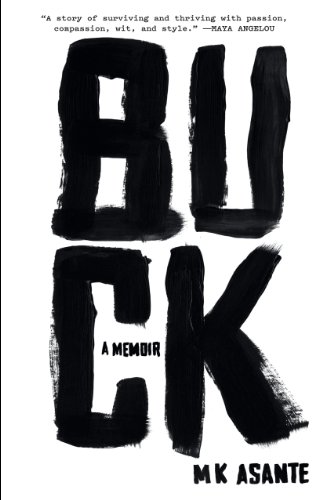
“Buck: A Memoir” by MK Asante, M.F.A. ʼ06

The Los Angeles Times called Asante “one of America’s best storytellers.” He has an M.F.A. from the UCLA School of Theater, Film, and Television and is the author of five books. He recounts his experiences growing up in North Philadelphia in the bestselling “Buck: A Memoir,” and shares the story of how literature changed his life. His forthcoming book, “Nephew: A Memoir in 4-Part Harmony” is about the transformational power of family bonds.

Review:

“Frequently brilliant and always engaging . . . It takes great skill to render the wide variety of characters, male and female, young and old, that populate a memoir like ‘Buck.’ Asante [is] at his best when he sets out into the city of Philadelphia itself. In fact, that city is the true star of this book. Philly’s skateboarders, its street-corner philosophers and its tattoo artists are all brought vividly to life here. . . Asante’s memoir will find an eager readership, especially among young people searching in books for the kind of understanding and meaning that eludes them in their real-life relationships. . . A powerful and captivating book.” - Hector Tobar, Los Angeles Times


“Living Colour’s Time’s Up” by Kimberly Mack, M.A. ʼ11, Ph.D. ʼ15

Kimberly Mack is a double Bruin, with a M.A. and Ph.D. in English. Her latest book, “Living Colour’s Time’s Up,” is part of the 33 1/3 series on iconic record albums. The book builds a legacy of their experimental and political second studio album, which blends rock with jazz, soul-pop and metal.

Review:

"Expansive. . . . Mack digs deep into Living Colour's history as a band while fleshing out their story with some crucial historical and personal context." ― Okayplayer


The Do-Over by Suzanne Park, MBA ʼ02

Suzanne Park is a former comedian and the author of seven books. She holds an MBA in marketing strategy and entertainment from the UCLA Anderson School of Management where she was a first year Dean's fellowship recipient. In her latest romance novel, "The Do-Over," a young woman must return to college to be eligible for her dream job. Once there, she reunites with someone special from her past.

Review:

"'The Do-Over' is a delight — hilarious and smart, with insightful commentary about second chances, self-doubt and what it really means to have a successful life." - Real Simple


***

Send your Books by Bruins recommendations to connectfeedback@alumni.ucla.edu. You can also search for authors or share news on the UCLA Alumni Class Notes page.

Books by Bruins Library

Previous articles in the Books by Bruins series


Recent Articles

Best of Connect 2023

10Introducing the Bruin Promise

January Edition


Introducing the Bruin Promise


Once a Bruin, Always a Bruin! UCLA is taking that a step further with a promise that educational opportunities available to students will also be made available to alumni. A new website has just launched that provides you with unlimited access to the University's vast resources and offerings. It's our commitment to be an enduring presence in the lives of alumni, enlightening Bruins through every stage of life.

9UCLA Applications for Fall 2023 Admission Remain at Near-Historic Highs

March Edition


UCLA Applications for Fall 2023 Admission Remain at Near-Historic Highs


UCLA has received more than 169,800 applications for fall 2023 admission, with approximately 145,900 coming from freshman applicants and nearly 24,000 from transfer applicants — making UCLA once again the most applied-to four-year university in the nation.

8UCLA Acquires Iconic Downtown L.A. Building, Fulfilling Its Decade-long Vision

August Edition


UCLA Acquires Iconic Downtown L.A. Building, Fulfilling Its Decade-long Vision


With the acquisition of the historic Trust Building in downtown Los Angeles, the University, which had long sought to expand its presence in the heart of the city, has taken another major step in broadening access to a UCLA education and strengthening its engagement with the city’s diverse and dynamic communities.

7Making Maroon 5, Losing It All, Finding Recovery

February Edition


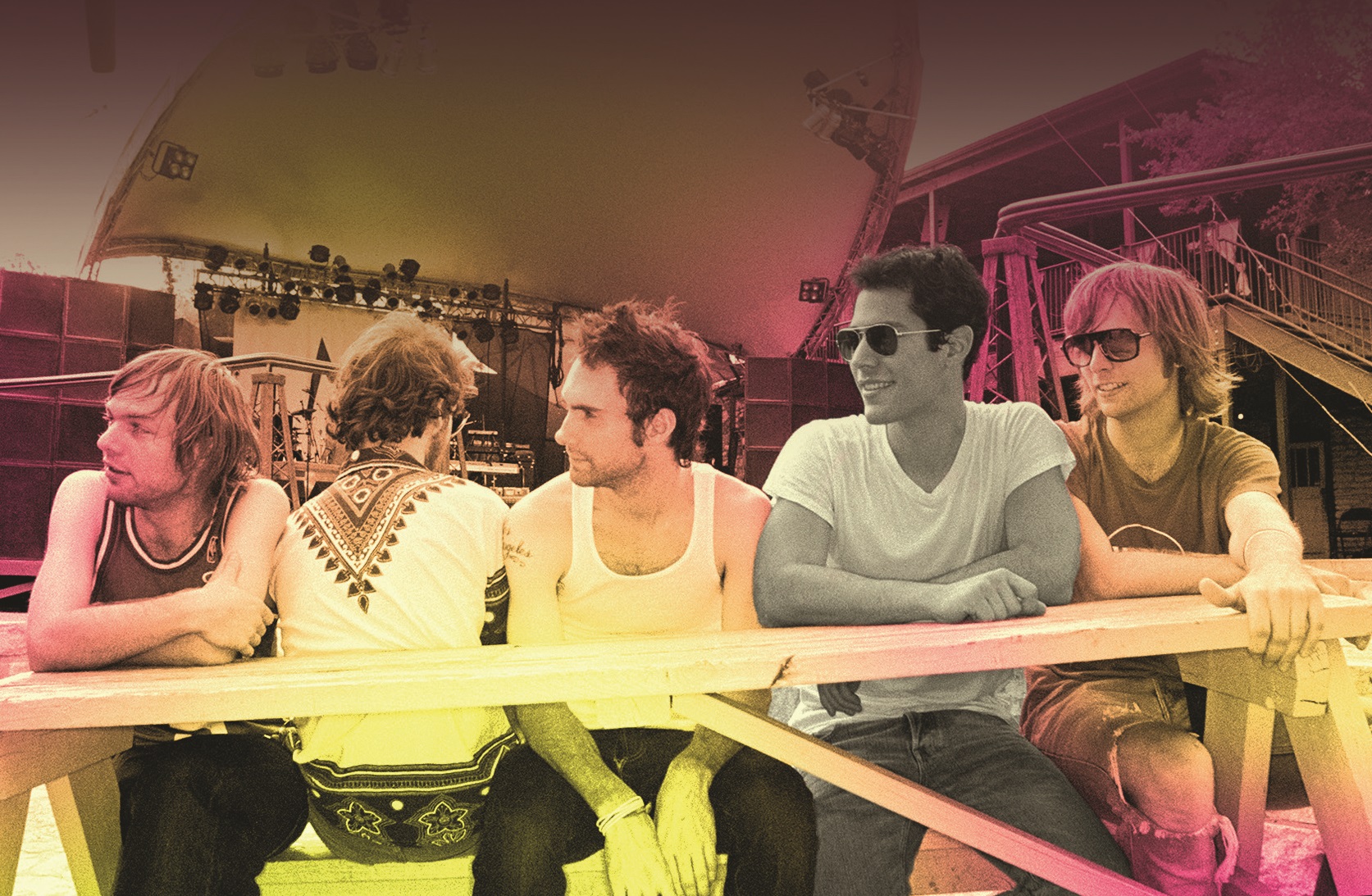
Making Maroon 5, Losing It All, Finding Recovery


In his own words, Ryan Dusick '01, the drummer and founding member of Kara's Flowers, which later became Maroon 5, takes us on an introspective journey on the highs and lows of pop stardom, his struggles with physical and mental health, and rising from the depths of addiction to a new purpose.

6Alumni Travel Further Adventures

February Edition


Alumni Travel Further Adventures


UCLA Alumni Travel proudly debuts this series of adventurous trips, an exciting way for Bruins who are active and curious to explore a destination’s culture, history and local life while also challenging themselves with exhilarating activities like hiking and zip-lining. Book your adventure today!

5UniCamp Devastated by Tropical Storm Hilary. Here's How You Can Help

October Edition


UniCamp Devastated by Tropical Storm Hilary. Here's How You Can Help


It is with a heavy heart that we are announcing the closure of Camp River Glen after the site was ravaged by a 30-foot-tall flash flood from Tropical Storm Hilary. We are determined to provide our youth campers and student volunteer counselors with a summer program in 2024. We are working diligently to make this happen at an alternate campsite. Stay tuned for camp dates!

4Rest in Peace Powell Cat (2013-2023)

March Edition


Rest in Peace Powell Cat (2013-2023)


Powell Cat was found dead outside Kaufman Hall on Thursday afternoon. Long considered an unofficial campus mascot, Powell Cat has resided at UCLA since around 2015. Their cause of death is unclear at this time.

3Randall Park '97 Commencement Speech

August Edition


Randall Park '97 Commencement Speech


Actor-comedian Randall Park gave one of his best performances at this year's UCLA College Commencement. He delivered a heartwarming message about kindness, while leaving the audience in stitches from his sarcastic wit and absurd stories. It was an instant classic you have to see for yourself.

2Come to Dinner

January Edition


Come to Dinner


Arrive as strangers, leave as friends. That's what happens when Bruins feast at dinner tables around the world for the annual Dinners for 12 Strangers gatherings. Alumni hosts are inviting you to join them for a night of food, fun and friendship. Sign up to attend a dinner near you!

1Bruin-Owned Restaurants Part 3

January Edition


Bruin-Owned Restaurants Part 3


As the summer sizzles, so should your food. We've compiled for you the third edition of select Bruin culinary businesses to tempt your taste buds and lure you to dine out in support of these UCLA alumni. Warning: the following images will make you hungry.


Recent Articles

Bruin-Owned Businesses: Gift Ideas 3

G

ive the gift that supports Bruin entrepreneurs! From stocking stuffers to experiential presents, these unique and eco-friendly gift ideas are a thoughtful and creative way to make someone's holiday bright. Be sure to scroll to the bottom and explore gift ideas from previous years.


Italian Olive Wood

Owners: Chris Arranaga ʼ82, MBA ʼ85, and Jen Arranaga ʼ95

Location: 4100 Flat Rock Drive, Riverside CA 92505

Phone: 951-353-8133

Website: https://italianolivewood.com/

Email: ciao@italianolivewood.com

About:

In 2021, co-founders Chris Arranaga and his wife Jen purchased a farmhouse that dates back to the early 1100s. Situated on a property that spans 17 acres and nurtures over 300 olive trees with about 4 acres of virgin forest, the property is located in the heart of Tuscany just outside of Florence, Italy. As the couple set about bringing the villa and property back to its former glory, they discovered a significant number of Italian olive wood trees that had fallen. They had the idea to share the beauty of that precious old wood with their friends and family back home and met with local artisans to hand-carve boards from these fallen trees.

Review:

"These olive wood serving boards are absolutely beautiful. I love that they are sourced sustainably and each is uniquely crafted by local Italian artisans. I have four and plan to use them for all manner of purposes - for charcuterie, cheese, chopping, and even as individual sandwich and chip plates. I bought them for gifts but am struggling with which ones to give and which to keep.” - Jayne B.


Hand & Stone Massage and Facial Spa

Owner: Ariel Ben-Zeev, MBA ʼ00

Location: 11 Railroad Ave., Danville, CA 94526

Phone: 925-885-6040

Website: https://handandstone.com/

Email: spa@handandstone.com

Social: @handandstoneusa

About:

Our philosophy is simple. Consistently deliver the highest quality professional massage and facial services at affordable prices seven days a week. Guests entering Hand and Stone Massage and Facial Spa will be enveloped in soothing aromas and sounds while leaving behind the stress of deadlines of hectic schedules. Hand and Stone Massage and Facial Spa offers deluxe experiences perfect for both the spa beginner and seasoned veteran seven days a week with convenient hours. Hand & Stone Massage and Facial Spas feature several treatment rooms, including private sanctuaries for couples.

Review:

“Professional, accommodating and friendly place. My masseuse Natasha will work on my painful areas with a little firmer massage if needed. Natasha is very detailed and focused on my sore areas while giving me a wonderful full-body massage in a very quiet and relaxing environment. My other masseuse Maricar is very thorough and also gives a relaxing massage. Both masseuses start on time and end on time and have never asked me to buy anything. This has been my go-to massage place for over four years and the place, Natasha & Maricar are one of the best! Highly recommend!” - K. W.


Rothstein Jewelers of Beverly Hills

Co-Owner: Janet Rothstein ʼ79

Location: 8950 W. Olympic Blvd. #209, Beverly Hills, CA 90211

Phone: 310-858-3800

Website: https://www.rothsteinjewelers.com

Email: rothsteinjewelry@aol.com

Social: @rothsteinjewelers

About:

Rothstein Jewelers have been called the "best kept secret in Beverly Hills" and have 20 years of experience. They have custom-design engagement rings, wedding bands, earrings, necklaces, bracelets, music and more. Come up to our store and become part of our family.

Review:

“Rothstein Jewelers is the place to go. They are helpful, friendly, knowledgeable, very reasonable, and most importantly, extremely trustworthy. My friends and I have been going to them for years. I have bought beautiful new jewelry, they have repaired and re-set jewelry, and they have even pierced my daughters’ ears. They always listen to what I want, and if they don't carry it, they'll either find it or have it made. Janet found a setting for me that she knew I would like. It was perfect and it didn’t cost a fortune, either. Janet takes the time to get to know the customers and make sure the customers are happy!” - Bonnie G.


Rise Academy of Dance

Owner: Nicole Cohen ʼ06

Location: 633A N. Pacific Coast Highway, Redondo Beach, CA 90277

Phone: 424-257-8946

Website: https://www.riseacademyofdance.com/

Email: RiseAcademyOfDance@gmail.com

Social: @rise_academy_dance

About:

This holiday, give the gift of dance! Enroll your loved ones in our recreational track for a fun experience of learning and improvement. For those aspiring to dance professionally, our pre-professional and competitive tracks will set the stage for a spectacular journey in the dance world. Regardless of the student's path, Rise Academy of Dance will provide high-quality instruction in a supportive environment that will allow each student to thrive in their own right. At Rise Academy of Dance, every student is given the attention they need to accomplish their dance goals. The studio offers a variety of dance styles for its students ranging in age from 2.5 years to adult, and creates a personalized path for each student to follow depending on their dance goals.

Review:

“Ms. Nicole is excellent (she comes with a pretty impressive dance résumé too). My daughter is learning great dance techniques and having so much fun while doing so. She is highly encouraging and caring towards all her students. I would recommend this studio. She specializes in jazz, mommy & me, cheer and is starting a competitive dance team.” - J D.


Blackbird General Store

Owner: Sharon Repass ʼ89

Location: 23504 Calabasas Road, Suite 2, Calabasas, CA 91302

Phone: 818-805-9205

Website: https://blackbirdgeneralstore.com/

Email: info@blackbirdgeneralstore.com

Social: @blackbirdgeneral

About:

Blackbird General Store is a modern general store established in October 2016. We are focused on unique, one-of-a-kind gifts and goods for the whole family. We feature a highly curated selection of apparel, jewelry, accessories, apothecaries, home goods, gifts, books, gourmet foods, sweets and so much more! Think of us as a hip, updated version of the “general store” concept of the past. We are a gift shop of exceptional quality and impeccable design, built upon a foundation of warmth and modernity. Here you will find something for everyone. We are specifically…general!

Review:

“This is the best little store if you're looking for gifts for someone, really anyone. They have all sorts of things from candles to unique items, to hats, to vintage T-shirts to baby gifts. The women are really nice and helpful. They do a great job wrapping everything so it's kind of a one-stop shop. I got a real Rolling Stones vintage T-shirt by Made Worn (which is really expensive typically) but it was 50% off in their store. Definitely check out this cute little store if you're in Calabasas” - Brittany F.


Studio SLB Lifestyle Photography

Owner: Shlomit Levy Bard ʼ94

Location: Mostly Southern California. Travel sessions available in Las Vegas, New York and San Diego.

Phone: 424-209-9149

Website: https://www.studioslbphoto.com/

Email: studioslbphoto@gmail.com

Social: @studioslb

About:

Founded by award-winning photojournalist Shlomit Levy Bard, Studio SLB Photography is a full-service custom photography boutique. We specialize in lifestyle portraiture, which is a hybrid of documentary-style and portrait photography, focusing on capturing the unique personalities and relationships of our clients. Shlomit's unassuming, relaxed approach enables her to bring out the best in the children, families and professionals she works with, and to put even her most camera-shy subjects (especially reluctant dads) at ease.

Review:

“Shlomit and her crew are professional and attentive to all of the details. They make the photo session fun and great photos are the result. Shlomit has a lot of ideas to help create the vision of the client. In this case, me! She understood what I wanted and needed. A great experience. Highly suggest!” - Michelle P.


Evolue Skincare

Owner: Jean Seo ʼ99

Location: 287 S. Robertson Blvd., Unit 363, Beverly Hills, CA 90211

Website: https://evolue.com/

Email: info@evoluebeauty.com

Social: @evolueskincare

About:

Evolue was founded with a passionate, relentless spirit to heal the world from toxic skincare and to provide the best ingredients and results to everyone and anyone. Jean opened the very first eco-chic beauty boutique in 2007. Jean's Beverly Hills shop stocked the most popular green beauty brands, but her discerning Hollywood celebrity clients weren't satisfied with the results. So Jean researched what makes people age and formulated products with natural moisturizing factors that our body naturally produces but depletes with age.

Review:

“My experience with Evolué has been excellent in every aspect! Ever since I met the brand and they explained how my skin type worked, what products I needed and how to use them for deliveries they have been wonderful in my case! Always with 100% personalized attention, the products are a dream for my skin. I really recommend the brand 100%.” - Ana S.


Transplant Vintage

Owner: Laura Laubach ʼ22

Services: E-Commerce

Website: https://www.transplantvintage.com/

Email: hello@transplantvintage.com

Social: @transplantvintage

About:

Transplant Vintage celebrates the crème de la crème in vintage treasures. Immerse yourself in the allure of ʼ60s mod, the rebellious spirit of ʼ70s rock 'n' roll and the opulent glamour of the ʼ80s. At Transplant Vintage, we curate a collection that transcends mere clothing; it's an ode to an era marked by revolutionary cultural shifts. Our pieces encapsulate the essence of that moment when music became a movement and style that dared to challenge societal norms. It's more than just fashion; it's an homage to your favorite Stones album, a glimpse of your mom's college days and the echo of the venue where you experienced your first live show. Each garment at Transplant Vintage is a work of art, meticulously chosen to evoke nostalgia and resonate with the passionate love for vintage music and style.

Review:

“The dress is absolutely stunning and in great condition. It was wrapped beautifully with a lovely note. It got to me super fast. The measurements were accurate. I found the perfect wedding dress - and it fits great! Thank you so much!” - Calaudia      


Six Taste Food Tours

Owner: Sally Tiongco ʼ04

Location: Los Angeles

Phone: 213-798-4749

Website: https://www.sixtaste.com/

Email: info@sixtaste.com

Social: @SixTaste

About:

Our passion is food, fun and exploration. Our knowledgeable and irresistibly cool tour guides take you on a three- to four-hour historical and cultural stroll through Los Angeles while giving you a taste of the diverse dishes this city offers. Six Taste offers location-themed food tours that feature generous samples from four to seven of the best and most unique restaurants in each neighborhood.

Review:

“SixTaste was a great group activity! I enjoyed hanging out with Sally from the Valley and learning more about her personal experiences growing up in Los Angeles and how it related to each food destination. Everyone on our food journey was very nice and accommodating to our entire team. I look forward to participating in another food tour. Thanks Sally for making our corporate outing a success! You Rock!” - Brittany S.


F45 Training Arts District

Owner: Paul Ohshima ʼ98

Location: 300 S Santa Fe Ave., Los Angeles, CA 90013

Phone: 310-951-1896

Website: https://f45training.com/studio/artsdistrict/

Email: artsdistrict@f45training.com

Social: @f45_training_artsdistrict

About:

Functional training is the engagement in exercises that mimic or recreate everyday movement. These types of exercises typically involve the use of your full body and multiple muscle groups. This style of training builds and sculpts lean, functional muscle and all can be found at F45 Training. The fixed, 45-minute duration workouts exist to provide a timing structure to maximize our members' growth and progress. Our daily workouts vary the amount of exercise stations, the work time / rest time ratio and the number of repetitions through the "exercise circuit" of each day. This provides a challenging workout for our clientele that is always evolving and never the same.

Review:

“I really love this gym. It has quickly become the favorite part of my days and it is something that I look forward to. I started off dreading my life after these workouts, nearly passing out the first few classes I attended, but after a month of going consistently, I was hooked. I decided to take the plunge and commit to a membership because it's so close to me and super convenient, sometimes I sign up within minutes of the class start time. The workouts challenge and push me to grow stronger than I have been in a long time. The trainers are great and very personable, constantly pushing and motivating everyone to dig deep and get that one more rep in.” - Stephen L.


Edelweiss Flower Boutique

Owner: Elizabeth Seiji ʼ85

Location: 1722 Ocean Park Blvd., Santa Monica, CA  90405

Phone: 310-633-8459

Website: https://www.edelweissflower.com/

Email: edelweissadmin@verizon.net

Social: @edelweissflowerboutique

About:

A Santa Monica florist with international, national and local award-winning designers, Edelweiss Flower Boutique has served the greater Los Angeles area for over 25 years. We're a family-run business and love serving our neighborhood.

Review:

“I have been using Edelweiss for the past few years to purchase my yearly Thomas Kinkade Christmas Village bouquet. They do such an amazing job on the arrangement and everyone in the store is so nice. They always go out of their way to chat with me and make me feel at home when I'm in the store. They have become my go-to floral shop!” - Nicholas M.


The Hängar

Owner: Corinne D. Weber ʼ99

Location: 2408 Lincoln Blvd., Santa Monica, CA 90405

Phone: 310 - 392 - 6111

Website: https://thehangarla.com/

Email: thehangar.la@gmail.com

Social: @thehangarla

About:

An eclectic mix of new furniture and one-of-a-kind items, home decor, home accessories, original art and a vintage clothing annex.

Review:

“Okay, this store is seriously to die for! The owner, Corrine, is seriously a day of sunshine. This store is filled with love and thoughtful pieces. She has introduced me to so many amazing pieces of unique Bohemian chic furniture. Her art is also to die for and the artist came directly to our home to hang it! Corrine is so warm and kind and I am grateful I found this beautiful shop.” - Jennifer Y.


Artsy Voiceprint

Owner: Taline Levonian ʼ98

Services: E-Commerce

Website: https://artsyvoiceprint.com/

Email: support@artsyvoiceprint.com

Social: @artsyvoiceprint

About:

Artsy Voiceprint creates personalized soundwave art gifts from the memorable sounds in your life. Whether it's the big moments or the everyday "I love you." We take a favorite song, a special voice message, your baby's heartbeat in utero, or a dog's bark and turn it into a one-of-a-kind and meaningful art.

Review:

“I recently ordered a gift for my friend's 30th wedding anniversary. The product selection was fantastic, offering a range of options suitable for a milestone celebration. The website was user-friendly, making the ordering process a breeze. I appreciated the attention to detail in the product descriptions, helping me choose the perfect gift. The delivery was prompt, When my friend opened the gift, their faces lit up with joy. The quality of the product exceeded my expectations – it was not just an item; it was a cherished keepsake. I highly recommend it to anyone looking to make special moments even more extraordinary. Thank you for contributing to the joy of this milestone celebration!” - Bon D.


Cotton Candy Queens

Owner: Samantha Safari (Smitley) ʼ20

Location: Chattanooga, TN

Phone: 423-309-2481

Website: https://cottoncandyqueens423.com/

Social: @cottoncandyqueens423

About:

We take pride in offering fresh, flavorful cotton candy in a variety (many, many, many) gourmet flavors, including dye-free organic and sugar-free options!  We enjoy live spinning and creating personalized, prepackaged options to suit your needs!

Review:

“Cotton candy queens did my daughter's third birthday party and were absolutely amazing!

The kids LOVED it and so did the adults. They were so sweet and creative with the flavors. An absolute hit for any party!” - Chelci L.


Jurassic Gallery

Owner: Danael Karlsson ʼ13

Services: E-commerce

Website: https://jurassicgallery.com/

Social: @jurassicgallery

About:

Jurassic Gallery was created by a family who love fossils, meteorites, and the natural beauty that comes from Earth. Their vision is to make authentic dinosaur fossils, meteorites and jewelry available to anyone. They are a small family business that has participated in the legal fossil excavation and preparation business over the last 20 years. They have sold full dinosaur skeletons, skulls and parts such as horns, feet, claws and other bones. They take great care in sourcing the sites they work and the bones they buy, as to abide by the country’s and international laws of collecting and reselling.

Review:

“I've only ever come across very few naturally prismatic shaped tourmalines as high quality as this in the many years I've been collecting. The pictures truly don't do this piece justice and I'm surprised no one has jumped on this sooner! I've been searching for an amazing Black Tourmaline pendant for a very long time - trying to stay away from those cookie-cutter pendants - and I've finally found an epic piece to wear. Thank you so much for the fast shipping and secure packaging. Love the packaging materials used.” - Kira


***

To submit a Bruin-owned business for future consideration, please send a note to connectfeedback@alumni.ucla.edu.

All Bruin-Owned Business Articles


Recent Articles

Healing the Wounds of War

U

CLA’s Operation Mend is dedicated to improving the quality of life for wounded service members, veterans and their families. It is the only program in the nation dedicated to plastic and reconstructive surgery, and medical and psychological treatment for post-9/11 military service members. The program has helped more than 850 patients and 450 caregivers at UCLA Health’s top-ranked medical facilities with world-class experts and the latest in medical technology.

Operation Mend warrior Misty Rose Sow was inspired by her family’s military service to enlist in the U.S. Air Force. She served as an Aircraft Guidance and Control Specialist with the 552nd AGS and the 71st Rescue Squadron during Operation Enduring Freedom. By the end of more than three years of service, Misty's mental health was in crisis. She said, “I had so much trauma stored in my body, it felt like the physical body could barely contain the buried emotions, and the body itself was having challenges to function at even 30 percent."

Marine Corporal Aaron Mankin
Marine Corporal Aaron Mankin (Ret.) with his son Hunter

A fellow veteran told her about UCLA’s Health’s Operation Mend program. At UCLA, a holistic approach that blends Eastern and Western medicine resonated with Misty as she began her healing journey. Misty said, "There are stages of healing after trauma, and I used to believe it was surviving, existing and living; I had no idea thriving was even possible until Operation Mend.”

The program was born when Ronald Katz and his late wife, Maddie, both Bruins, were watching a news report about Marine Corporal Aaron Mankin, who was burned on more than 25 percent of his body when his vehicle drove over an improvised explosive device in Iraq. Inspired by his story of resilience, the couple decided they needed to find a way to help.

Operation Mend at UCLA was launched in 2007 through this vision and the couple’s generosity. UCLA brought together stakeholders including Ronald Reagan UCLA Medical Center, Brooke Army Medical Center in Texas and the U.S. Department of Veterans Affairs to provide medical, surgical and psychological treatment to post-9/11 veterans and service members injured in the line of duty. An inventor and entrepreneur, UCLA recently honored Katz with the Fiat Lux Award for his philanthropic giving and volunteer service to the university.

Ron Katz, Founder of Operation Mend
Ron Katz ʼ58, Co-Founder of Operation Mend

Operation Mend helps to eliminate barriers to treatment and provides services free of charge to qualified patients, as well as providing travel and lodging for warriors and their families. The program receives no financial support from government agencies and there are no co-payments, cost or authorization requirements for care at UCLA. To continue this important work, Operation Mend has received approximately $75 million from more than 5,000 donor contributions.

Corporal Mankin became Operation Mend’s first patient. To provide extra care and support, Todd Katz ʼ83 and his wife, Dana, created the Operation Mend Buddy Family Program. The program matches warriors with local individuals or couples, who offer social support, arrange outings, share meals, and help the warrior and their caregivers through the process. The Katz family not only created the program, but together with their children, they served as the first “buddy family” for Corporal Mankin.

This hands-on opportunity for volunteers to make a meaningful difference in an injured person’s recovery is rewarding for everyone involved. Dana Katz told UCLA, “It's been a great thing to be a part of over all these years. To watch people connect, watch people heal and get back to life."

The Katz family continues to be deeply involved in ensuring Operation Mend achieves its goals. Ron and Maddie’s sons, Todd and Randy Katz, together with their families, established the Ronald A. Katz Center for Collaborative Military Medicine at UCLA in 2013. The program furthers the work of Operation Mend by building partnerships between the University and the U.S military to address the unique challenges of caring for wounded veterans.

U.S. Army Staff Sergeant Darius Johnson

UCLA has a longstanding commitment to supporting veterans and service members, and has been U.S. News and World Report’s No. 1 Public University for Veterans seven years in a row. This past November, Chancellor Block along with health care professionals and leaders from UCLA Health joined Operation Mend patients and their families to march in the New York City Veterans Day Parade. In his message to the UCLA community he said, “America’s Veterans reflect an extremely diverse group of backgrounds and identities, but they are bound together by their selfless service to our nation. This Veterans Day, let us honor them and take inspiration from the example they set.”

Operation Mend gives wounded service members a chance to rewrite their future. U.S. Army Staff Sergeant Darius Johnson was severely wounded in Afghanistan, suffering burns to 30 percent of his body, a traumatic brain injury, punctured lung, broken jaw and severe arm injury. He came to Operation Mend through a friend’s referral, and was treated for his physical injuries. He also completed the Intensive Treatment Program for Post-Traumatic Stress. Today, Darius is married and pursuing a master’s degree. He says, "The program gave me the tools to accept that what happened wasn't my fault; it was beyond my control. You can't do this stuff on your own, and you can't do it halfway."

For more info, visit uclahealth.org/programs/operationmend.


Recent Articles

Diversity Digest Spotlight - UCLA Chicano Studies Research Center: Research for Community with Veronica Terriquez, M.A. ’04, Ph.D. ’09

Denise Pacheco, M.A. ’04, Ph.D. ’11, Senior Director for UCLA Alumni Diversity Programs & Initiatives connected with professor and Director for the Chicano Studies Research Center at UCLA, Veronica Terriquez, M.A. ’04, Ph.D. ’09 to learn about her work with the Center and its impact on community.

T

he Chicano Studies Research Center (CSRC) emerged in the midst of social protest against profound disparities in educational access for the Mexican-descent population in the United States. Established in 1969 as a result of student organizing, the CSRC formalized a directorship in 1971. Today, that director is alumna Veronica Terriquez, M.A. ’04, Ph.D. ’09.

Veronica Terriquez

From the San Gabriel Valley in Los Angeles County, Veronica Terriquez earned her master’s degree and Ph.D. in Sociology from UCLA. She now proudly works toward advancing ethnic and racial justice on campus and in the greater California community as the director of the Chicano Studies Research Center. As a graduate student, Terriquez worked in the school of education’s Institute for Democracy Education and Access conducting quantitative research benefiting the public. The skills Terriquez gained through her graduate studies have served her well in leading a center that conducts research to advance public knowledge and non-partisan civic engagement.

“The CSRC is accountable to the university and broader community. I am a public servant and have been trained in conducting research for societal benefit,” says Terriquez.

She takes great pride in the Center’s commitment to foster multidisciplinary research efforts. One priority of hers is to promote diversity in Science Technology Engineering and Math (STEM).

“There is so much opportunity to make UCLA the number one institution in STEM for Latinx, first-generation and other scholars of color.”

In other work, the CSRC has led collaborative, cross-disciplinary research on young people and their experiences in California. Latinx youth outnumber their peers in other racial and ethnic groups in California making the Center’s sponsored research even more critical for the state.

“The COVID 19 pandemic really laid bare how much young people were suffering in the lowest income communities which are disproportionately Latinx, African American, Southeast Asian, Pacific Islander and American Indian. Our participatory action research addresses educational disparities, health and mental health issues, workforce development and labor rights, as well as opportunities for civic engagement.”

The CSRC's initiatives aim to address social inequalities and promote a healthy multiracial democracy. This work includes the California Freedom Summer (CFS) Participatory-Action Research Project and the Latina Futures, 2050 Lab. Through university-community partnerships, CFS trained 114 college and high school students as Summer 2022 fellows and youth action researchers in 501(c)3 nonprofit organizations to mentor other young leaders, conduct voter education and exploratory research that could inform future grassroots campaigns. In collaboration with the UCLA Latino Policy and Politics Institute, in 2022 the CSRC launched the Latina Futures, 2050 Lab( LFL), which envisions a society in which Latinas have an equal opportunity to lead and everyone thrives. This initiative is driven in part by the fact that Latinas experience a significant wage gap and also remain extremely underrepresented in critical fields that will determine the future of our state, our country and our planet.

“Through our initiatives, we are supporting research, community programing and leadership development opportunities that center equity and inclusion,” said Terriquez.

Learn more about and contribute to the Chicano Studies Research Center and the programs highlighted by Dr. Terriquez in this article by visiting the following websites:


Recent Articles

Timeless Tailgaters

Gary ʼ81 and his wife Araceli ʼ90 Bacio, Lauren Bacio, Silvia Bacio and Richard Bacio ʼ79

O

ne of America’s greatest pastimes is the college football tailgate party. It’s a tradition like no other. The atmosphere is rife with school spirit, the savory smell of food on the grill fills the air, and laughter and music can be heard all around. The Rose Bowl Fun Zone in Lot H has become the gathering place for real Bruin fans, where friends become family, and families pass down a time-honored tradition to succeeding generations. This is where the die-hards come to live it up.

Gary ʼ81 and Richard ʼ79 Bacio
The Bacio Brothers

Set against the backdrop of a perfect Southern California day, the highly-anticipated Homecoming game against the Colorado Buffaloes and Coach Prime (Deion Sanders) brought Bruin Nation out in full force. For brothers Richard ʼ79 and Gary ʼ81 Bacio, this has been a family affair dating back to 1965 when their father first brought them to UCLA games at the Los Angeles Memorial Coliseum, when they were only nine and six years old, respectively. Richard recalled that the tailgates started with their parents and their friends, until he and his brother came of age and kept the tradition going, When the Rose Bowl became the home of UCLA Football in 1982, they were able to secure their prime tailgate location next to the Alumni Band, and they became a staple in this tight-knit community. He said, "To put it in perspective, I have not missed a Bruin home game since October 1978, which was my senior year at UCLA." Regardless of the team’s record in the standings, you can always expect to find the Bacio brothers, along with their wives, friends and children, spending their fall Saturdays at their favorite spot. "What makes tailgating special to me is all the great people I’ve met through the years. Most of those lifelong friends I have tailgated with for over 35 years! In fact, we say that we are all 'family.' What we all share, like a family, is our love of UCLA and, specifically, UCLA Football."

Kappa Sigma
Mark Anderson ʼ80 and Kappa Sigma Fraternity

Not too far away, at the other end of the row of blue and gold canopies was a large crowd of mixed-age Bruins at the Kappa Sigma Bruins tailgate. Hosted by the fraternity’s advisor for the L.A. region, Mark Anderson ʼ80, this tent was alive with energy along with food and a beverage offered to Kappa Sigma members and guests free of charge. The tent hosts anywhere from 25 to 75 people each game, which includes Kappa Sigma alumni, current undergrad members, sometimes their parents and occasionally a sorority from UCLA. Anderson has been tailgating for over 43 years. He started with four people, a few lawn chairs, some tables, snacks and coolers, and later added canopies, flagpoles and a barbecue. They originally set up next to the alumni band to support them and enjoy their spirit and music and have stayed next to them the entire time.

Across the way from the Kappa Sigma tailgate was a row of 10 Bruin tents, each with different decorations, food offerings and cultural makeup. According to Desarie Martinez, host for one of the tents, this was a blended family that’s been coming together to tailgate at the same location for over 32 years. They shared food, played games and laughed out loud over drinks. It began with Oscar McCullar and his wife around 35 years ago, and the trail of tailgate tents only grew. Despite many of them not having graduated from UCLA, their love for the school is undeniable. Oscar’s 36-year-old grandson, Rich McCullar Jr., has been tailgating with the family since he was four and even sports an intricate tattoo of his grandfather, Oscar, wearing a Rose Bowl shirt on his left arm. His father Rick McCullar summed up their dedication, “It’s all about love and family. That’s why we come here year after year no matter how the Bruins are doing.” 

Desarie Martinez
Desarie Martinez
Rich McCullar Jr.
Rich McCullar Jr. shows off the tattoo of his grandfather, Oscar McCullar.

Situated next to the Alumni Band, there’s a group of Bruins who specialize in the food served at their tailgates. On this day, they were frying up a pair of steaks on the grill paired with some good wine from Strasburg, France. Other days, depending upon the time of the game, they’ve served paella, gourmet pizza and tamales for breakfast. Ed Alvarez ʼ70, Anna Magini ʼ74, M.N. ʼ77, Gary Phillips, Cert. ʼ91, and his wife Nancy, have been tailgating since 1988, a tradition that began with Danny Gant who was with the Santa Clarita Bruins. They’ve traveled to away games, attended tailgates at other schools, and they’re convinced there’s no better place than the party at the Rose Bowl. Gary said, “You can’t beat the weather, the gorgeous mountains in the background, the grass under your feet and the band playing next to you. What’s not to love?”

The love for UCLA is apparent at every Rose Bowl tailgate. Generations of Bruins, whether by degree or fandom, showcase the rich diversity of the Bruin community, bringing with them the spirit of friendship and sharing of food and drink and good times. With music blaring, drinks flowing, flat screens showing the day’s football highlights, and tailgate games like foosball, cornhole and beer pong underway, these parties are a Bruin tradition like no other.

Ed Alvarez ʼ70, Anna Magini ʼ74, M.N. ʼ77, Gary Phillips, Cert. ʼ91, Nancy Phillips and Danny Gant
Ed Alvarez ʼ70, Anna Magini ʼ74, M.N. ʼ77, Danny Gant, Nancy Phillips and Gary Phillips, Cert. ʼ91

Recent Articles

Bruin Creative Writing Stories

L

ast September, we announced a creative writing assignment with a simple premise: In less than 500 words, tell us a story that begins with "I found a hidden door in Kerckhoff and it took me..." Several Bruin creatives had fun with it and submitted these stories that capture the imagination. Can you guess which was generated by A.I.?

Shoshi Buge, M.A. ʼ02

I found a hidden door in Kerckhoff and it took me...deep below campus to a dream world of memories. But I didn't know that when I asked a passing student for directions to the nearest bathroom. “Around the corner and down the hall.” Following her suggestion, I turned and saw a simple wooden door glimmering in the shadows of a dark hall. I walked forward, grabbing the handle. The door creaked but didn’t move. I tried again, putting my weight into it. Last thing I remember was stumbling forward and down, down, down.

I landed in a concrete tunnel, damp and chill. 1960s protest graffiti was scrawled across the walls and exposed pipes covered in stickers for punk bands ran along the ceiling. “This must be one of the tunnels that runs under campus.” I’d heard the stories, but I thought they’d all been sealed shut. As my eyes adjusted to the gloom, I made out a wooden bookshelf up against the far wall. I gasped as I realized that the shelves stretched down the tunnel and as far as I could see, filled with books of all shapes and sizes.

Books are made to be opened so I grabbed one at random, a slim book with a black cloth cover. I opened it and was startled by the sound of a math lecture. The next book held nothing but the wind whispering through the trees and a scent of ocean breeze, interrupted suddenly by the sudden roar of something large and angry. I slammed it shut. A blue and gold book held the voice of Coach Wooden, “Never allow anyone else to define your success.” A basketball bounced in the background. 

I kept going, opening books to sounds of a conversation, a protest or a study session. I wandered from book to book, overwhelmed. Some books made me angry, some made me cry. It dawned on me slowly, “Memories. This is where they keep the memories.” The sounds of water dripping in the tunnel turned into tapping, it got louder and closer. I blinked - opening my eyes to light streaming through my dorm room windows. 

The tapping turned to knocking. “Hey. Are you in there?”

I rubbed the sleep from my eyes, “I’ll be right there.” Shaking off the groggy feeling, I reassured myself it was all just a very vivid dream. As I started getting ready for the day I noticed a small green book perched on my desk that hadn’t been there before. I cracked it open and read the first line, “I found a hidden door in Kerckhoff.”

Aletta Cooke ʼ19

I found a hidden door in Kerckhoff, and it led me to an abandoned room. The shelves were haphazardly lined with news clippings, memorabilia and awards. A spinning, smoke-colored orb catches my eye. Its mystical aura obviously out of place, I reach out to touch it and the walls of the room ripple like quicksand, folding in on themselves.

The floor disappears underneath me and I plummet into a void, falling so fast that I can only scream, until... SMACK!

The ground of a green tennis court meets me, and the roar of a crowd fills my ears. Scrambling to my feet, I feel the cool grip of a racket being thrust into my hand. A lean, athletic man exuding distinct grace, smiles down at me. "You're... Arthur Ashe?" I gasp.

He chuckles. "Last time I checked, I was. You ready to return the serve?"

“Me? Uh, I’m not a tennis player,” I stammer.

He grins, already getting into position. Feeling inspired, I toss the ball up. Just as I bring the racket down, the court's sunlight dims theatrically.

A single spotlight flares to life, illuminating a figure with fiery red hair, poised on stage. She effortlessly delivers one comedic line after another, receiving escalating laughter and applause. "You there! Fancy being part of the fun?" It’s the unmistakably gifted Carol Burnett, and I’ve just been invited to be a part of her act. Nervous, I stand on shaky legs, encouraged by the claps and cheers of the crowd, and slowly walk forward.

“Have a seat, kid,” she says, gesturing to a chair. As I sit, my chair shakes violently, hurtling me through a green light as the crowd becomes pixelated, one by one.

A team clusters around an early computer, green lights casting an eerie glow. Amidst the soft hum and key taps, a commanding voice stands out. When he turns, I recognize it’s Leonard Kleinrock. A nudge from behind. "We're sending the message," comes an excited whisper. Kleinrock locks eyes with me, smiles, and nods. "Press send." Trembling, I comply. Cheers erupt. Overwhelmed, I sink into the chair, realizing I've just aided in the birth of the internet. The computer's bright light dissolves, plunging me back into the abandoned room. My heart hammers with the reality that a time portal exists hidden in Kerckhoff! A resounding crack breaks the silence, and an ancient leather-bound book launches out of thin air, landing at my feet with a thud. Its title gleams in worn gold leaf: “The Ghosts of Royce Hall.” Coldness grips the room, and as I lunge for the book, a ghostly hand snatches it away, hissing, “You tread where only ghosts should dwell!” Sinister shadows yank me backwards with unearthly strength, forcing me out of the room. The door slams shut with finality, its handle vanishing before my eyes. As modern-day Kerckhoff Hall reappears before me once more, I know that this is only the beginning.

Dulcinea del Toboso, M.A. ʼ98

I found a hidden door in Kerckhoff. Before I opened it, I was a naive, nerdy girl who wandered the campus in awe. After going through that door, I became a married woman, to my high school sweetheart. Years later, none of the sweet heart remained. How could a UCLA graduate end up in a relationship like this one? Toxic and abusive. Well, it happened gradually. 

It was a subtle journey, masked in hopes and dreams. He went to war, was diagnosed with PTSD. He was often angry. His frustration made sense. He was so smart and the world was a mess. Incompetence, ignorance and bureaucracy exasperated him. He went out less, isolated himself more. I felt my duty was to be a supportive, understanding wife. Always and forever, right? In sickness and in health, I promised. Years went by then somehow, I became the trigger. How could I feed that to our children?! Black skulls drawn with sharpies appeared on our milk carton. Strawberries would make our children gay, he claimed. Why would we watch those dumb shows?! No more Disney or Sponge Bob. We were forced to watch obscure documentaries that talked of conspiracy theories designed to brainwash us. He was our self-proclaimed savior. 

How could I be so stupid as to believe in religion?! All priests were pedophiles! Why did I call that number so many times?! Was I having an affair?! Why did I question his financial decisions regarding our money?! Didn’t I trust him?! Why was I emasculating him?!  Belligerent woman, he called me. It was my fault he was unfaithful. It was my fault his career was over. It was my fault our daughter wore crop tops and our son wasn’t an alpha male. How ungrateful I was! To not appreciate all that he did for us?! Broken glass, dirty words, splattered vitriol, shattered dreams. There was no physical violence, it couldn’t be that bad I told myself. I was loyal and idealistic. Why not run toward the door? Because it happened gradually. Because it made my head spin. Because it paralyzed me. I was in a house of mirrors, there were doors everywhere, but they seemed out of reach.

People judged me for staying. But they did not live my life. He’s not the only one to call me stupid. I saw it in everyone’s eyes–their frustration, their pity. He’s just the only one to say it out loud. I went through the Domestic Abuse Door. Never would I have expected to find that door in Kerckhoff. Education was supposed to protect me. Don’t be fooled! You can run into a door like that anywhere! It took me years, but I was able to find my way out. Before I went through the door, and unbeknownst to me, I had acquired what it took to survive what awaited me. Education was what grounded me, helped me develop a strategy and an exit plan. Education was the key that eventually got me out.

Darlene Gaston, MBA ʼ82

I found a hidden door in Kerckhoff and it took me to a long dark corridor that stretched 25 feet until it met a down staircase. A faraway dim light below illuminated the outlines of the stairs. Muffled voices floated up from the light. What is this place? Why had I never seen it before?

Is that laughter I hear? First a chuckle, then titters and now belly laughs. Should I see what’s going on? There was only one answer to that question. I crept closer, clutching the side of the wall, waiting for my eyes to adjust to the dim pen light while I tiptoed in that direction.

“What topic should we select for our public argument this year?” said a voice.

“I don’t know. Why can’t we use the same topic, “Which school is better?” said another.

“That’s the same discussion that we always use.”

“I know. Because it works. Okay, what about which school has the better NIL, Name, Image and Likeness program?”

The first voice sounded like Joe Bruin, but who was the second voice? I inched closer and I was close enough now to see a large room bathed in light. At the door jam, I edged my head around the corner. One eye had an obstructed view of the room, but I could see most of the room’s occupants.

It was arranged like a banquet hall with food laden tables reminiscent of Thanksgiving. Several people sat at the tables. I saw Joe Bruin, his sister Josephine, Josie and a couple of toddler Bruins chasing each other around the room. No one noticed me.

“Is that… no, it can’t be. It is. That’s Tommy Trojan. What’s he doing here?

“Uncle Joe, can we ride Traveler?” said the toddler girl Bruin.”

“Ask your dad,” Joe Bruin bristled.

“Dad, can we?”

Who is their dad, I thought? I looked around the room. Why was everyone looking at Tommy Trojan? Holy Cow! Was he their father? Wait, who was their mother?

“Kids, remember what your dad and I discussed with you?” said Josie Bruin. “You’re too young for Traveler now.”

My head is going to explode. Tommy Trojan and Josie Bruin are married, with toddler Bruins? How does no one know about this?

“Alright, let’s pack up everyone,” said Joe Bruin.

“Traveler and I have on our Bruin costume disguises, so we’ll leave first. Next month, let’s meet at Kerckhoff Hall at USC. Good night,” said Tommy Trojan. “Let’s go kids.”

“I want to ride Traveler.”

Charlene Gupta, J.D. ʼ96

I found a hidden door in Kerckhoff, and it took me on an unexpected journey through time and space. It all started on a drizzly afternoon at UCLA, when I was exploring the labyrinthine corridors of Kerckhoff Hall, that venerable, ivy-covered building on campus known for its mysterious passageways and hidden secrets.

I had always been a curious soul, so when I stumbled upon a peculiar, ornate door tucked away in a dimly lit corner of the basement, I couldn't resist the urge to turn the ancient brass knob. To my amazement, it creaked open, revealing a swirling vortex of colors that seemed to defy the laws of physics. My heart raced, and with an exhilarating mix of trepidation and excitement, I stepped through.

The instant I crossed the threshold, I was transported to a bustling 1920s jazz club, the air thick with the sultry sounds of a saxophone. I was dressed in a dapper pinstripe suit and flapper dancers twirled around me, their beaded dresses shimmering. The club's name, "The Time Slip Lounge," was emblazoned in neon lights. People sipped Prohibition-era cocktails, and I found myself chatting with a charismatic, fedora-wearing bartender who spoke in witty, rapid-fire banter.

As the night progressed, I learned that this was no ordinary speakeasy; it was a place where time travelers from all eras convened to share stories of their journeys through history. I listened in awe as a Victorian explorer recounted his encounters with dinosaurs and pirates, while a space traveler from the distant future described the wonders of distant galaxies.

Eventually, I met a mysterious woman named Isabella, who claimed to be from a time yet to come. She had an air of enigmatic knowledge about her and possessed a small device that allowed her to navigate through time. With her guidance, I embarked on a series of adventures that took us from ancient Egypt to the moon landing, all the while learning the intricacies of time travel.

However, our escapades were not without peril. We narrowly escaped being trapped in the French Revolution, and during a detour to a post-apocalyptic future, we encountered a fierce robot uprising. Each adventure was a thrill, an exploration of different times and cultures.

As my journeys through time and space continued, I grew more attached to Isabella, and the connection between us deepened. We witnessed historical events and significant moments together, but the price of time travel became evident. Paradoxes threatened the fabric of reality, and the responsibility of preserving the timeline weighed heavily on our shoulders.

One fateful day, as we ventured to the distant past, we encountered a paradox so monumental that it threatened to unravel all of history. To set things right, Isabella had to make an unimaginable sacrifice, erasing herself from existence to mend the rift. With tears in her eyes, she whispered a heartfelt goodbye and vanished before my eyes.

I returned through the hidden door in Kerckhoff, alone and profoundly changed by my extraordinary journey. The world I had known would never be the same, and my heart was filled with a mixture of gratitude and grief.

I often visited that enigmatic door, but it remained sealed, an eternal testament to the adventures that awaited me on the other side. My life had been transformed by the hidden door in Kerckhoff, an experience that showed me the boundless wonders of time and space, and the profound impact of human connection.

Hon Hoang ʼ14

I found a hidden door in Kerckhoff and as I passed through the corridor it took me a moment to realize there was a man writing on the chalkboard. He appeared to be a young professor or perhaps a grad student. I couldn’t tell, but from his outfit, demeanor and the age of his face or at least what I can see with his back turned, he wasn’t an undergrad like me. “Please have a seat anywhere,” he said without missing a beat, his chalk continued rhythmically on the board.

“I’m sorry, do you have a class in a bit? I was just looking for a quiet place to study,” I said sheepishly as to minimize my intrusion.

“Please have a seat anywhere,” he said again as if my words had evaporated throughout the lecture hall before it reached his ears. I found a spot in one of the hundreds of available seats. As I began unpacking, I realized that I was in a lecture hall within Kerckhoff. I didn’t realize the building even had a lecture hall let alone one of this scale. I tried to retrace my steps as to which hallway and staircase brought me here, but I couldn’t really recall. It’s as if in a daze or the distractions of my everyday life drifted me here.

I look up to ask the chalk-dusted man, but before a word can leave my lips, “Why are you here?” he asked, clearly vexed by my presence.

“If you want an honest answer, I don’t know.” I said.

“That’s not really an answer, let alone an honest one now is it?” he responded without missing a stroke of smooth scratching. I was silent for a time as I realized he had taken up most of the board with his scribbles. I couldn’t make out what he had written, it was what might’ve been a strange mix of chemical formulas and a foreign language for all I knew. I was never quite good at anything academic and I was surprised that I ever found myself here, at a place like this with other people who seem to be better than the person I am.

The man cleared his throat to help gather my scattered attention, “How did you get here?”

Unsure of how to answer without repeating myself, I simply said “I don’t know.”

This, this, repetition is what made him break his chalky cadence. He calmly set his chalk down, dusted off his hands, straightened his two piece attire, adjusted his rolled up sleeves, and calmly started walking over to me. He kept the same pace as he walked up about 50 steps to the row I was sitting in, keeping the same steady and stern pace as he kept his eyes locked on my position for the entire duration. With each step echoing through the empty lecture hall, he eventually reached my row and as he towered over me, he asked, “What do you know?”

Anthony Izaguirre ʼ73

I found a hidden door in Kerckhoff, and it took me on a journey beyond the boundaries of reality. My two-decade tenure as a professor at the University of California, Los Angeles had been marked by routine, predictability and the monotony of academic life. However, on this particular day, reality itself seemed to warp and shift.

Kerckhoff Hall had always been an enigmatic place, filled with the echoes of countless lectures and discussions. Yet, it was a sunlit afternoon, and as I wandered its timeless corridors, something peculiar tugged at my curiosity. A dimly lit passageway, overlooked for years, beckoned me with a peculiar aura. The light filtering through the aged windows painted strange patterns on the floor, and a subtle, otherworldly hum filled the air.

At the end of the corridor, I encountered an ornate wooden panel that appeared strangely out of place. Its intricate carvings hinted at a forgotten history. With a sense of déjà vu, I gave the panel a gentle push, and it swung open, revealing a passage that defied the laws of space and time.

I crossed the threshold into a chamber that existed at the intersection of dream and reality. The room was frozen in a surreal moment, with dusty relics from a past era scattered haphazardly. Old, forgotten books lined the shelves, pages of forgotten knowledge fluttering like the wings of phantom birds. Antique furniture whispered secrets of long-lost conversations, and a chalkboard bore equations and musings that danced between the rational and the inexplicable.

As I ventured further into this uncanny realm, I began to feel an inexplicable connection to the echoes of past scholars. Conversations of yesteryears lingered in the air, as if time had folded upon itself. The very essence of Kerckhoff Hall had transcended the boundaries of perception.

The surreal discovery of this hidden room was a portal to an alternate dimension, where the boundaries between past and present blurred. My journey into the hidden door became an exploration of the ineffable mysteries of existence, reminding me that even within the confines of the known world, there remained a vast universe of enigma waiting to be uncovered.

Delia Mizrahi, First Year Student

I found a hidden door in Kerckhoff and it took me… to Boelter Hall. There's a lot that I don’t understand about this passage, and a lot that I don’t know if I ever will understand. But let me tell you how I came across this odd passageway.

I started at UCLA two weeks ago; living on The Hill, taking classes at South Campus, and going to In-N-Out in Westwood. I grew up not far from here, so I worried that I wouldn’t feel the college life feeling, but I definitely do. It is hitting in every way possible. Most notably, my sleep schedule. I used to get nine hours every night, but now I find myself with less than a handful of hours. It’s been a rough transition, and one that has made me realize that I am in need of a supplement; coffee. I was never a coffee drinker, but now, it carries my day along, and a day without it is a hard one.

However, I didn’t realize this until too late. The first time I walked into Kerchoff my feet were dragging, I had large eye bags, and no clue where to go. I spent 15 minutes wandering the halls until I came across an ominous unnamed wooden door on the second floor. There was nowhere else to go. I pulled on the handle and it opened easily to a dimly lit hallway. I stepped forward. The door closed slowly behind me. I kept walking. After 20 steps I reached a door at the end of the hall. I turned the cold knob and stepped out into a blinding hallway. Where could I be? I walked out and began searching for signs. It was quiet here, no one in sight. There was a sign at the end of the hall that read “Boelter Hall Exit.” How was that possible?

For the next week I would enter a door at Kerckhoff and exit another at Boelter. I wanted to understand it. To explain it. I’d enter the door facing south, but I’d exit facing north. I confirmed that the hallway was straight by running my hands along the walls in case there was any slight curve. I tried the passage at different hours of the day, but all of them led to the first floor. I tried staying in the hallway for hours, waiting for the magic to run out, but it never did.

After weeks of exploring, I grew tired, the coffee was no longer a strong enough supplement. I was falling behind in my classes, and anyways, I ran out of new methods to try. So instead, I used the door to my favor. I would walk Kerckhoff each morning, enter the door, and cut six minutes off my walk. And after my whole first year, all that I could say was that maybe someone gifted this little magic trick to the STEM majors that need some help getting to their 8 A.M.’s.

Deborah Rapaport Ishida, M.D. ʼ69

I found a hidden door in Kerckhoff, and it took me to a platform that was elevated above the ground. All the noise I had experienced inside the hall completely vanished, and the silence was deafening. I decided that I didn’t want to be here, but when I looked at the door, there was no handle to let me back inside. I beat furiously against the door, and screamed at the top of my lungs, but nobody came to my assistance. I was petrified, sweat poured down my face, and under my armpits. Terror engulfed my whole being.

Suddenly a whooshing sound startled me, and a strong wind blew at my hair and clothes. I looked up, and saw a shiny saucer like entity bearing down onto the platform. Myriad lights flashed multiple colors, red, blue and yellow. They were not operating in a random manner, but seemed coordinated, like some kind of speech, or music rhythm.

I tried to run, to get away, but my feet were fixed to the platform. My heart beat out of my chest, I was petrified, my whole life flashed before my eyes.

A door opened in the unidentified flying object, and I felt a force pulling me towards it. I tried to resist, but it was of no help.

My feet, previously glued to the ground, lifted off of the platform, and I was sucked into the vessel, kicking and screaming. The door closed; I was doomed. 

I heard a sound like a fierce tornado, and then we were airborne in a split second.

Where was I going? Would I be harmed? Why me?

All those questions were to be answered very soon.

Nick Todd ʼ85, M.A. ʼ87

I found a hidden door in Kerckhoff and it took me a few moments to even recognize it as such, because it was disguised as part of a mural in the storage room behind the Baskin Robbins counter. This door, typically obscured by shelves, had finally become accessible as the space underwent reconfiguration.

My connection to this corner of Kerckhoff was twofold: as an ice cream enthusiast and later as an employee, striving to fund my way through college during the academic year of 1984-85, when tuition had skyrocketed to an unthinkable $455 per quarter. This enigmatic door seemed incongruous – too small for a closet, yet too insignificant to lead anywhere substantial.

Upon discovery, I attempted to open it, but a sturdy padlock thwarted my curiosity. An attached brass plate bore the inscription, "Do not open until 1970. For access, contact Chair, Department of History."

Determined to unearth the door's secrets, I embarked on an investigative journey to Bunche Hall, where I hoped to uncover why the history department was linked to a previously hidden artifact in Kerckhoff. Alas, the trail went cold, and my pursuit necessitated further detective work. The accommodating staff offered a list of history department chairs dating back to the 1950s, alongside their contact information.

A fortuitous call connected me with Dr. Bruce Pederson, a history professor who had chaired the department from 1960 to 1962. His revelation was astonishing – the door and its contents were components of an experiment initiated in 1960. Pederson had tasked his students with predicting the state of the world in 1970 for a time capsule he intended to bury at UCLA. The second part of his experiment was determining how long it would take for someone to attempt to unlock the door and contact him for the combination. He had begun to lose hope that this would occur in his lifetime.

Since he had never reviewed the predictions submitted by his students, his excitement was palpable. In his late seventies and ailing, he entrusted me with the task of opening the door and retrieving the time capsule's contents.

The next day, armed with the combination (32-39-42), I successfully unlocked the door. Inside, I found a tall metal box filled with hundreds of sheets of paper. After a restless night, I brought this trove to Pederson's home, and we eagerly delved into the predictions made by Bruins from a bygone era.

The forecasts were a mix of fun and foreboding. Mickey Mantle, who would have been 38 during the 1970 baseball season, was, by one baseball fan, projected to be closing in on Babe Ruth’s cherished record of 714 career homeruns (Mantle retired after the 1968 season with 536).  A few thought Elvis Presley, newly released from the military, would reestablish his dominance of the record charts.  Rock and roll would still be popular, but not as popular as Frank Sinatra and Bobby Darin, one student opined.

Some students anticipated a world ravaged by World War III, while many expected flying cars and videophones by 1970.

As we explored these fascinating insights, Pederson instructed me to retrieve the last sheet, which bore his name and a visionary proclamation: "I, Bruce Pederson, predict that this time capsule of predictions will eventually be found, that the world will have moved beyond the differences threatening our very existence in 1960, that as we learn more about ourselves, we will become more tolerant, and that the next century will usher in an era free from war, poverty and disease – a new age of enlightenment."

Submitted for your consideration, to quote “The Twilight Zone,” with no further comment necessary.

CLICK TO LEARN WHICH STORY WAS A.I. GENERATED

Charlene Gupta aka Chat GPT

Anthony Izaguirre aka A.I.


Recent Articles

cog user CLOSE MENU