Author Archives: Hon Hoang
Bruin-Owned Businesses: Gift Ideas 3
G
ive the gift that supports Bruin entrepreneurs! From stocking stuffers to experiential presents, these unique and eco-friendly gift ideas are a thoughtful and creative way to make someone's holiday bright. Be sure to scroll to the bottom and explore gift ideas from previous years.
Italian Olive Wood

Owners: Chris Arranaga ʼ82, MBA ʼ85, and Jen Arranaga ʼ95
Location: 4100 Flat Rock Drive, Riverside CA 92505
Phone: 951-353-8133
Website: https://italianolivewood.com/
Email: ciao@italianolivewood.com
About:
In 2021, co-founders Chris Arranaga and his wife Jen purchased a farmhouse that dates back to the early 1100s. Situated on a property that spans 17 acres and nurtures over 300 olive trees with about 4 acres of virgin forest, the property is located in the heart of Tuscany just outside of Florence, Italy. As the couple set about bringing the villa and property back to its former glory, they discovered a significant number of Italian olive wood trees that had fallen. They had the idea to share the beauty of that precious old wood with their friends and family back home and met with local artisans to hand-carve boards from these fallen trees.
Review:
"These olive wood serving boards are absolutely beautiful. I love that they are sourced sustainably and each is uniquely crafted by local Italian artisans. I have four and plan to use them for all manner of purposes - for charcuterie, cheese, chopping, and even as individual sandwich and chip plates. I bought them for gifts but am struggling with which ones to give and which to keep.” - Jayne B.
Hand & Stone Massage and Facial Spa

Owner: Ariel Ben-Zeev, MBA ʼ00
Location: 11 Railroad Ave., Danville, CA 94526
Phone: 925-885-6040
Website: https://handandstone.com/
Email: spa@handandstone.com
Social: @handandstoneusa
About:
Our philosophy is simple. Consistently deliver the highest quality professional massage and facial services at affordable prices seven days a week. Guests entering Hand and Stone Massage and Facial Spa will be enveloped in soothing aromas and sounds while leaving behind the stress of deadlines of hectic schedules. Hand and Stone Massage and Facial Spa offers deluxe experiences perfect for both the spa beginner and seasoned veteran seven days a week with convenient hours. Hand & Stone Massage and Facial Spas feature several treatment rooms, including private sanctuaries for couples.
Review:
“Professional, accommodating and friendly place. My masseuse Natasha will work on my painful areas with a little firmer massage if needed. Natasha is very detailed and focused on my sore areas while giving me a wonderful full-body massage in a very quiet and relaxing environment. My other masseuse Maricar is very thorough and also gives a relaxing massage. Both masseuses start on time and end on time and have never asked me to buy anything. This has been my go-to massage place for over four years and the place, Natasha & Maricar are one of the best! Highly recommend!” - K. W.
Rothstein Jewelers of Beverly Hills

Co-Owner: Janet Rothstein ʼ79
Location: 8950 W. Olympic Blvd. #209, Beverly Hills, CA 90211
Phone: 310-858-3800
Website: https://www.rothsteinjewelers.com
Email: rothsteinjewelry@aol.com
Social: @rothsteinjewelers
About:
Rothstein Jewelers have been called the "best kept secret in Beverly Hills" and have 20 years of experience. They have custom-design engagement rings, wedding bands, earrings, necklaces, bracelets, music and more. Come up to our store and become part of our family.
Review:
“Rothstein Jewelers is the place to go. They are helpful, friendly, knowledgeable, very reasonable, and most importantly, extremely trustworthy. My friends and I have been going to them for years. I have bought beautiful new jewelry, they have repaired and re-set jewelry, and they have even pierced my daughters’ ears. They always listen to what I want, and if they don't carry it, they'll either find it or have it made. Janet found a setting for me that she knew I would like. It was perfect and it didn’t cost a fortune, either. Janet takes the time to get to know the customers and make sure the customers are happy!” - Bonnie G.
Rise Academy of Dance

Owner: Nicole Cohen ʼ06
Location: 633A N. Pacific Coast Highway, Redondo Beach, CA 90277
Phone: 424-257-8946
Website: https://www.riseacademyofdance.com/
Email: RiseAcademyOfDance@gmail.com
Social: @rise_academy_dance
About:
This holiday, give the gift of dance! Enroll your loved ones in our recreational track for a fun experience of learning and improvement. For those aspiring to dance professionally, our pre-professional and competitive tracks will set the stage for a spectacular journey in the dance world. Regardless of the student's path, Rise Academy of Dance will provide high-quality instruction in a supportive environment that will allow each student to thrive in their own right. At Rise Academy of Dance, every student is given the attention they need to accomplish their dance goals. The studio offers a variety of dance styles for its students ranging in age from 2.5 years to adult, and creates a personalized path for each student to follow depending on their dance goals.
Review:
“Ms. Nicole is excellent (she comes with a pretty impressive dance résumé too). My daughter is learning great dance techniques and having so much fun while doing so. She is highly encouraging and caring towards all her students. I would recommend this studio. She specializes in jazz, mommy & me, cheer and is starting a competitive dance team.” - J D.
Blackbird General Store

Owner: Sharon Repass ʼ89
Location: 23504 Calabasas Road, Suite 2, Calabasas, CA 91302
Phone: 818-805-9205
Website: https://blackbirdgeneralstore.com/
Email: info@blackbirdgeneralstore.com
Social: @blackbirdgeneral
About:
Blackbird General Store is a modern general store established in October 2016. We are focused on unique, one-of-a-kind gifts and goods for the whole family. We feature a highly curated selection of apparel, jewelry, accessories, apothecaries, home goods, gifts, books, gourmet foods, sweets and so much more! Think of us as a hip, updated version of the “general store” concept of the past. We are a gift shop of exceptional quality and impeccable design, built upon a foundation of warmth and modernity. Here you will find something for everyone. We are specifically…general!
Review:
“This is the best little store if you're looking for gifts for someone, really anyone. They have all sorts of things from candles to unique items, to hats, to vintage T-shirts to baby gifts. The women are really nice and helpful. They do a great job wrapping everything so it's kind of a one-stop shop. I got a real Rolling Stones vintage T-shirt by Made Worn (which is really expensive typically) but it was 50% off in their store. Definitely check out this cute little store if you're in Calabasas” - Brittany F.
Studio SLB Lifestyle Photography

Owner: Shlomit Levy Bard ʼ94
Location: Mostly Southern California. Travel sessions available in Las Vegas, New York and San Diego.
Phone: 424-209-9149
Website: https://www.studioslbphoto.com/
Email: studioslbphoto@gmail.com
Social: @studioslb
About:
Founded by award-winning photojournalist Shlomit Levy Bard, Studio SLB Photography is a full-service custom photography boutique. We specialize in lifestyle portraiture, which is a hybrid of documentary-style and portrait photography, focusing on capturing the unique personalities and relationships of our clients. Shlomit's unassuming, relaxed approach enables her to bring out the best in the children, families and professionals she works with, and to put even her most camera-shy subjects (especially reluctant dads) at ease.
Review:
“Shlomit and her crew are professional and attentive to all of the details. They make the photo session fun and great photos are the result. Shlomit has a lot of ideas to help create the vision of the client. In this case, me! She understood what I wanted and needed. A great experience. Highly suggest!” - Michelle P.

Owner: Jean Seo ʼ99
Location: 287 S. Robertson Blvd., Unit 363, Beverly Hills, CA 90211
Website: https://evolue.com/
Email: info@evoluebeauty.com
Social: @evolueskincare
About:
Evolue was founded with a passionate, relentless spirit to heal the world from toxic skincare and to provide the best ingredients and results to everyone and anyone. Jean opened the very first eco-chic beauty boutique in 2007. Jean's Beverly Hills shop stocked the most popular green beauty brands, but her discerning Hollywood celebrity clients weren't satisfied with the results. So Jean researched what makes people age and formulated products with natural moisturizing factors that our body naturally produces but depletes with age.
Review:
“My experience with Evolué has been excellent in every aspect! Ever since I met the brand and they explained how my skin type worked, what products I needed and how to use them for deliveries they have been wonderful in my case! Always with 100% personalized attention, the products are a dream for my skin. I really recommend the brand 100%.” - Ana S.

Owner: Laura Laubach ʼ22
Services: E-Commerce
Website: https://www.transplantvintage.com/
Email: hello@transplantvintage.com
Social: @transplantvintage
About:
Transplant Vintage celebrates the crème de la crème in vintage treasures. Immerse yourself in the allure of ʼ60s mod, the rebellious spirit of ʼ70s rock 'n' roll and the opulent glamour of the ʼ80s. At Transplant Vintage, we curate a collection that transcends mere clothing; it's an ode to an era marked by revolutionary cultural shifts. Our pieces encapsulate the essence of that moment when music became a movement and style that dared to challenge societal norms. It's more than just fashion; it's an homage to your favorite Stones album, a glimpse of your mom's college days and the echo of the venue where you experienced your first live show. Each garment at Transplant Vintage is a work of art, meticulously chosen to evoke nostalgia and resonate with the passionate love for vintage music and style.
Review:
“The dress is absolutely stunning and in great condition. It was wrapped beautifully with a lovely note. It got to me super fast. The measurements were accurate. I found the perfect wedding dress - and it fits great! Thank you so much!” - Calaudia
Six Taste Food Tours

Owner: Sally Tiongco ʼ04
Location: Los Angeles
Phone: 213-798-4749
Website: https://www.sixtaste.com/
Email: info@sixtaste.com
Social: @SixTaste
About:
Our passion is food, fun and exploration. Our knowledgeable and irresistibly cool tour guides take you on a three- to four-hour historical and cultural stroll through Los Angeles while giving you a taste of the diverse dishes this city offers. Six Taste offers location-themed food tours that feature generous samples from four to seven of the best and most unique restaurants in each neighborhood.
Review:
“SixTaste was a great group activity! I enjoyed hanging out with Sally from the Valley and learning more about her personal experiences growing up in Los Angeles and how it related to each food destination. Everyone on our food journey was very nice and accommodating to our entire team. I look forward to participating in another food tour. Thanks Sally for making our corporate outing a success! You Rock!” - Brittany S.
F45 Training Arts District

Owner: Paul Ohshima ʼ98
Location: 300 S Santa Fe Ave., Los Angeles, CA 90013
Phone: 310-951-1896
Website: https://f45training.com/studio/artsdistrict/
Email: artsdistrict@f45training.com
Social: @f45_training_artsdistrict
About:
Functional training is the engagement in exercises that mimic or recreate everyday movement. These types of exercises typically involve the use of your full body and multiple muscle groups. This style of training builds and sculpts lean, functional muscle and all can be found at F45 Training. The fixed, 45-minute duration workouts exist to provide a timing structure to maximize our members' growth and progress. Our daily workouts vary the amount of exercise stations, the work time / rest time ratio and the number of repetitions through the "exercise circuit" of each day. This provides a challenging workout for our clientele that is always evolving and never the same.
Review:
“I really love this gym. It has quickly become the favorite part of my days and it is something that I look forward to. I started off dreading my life after these workouts, nearly passing out the first few classes I attended, but after a month of going consistently, I was hooked. I decided to take the plunge and commit to a membership because it's so close to me and super convenient, sometimes I sign up within minutes of the class start time. The workouts challenge and push me to grow stronger than I have been in a long time. The trainers are great and very personable, constantly pushing and motivating everyone to dig deep and get that one more rep in.” - Stephen L.
Edelweiss Flower Boutique

Owner: Elizabeth Seiji ʼ85
Location: 1722 Ocean Park Blvd., Santa Monica, CA 90405
Phone: 310-633-8459
Website: https://www.edelweissflower.com/
Email: edelweissadmin@verizon.net
Social: @edelweissflowerboutique
About:
A Santa Monica florist with international, national and local award-winning designers, Edelweiss Flower Boutique has served the greater Los Angeles area for over 25 years. We're a family-run business and love serving our neighborhood.
Review:
“I have been using Edelweiss for the past few years to purchase my yearly Thomas Kinkade Christmas Village bouquet. They do such an amazing job on the arrangement and everyone in the store is so nice. They always go out of their way to chat with me and make me feel at home when I'm in the store. They have become my go-to floral shop!” - Nicholas M.
The Hängar

Owner: Corinne D. Weber ʼ99
Location: 2408 Lincoln Blvd., Santa Monica, CA 90405
Phone: 310 - 392 - 6111
Website: https://thehangarla.com/
Email: thehangar.la@gmail.com
Social: @thehangarla
About:
An eclectic mix of new furniture and one-of-a-kind items, home decor, home accessories, original art and a vintage clothing annex.
Review:
“Okay, this store is seriously to die for! The owner, Corrine, is seriously a day of sunshine. This store is filled with love and thoughtful pieces. She has introduced me to so many amazing pieces of unique Bohemian chic furniture. Her art is also to die for and the artist came directly to our home to hang it! Corrine is so warm and kind and I am grateful I found this beautiful shop.” - Jennifer Y.
Artsy Voiceprint

Owner: Taline Levonian ʼ98
Services: E-Commerce
Website: https://artsyvoiceprint.com/
Email: support@artsyvoiceprint.com
Social: @artsyvoiceprint
About:
Artsy Voiceprint creates personalized soundwave art gifts from the memorable sounds in your life. Whether it's the big moments or the everyday "I love you." We take a favorite song, a special voice message, your baby's heartbeat in utero, or a dog's bark and turn it into a one-of-a-kind and meaningful art.
Review:
“I recently ordered a gift for my friend's 30th wedding anniversary. The product selection was fantastic, offering a range of options suitable for a milestone celebration. The website was user-friendly, making the ordering process a breeze. I appreciated the attention to detail in the product descriptions, helping me choose the perfect gift. The delivery was prompt, When my friend opened the gift, their faces lit up with joy. The quality of the product exceeded my expectations – it was not just an item; it was a cherished keepsake. I highly recommend it to anyone looking to make special moments even more extraordinary. Thank you for contributing to the joy of this milestone celebration!” - Bon D.
Cotton Candy Queens

Owner: Samantha Safari (Smitley) ʼ20
Location: Chattanooga, TN
Phone: 423-309-2481
Website: https://cottoncandyqueens423.com/
Social: @cottoncandyqueens423
About:
We take pride in offering fresh, flavorful cotton candy in a variety (many, many, many) gourmet flavors, including dye-free organic and sugar-free options! We enjoy live spinning and creating personalized, prepackaged options to suit your needs!
Review:
“Cotton candy queens did my daughter's third birthday party and were absolutely amazing!
The kids LOVED it and so did the adults. They were so sweet and creative with the flavors. An absolute hit for any party!” - Chelci L.
Jurassic Gallery

Owner: Danael Karlsson ʼ13
Services: E-commerce
Website: https://jurassicgallery.com/
Social: @jurassicgallery
About:
Jurassic Gallery was created by a family who love fossils, meteorites, and the natural beauty that comes from Earth. Their vision is to make authentic dinosaur fossils, meteorites and jewelry available to anyone. They are a small family business that has participated in the legal fossil excavation and preparation business over the last 20 years. They have sold full dinosaur skeletons, skulls and parts such as horns, feet, claws and other bones. They take great care in sourcing the sites they work and the bones they buy, as to abide by the country’s and international laws of collecting and reselling.
Review:
“I've only ever come across very few naturally prismatic shaped tourmalines as high quality as this in the many years I've been collecting. The pictures truly don't do this piece justice and I'm surprised no one has jumped on this sooner! I've been searching for an amazing Black Tourmaline pendant for a very long time - trying to stay away from those cookie-cutter pendants - and I've finally found an epic piece to wear. Thank you so much for the fast shipping and secure packaging. Love the packaging materials used.” - Kira
***
To submit a Bruin-owned business for future consideration, please send a note to connectfeedback@alumni.ucla.edu.
All Bruin-Owned Business Articles
- Bruin-Owned Restaurants Part 4
- Bruin-Led Businesses: Nonprofits
- Books by Bruins: Summer Reading
- Books by Bruins - LGBTQ Stories
- Books by Bruins - Health and Wellness
- Bruin-Owned Businesses: Tech
- Books by Bruins - Stories About Women
- Books by Bruins - L.A. Stories
- Bruin-Owned Businesses: Gift Ideas 4
- Books by Bruins - Vol. II
- Bruin-Owned Beverage Businesses 2
- Bruin-Owned Businesses: Fitness and Wellness 3
- Books by Bruins
- Bruin-Owned Businesses: Gift Ideas 3
- Bruin-Owned Restaurants Part 3
- Bruin-Owned Businesses: Fitness and Wellness 2
- Bruin-Owned Photography Part Two
- Bruin-Owned Businesses: Gift Ideas 2
- Bruin-Owned Photography
- Bruin-Owned Art Galleries and Collectives
- Bruin-Owned Restaurants Part 2
- Bruin-Owned Gift Ideas
- Bruin-Owned Fitness and Wellness Businesses
- Bruin-Owned Event-Planning Businesses
- Bruin-Owned Apparel Businesses
- Bruin-Owned Beverage Businesses
- Bruin-Owned Restaurants
Recent Articles

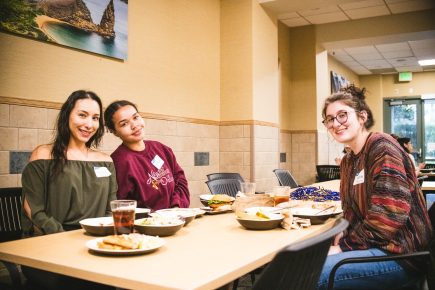
Healing the Wounds of War
U
CLA’s Operation Mend is dedicated to improving the quality of life for wounded service members, veterans and their families. It is the only program in the nation dedicated to plastic and reconstructive surgery, and medical and psychological treatment for post-9/11 military service members. The program has helped more than 850 patients and 450 caregivers at UCLA Health’s top-ranked medical facilities with world-class experts and the latest in medical technology.
Operation Mend warrior Misty Rose Sow was inspired by her family’s military service to enlist in the U.S. Air Force. She served as an Aircraft Guidance and Control Specialist with the 552nd AGS and the 71st Rescue Squadron during Operation Enduring Freedom. By the end of more than three years of service, Misty's mental health was in crisis. She said, “I had so much trauma stored in my body, it felt like the physical body could barely contain the buried emotions, and the body itself was having challenges to function at even 30 percent."

A fellow veteran told her about UCLA’s Health’s Operation Mend program. At UCLA, a holistic approach that blends Eastern and Western medicine resonated with Misty as she began her healing journey. Misty said, "There are stages of healing after trauma, and I used to believe it was surviving, existing and living; I had no idea thriving was even possible until Operation Mend.”
The program was born when Ronald Katz and his late wife, Maddie, both Bruins, were watching a news report about Marine Corporal Aaron Mankin, who was burned on more than 25 percent of his body when his vehicle drove over an improvised explosive device in Iraq. Inspired by his story of resilience, the couple decided they needed to find a way to help.
Operation Mend at UCLA was launched in 2007 through this vision and the couple’s generosity. UCLA brought together stakeholders including Ronald Reagan UCLA Medical Center, Brooke Army Medical Center in Texas and the U.S. Department of Veterans Affairs to provide medical, surgical and psychological treatment to post-9/11 veterans and service members injured in the line of duty. An inventor and entrepreneur, UCLA recently honored Katz with the Fiat Lux Award for his philanthropic giving and volunteer service to the university.

Operation Mend helps to eliminate barriers to treatment and provides services free of charge to qualified patients, as well as providing travel and lodging for warriors and their families. The program receives no financial support from government agencies and there are no co-payments, cost or authorization requirements for care at UCLA. To continue this important work, Operation Mend has received approximately $75 million from more than 5,000 donor contributions.
Corporal Mankin became Operation Mend’s first patient. To provide extra care and support, Todd Katz ʼ83 and his wife, Dana, created the Operation Mend Buddy Family Program. The program matches warriors with local individuals or couples, who offer social support, arrange outings, share meals, and help the warrior and their caregivers through the process. The Katz family not only created the program, but together with their children, they served as the first “buddy family” for Corporal Mankin.
This hands-on opportunity for volunteers to make a meaningful difference in an injured person’s recovery is rewarding for everyone involved. Dana Katz told UCLA, “It's been a great thing to be a part of over all these years. To watch people connect, watch people heal and get back to life."
The Katz family continues to be deeply involved in ensuring Operation Mend achieves its goals. Ron and Maddie’s sons, Todd and Randy Katz, together with their families, established the Ronald A. Katz Center for Collaborative Military Medicine at UCLA in 2013. The program furthers the work of Operation Mend by building partnerships between the University and the U.S military to address the unique challenges of caring for wounded veterans.

UCLA has a longstanding commitment to supporting veterans and service members, and has been U.S. News and World Report’s No. 1 Public University for Veterans seven years in a row. This past November, Chancellor Block along with health care professionals and leaders from UCLA Health joined Operation Mend patients and their families to march in the New York City Veterans Day Parade. In his message to the UCLA community he said, “America’s Veterans reflect an extremely diverse group of backgrounds and identities, but they are bound together by their selfless service to our nation. This Veterans Day, let us honor them and take inspiration from the example they set.”
Operation Mend gives wounded service members a chance to rewrite their future. U.S. Army Staff Sergeant Darius Johnson was severely wounded in Afghanistan, suffering burns to 30 percent of his body, a traumatic brain injury, punctured lung, broken jaw and severe arm injury. He came to Operation Mend through a friend’s referral, and was treated for his physical injuries. He also completed the Intensive Treatment Program for Post-Traumatic Stress. Today, Darius is married and pursuing a master’s degree. He says, "The program gave me the tools to accept that what happened wasn't my fault; it was beyond my control. You can't do this stuff on your own, and you can't do it halfway."
For more info, visit uclahealth.org/programs/operationmend.
Recent Articles
- The Fire Within: Leo Rochman’s Story of Resilience

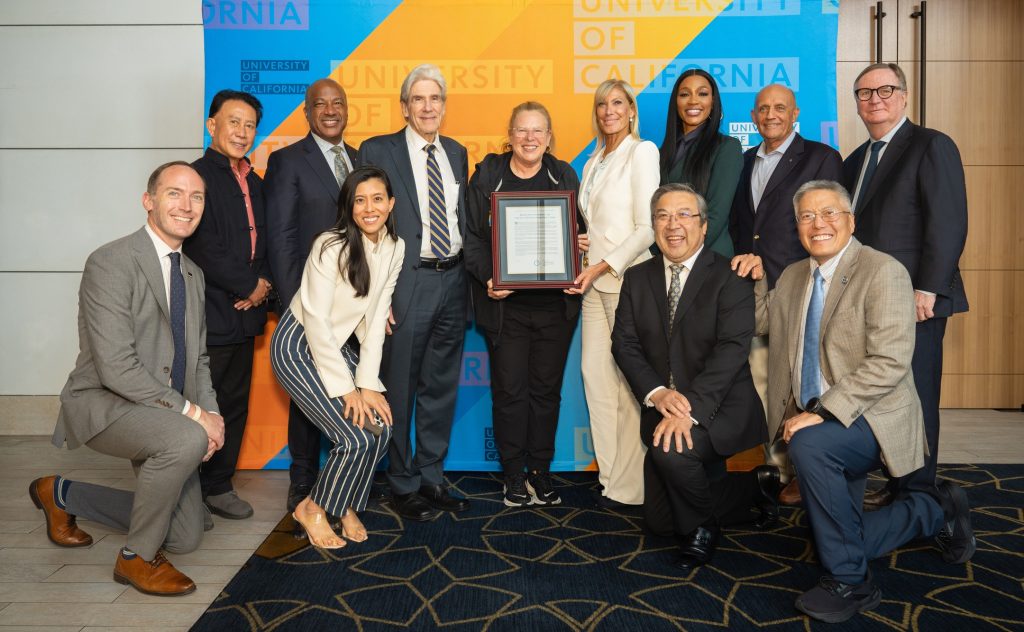
- UC Inspires Honors UCLA Alumni
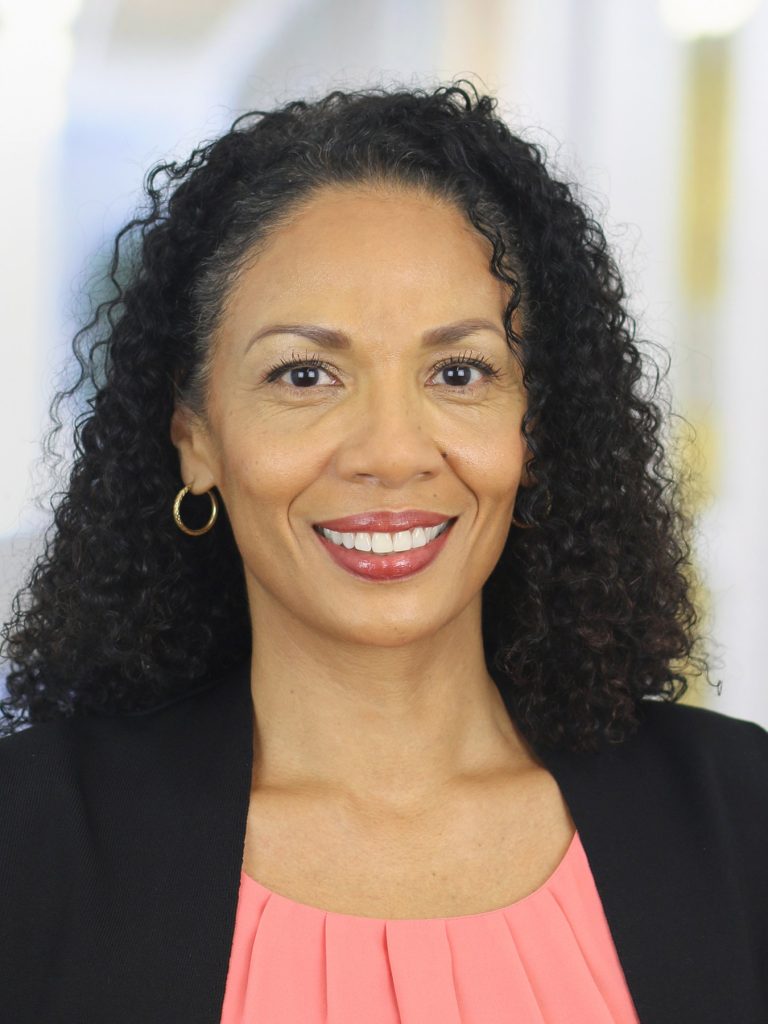
- UCLA AAP Alumni Spotlight - Adrianos Facchetti ’01, J.D.
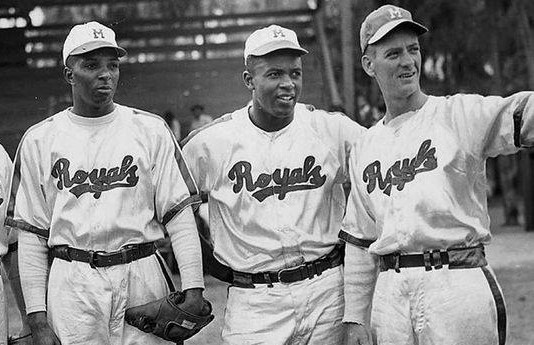
- The Story Behind Jackie Robinson’s 1946 Reintegration of Organized Baseball
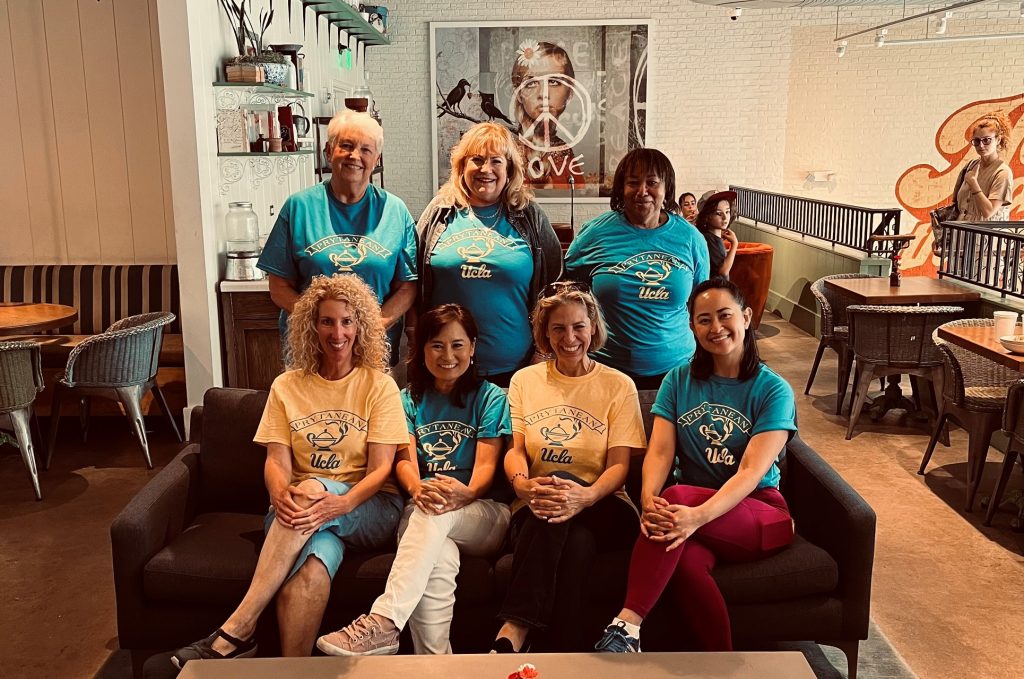
- UCLA Prytanean Celebrates Its Centennial
- Building Community: UCLA Disability Alumni Network Focuses on Belonging and Visibility
Gen Z in the Workforce Part II

Part II: A Mental Health Discovery
If you work with them, you may have noticed that the newest generation entering today’s workforce has some unique characteristics. In our last article about Gen Z in the Workforce, we discussed the business philosophies predominant among 22- to 26-year-olds, citing their application of cancel culture, preference for remote work and desire for work-life balance. On the surface it’s not always evident what factors shaped these philosophies but upon closer examination we hope to convey a better understanding of this group and help ease their transition into the workplace.
In this issue, our focus will center around Gen Z's mental health. According to McKinsey, Gen Zers are reporting higher rates of anxiety, depression and distress than any other age group. One reason was the pandemic, which affected everyone, but it disproportionately impacted Gen Z over older generations. That weighed heavily on their state of mind while exacerbating their overall concerns about finances, safety, securing a job and workplace preparation.
When it comes to their overall mental health, social isolation and loneliness stemming from the pandemic have played a role in their overall well-being. These issues, as reported by Deloitte, are associated with higher anxiety, depression and suicide rates. Physical distance led to the use of social media for meaningful and in-person socialization. As digital natives, they've turned to the internet for companionship and interaction. Working remotely only increased those feelings. Psychiatrists at Evernorth Heath Services say, "Gen Z are the loneliest, least resilient demographic alive today… No other generation feels less connected."
In a recent study of stress, Deloitte reported, "47% of Gen Z state financial insecurity contributes to their anxiety." Their biggest financial problems are student debt, inflation and the high cost of living. Affordable housing remains a challenge, since wages have mostly remained stagnant and homeownership has become unattainable in today’s market.
Gun violence is another contributor to their state of mind. Let us not forget that they are the children of Sandy Hook and mass shootings/school shootings are their reality. The American Psychological Association reports that 75% of Gen Zers said that mass shootings are "a significant source of stress," while according to a new survey from Blue Shield of California and Harris Poll, gun violence ranks as the top concern with 84% saying they experience negative mental health impacts. Some reports even indicate that Gen Z thinks about mass shootings at least once a week.
Another problematic issue affecting their mental health is their lack of confidence in securing a job when they graduate. Although the U.S. Bureau of Labor reports low unemployment, they face significant challenges. RippleMatch, a recruitment automation platform specializing in early career candidates, recently did a study where they reported on average 50% of Gen Zers say they are not confident they will find the proper role, and 57% plan to submit between 100-200 applications this year. In my experience working with our most recent grads, they reported that 95% of the time they never heard back from potential employers. To make matters worse, securing employment can take anywhere from 6-8 months. The discouragement from their job search experience contributes to their anxiety and depression, leading to feelings of helplessness and hopelessness.
Research has also shown that poor mental health makes Gen Zers feel less confident at work. Forbes reports that their pandemic-based college experiences, such as canceled internships and limited in-office work, impacted the rhythm of how soft skills are learned. The soft skills companies value include business etiquette, how to dress, how to introduce yourself, building workplace relationships, networking and behavior in an office environment — and not knowing how to fuel their insecurities and heighten imposter syndrome.
The Society for Human Resource Management found that "Gen Z reported lower personal confidence and self-esteem than all other generations." These young adults have reported feeling misunderstood by their managers and that the expectations employers have of them are unattainable.
With so many of these issues impacting the workplace, there are some steps that employers can take to help ease some of the anxiety so prevalent among this generation. One way is to adopt a compensation model that rewards employees for voluntarily participating in skill-based training. Doing so would help develop the soft skills necessary to succeed in their role. Not only would this serve as an incentive for employees financially, but it would also help employers address skill gaps.
Additionally, managers could receive coaching on nurturing relationships with their direct reports and creating a safe space for learning. They could use their one-on-ones to teach about expectations and deliverables and how to meet them. They could also serve as mentors who actively participate in Gen Z professional development by exposing them to some of their day-to-day activities, like hosting meetings and interacting with leadership.
There is some good news. Gen Zers increasingly express their desire to work in the office, which would undoubtedly expedite their professional development and help boost their confidence. This group is also adamant about caring for themselves and prioritizing mental health; with many resources available to help, they will find their way like every generation before them. Finally, they're eager to learn and will set aside their business philosophies to advance their career. With time and patience, they will eventually catch up; it's up to us to help them.
In Part III of Gen Z in the Workforce, we will celebrate Gen Z and why this generation is so important and worthy of our time and investment.

The Career Engineering series features the expert advice of Amy Rueda, a 25-year veteran of executive search, who has placed CEOs and C-suite executives across multiple industries and functional areas. Her passion for leading diversity initiatives that focus on change management and employee engagement is reflected in her portfolio of accomplishments. Amy studied political science and was born and raised in Los Angeles.
Email your career questions to connectfeedback@alumni.ucla.edu and Amy will try and answer them in next month’s issue of Career Engineering.
Career Engineering Articles
-
Navigating Job Loss and Rebuilding Your Career

The recent wave of federal layoffs has left thousands of professionals, many seasoned, accomplished and deeply valued in their organizations, suddenly without work. The abrupt loss has been more than a career disruption for UCLA alumni and others in similar positions — it has been a shock to the system. Job loss, particularly when it’s…
-
Career Anxiety and How Parents Can Help

As a 25-year veteran executive recruiter, I had the opportunity this summer to teach a career management course to UCLA recent graduates. It opened my eyes to some startling trends. A phenomenon that surprised me was the rise of "snowplow parenting." This is defined as a parenting style that seeks to remove obstacles from a…
-
Gen Z in the Workforce Part III

Part III: Shaping the Future Generation Z has emerged as a formidable force for positive change across various facets of society. They are having a transformative impact on the economy, artificial intelligence (AI), sustainability and social justice. As this generation enters the professional sphere, they bring with them a unique set of values, skills and…
-
Gen Z in the Workforce Part II

Part II: A Mental Health Discovery If you work with them, you may have noticed that the newest generation entering today’s workforce has some unique characteristics. In our last article about Gen Z in the Workforce, we discussed the business philosophies predominant among 22- to 26-year-olds, citing their application of cancel culture, preference for remote…
-
Gen Z in the Workforce Part I

Part I: Understanding Gen Z Philosophies Last summer, I had the privilege to teach a career management course for the Class of 2023, called The Classroom. The Classroom is a six-week program to help our most recent grads from UCLA transition from the classroom to the workforce. The sessions addressed the benefits of: As any…
-
Interview Strategies for Success

Landing a job, particularly your first, is nothing short of intimidating. The most challenging part of the process is the pressure to execute a stellar interview. This undertaking is not limited to those entering the workforce for the first time; it applies to everyone at all levels. Let's face it, interviewing is nerve-racking, especially when…
-
What to Know About Recruiters

Being contacted by a recruiter is one of the best feelings you can experience, personally and professionally. The experience of being acknowledged as a possible candidate often comes with feelings of accomplishment, recognition and pride. But are all calls from recruiters the same? Not necessarily. What varies are the types of recruiters that reach out…
-
What Steps to Take to Land Your Next Job

It's that time of year again when we revisit resolutions we've made for 2023. For those who have stuck with their goals, congratulations! Unfortunately, some of us didn't and feel guilty about breaking our promise. But the good news is that it's never too late to restart. For example, if one of your resolutions was…
-
Where to Work

After two and a half years into this pandemic, the workforce is redefining what constitutes the optimal workplace. For individuals seeking a greater work-life balance, the flexibility to work from home offers several health, financial and productivity benefits. For others, returning to the office offers distinct advantages in relationship-building and access to key resources. As…
-
Why References Matter

When a company begins to evaluate a final candidate for a position, they often do a thorough background check prior to extending an offer. Unfortunately, some candidates overstate their experience and don't realize they are putting their candidacy and reputation at risk. This is why references matter. Because they help validate the candidate’s achievements. But…
-
When a Job Search Feels Wrong

It was hard not to get excited when a recruiter called with a once-in-a-lifetime opportunity. She was looking for a corporate leader to oversee talent management for a global pharmaceutical company. The job description had my name written all over it. My experience and credentials aligned perfectly with the role's requirements. And the best part…
-
Selling Yourself

Congratulations! You've applied for your dream job and made it to the interview stage of the process. However, preparing for the job interview can be stressful and dominate your attention when thinking through every possible scenario that could come up during your face-to-face interaction with the executive recruiter or hiring manager. The key is to…
-
Who Gets Hired and Why?

The ideal executive candidate is the sum of multiple variables. Yes, we expect the résumé to shine and the interview to be stellar, but what is the DNA of the ideal candidate? Integrity is in the genetic code of an honest, sincere and principled leader. It is an ever-present code of conduct that is noble…
Diversity Digest Spotlight - UCLA Chicano Studies Research Center: Research for Community with Veronica Terriquez, M.A. ’04, Ph.D. ’09
Denise Pacheco, M.A. ’04, Ph.D. ’11, Senior Director for UCLA Alumni Diversity Programs & Initiatives connected with professor and Director for the Chicano Studies Research Center at UCLA, Veronica Terriquez, M.A. ’04, Ph.D. ’09 to learn about her work with the Center and its impact on community.
T
he Chicano Studies Research Center (CSRC) emerged in the midst of social protest against profound disparities in educational access for the Mexican-descent population in the United States. Established in 1969 as a result of student organizing, the CSRC formalized a directorship in 1971. Today, that director is alumna Veronica Terriquez, M.A. ’04, Ph.D. ’09.

From the San Gabriel Valley in Los Angeles County, Veronica Terriquez earned her master’s degree and Ph.D. in Sociology from UCLA. She now proudly works toward advancing ethnic and racial justice on campus and in the greater California community as the director of the Chicano Studies Research Center. As a graduate student, Terriquez worked in the school of education’s Institute for Democracy Education and Access conducting quantitative research benefiting the public. The skills Terriquez gained through her graduate studies have served her well in leading a center that conducts research to advance public knowledge and non-partisan civic engagement.
“The CSRC is accountable to the university and broader community. I am a public servant and have been trained in conducting research for societal benefit,” says Terriquez.
She takes great pride in the Center’s commitment to foster multidisciplinary research efforts. One priority of hers is to promote diversity in Science Technology Engineering and Math (STEM).
“There is so much opportunity to make UCLA the number one institution in STEM for Latinx, first-generation and other scholars of color.”
In other work, the CSRC has led collaborative, cross-disciplinary research on young people and their experiences in California. Latinx youth outnumber their peers in other racial and ethnic groups in California making the Center’s sponsored research even more critical for the state.
“The COVID 19 pandemic really laid bare how much young people were suffering in the lowest income communities which are disproportionately Latinx, African American, Southeast Asian, Pacific Islander and American Indian. Our participatory action research addresses educational disparities, health and mental health issues, workforce development and labor rights, as well as opportunities for civic engagement.”
The CSRC's initiatives aim to address social inequalities and promote a healthy multiracial democracy. This work includes the California Freedom Summer (CFS) Participatory-Action Research Project and the Latina Futures, 2050 Lab. Through university-community partnerships, CFS trained 114 college and high school students as Summer 2022 fellows and youth action researchers in 501(c)3 nonprofit organizations to mentor other young leaders, conduct voter education and exploratory research that could inform future grassroots campaigns. In collaboration with the UCLA Latino Policy and Politics Institute, in 2022 the CSRC launched the Latina Futures, 2050 Lab( LFL), which envisions a society in which Latinas have an equal opportunity to lead and everyone thrives. This initiative is driven in part by the fact that Latinas experience a significant wage gap and also remain extremely underrepresented in critical fields that will determine the future of our state, our country and our planet.
“Through our initiatives, we are supporting research, community programing and leadership development opportunities that center equity and inclusion,” said Terriquez.
Learn more about and contribute to the Chicano Studies Research Center and the programs highlighted by Dr. Terriquez in this article by visiting the following websites:
- Chicano Studies Research Center
- California Freedom Summer Action-Research Project
- Donate to the California Freedom Summer
- Read a feature story on the California Freedom Summer Action-Research Project
- Latina Futures, 2050 Lab
- Latina Futures Law & Policy Symposium
- Latina Equal Pay Day study analysis and handout
- Contribute to the CRSC Director’s Fund (select CRSC Director’s Fund from the dropdown menu)
Recent Articles
- The Fire Within: Leo Rochman’s Story of Resilience
- UC Inspires Honors UCLA Alumni
- UCLA AAP Alumni Spotlight - Adrianos Facchetti ’01, J.D.
- The Story Behind Jackie Robinson’s 1946 Reintegration of Organized Baseball
- UCLA Prytanean Celebrates Its Centennial
Timeless Tailgaters
O
ne of America’s greatest pastimes is the college football tailgate party. It’s a tradition like no other. The atmosphere is rife with school spirit, the savory smell of food on the grill fills the air, and laughter and music can be heard all around. The Rose Bowl Fun Zone in Lot H has become the gathering place for real Bruin fans, where friends become family, and families pass down a time-honored tradition to succeeding generations. This is where the die-hards come to live it up.

Set against the backdrop of a perfect Southern California day, the highly-anticipated Homecoming game against the Colorado Buffaloes and Coach Prime (Deion Sanders) brought Bruin Nation out in full force. For brothers Richard ʼ79 and Gary ʼ81 Bacio, this has been a family affair dating back to 1965 when their father first brought them to UCLA games at the Los Angeles Memorial Coliseum, when they were only nine and six years old, respectively. Richard recalled that the tailgates started with their parents and their friends, until he and his brother came of age and kept the tradition going, When the Rose Bowl became the home of UCLA Football in 1982, they were able to secure their prime tailgate location next to the Alumni Band, and they became a staple in this tight-knit community. He said, "To put it in perspective, I have not missed a Bruin home game since October 1978, which was my senior year at UCLA." Regardless of the team’s record in the standings, you can always expect to find the Bacio brothers, along with their wives, friends and children, spending their fall Saturdays at their favorite spot. "What makes tailgating special to me is all the great people I’ve met through the years. Most of those lifelong friends I have tailgated with for over 35 years! In fact, we say that we are all 'family.' What we all share, like a family, is our love of UCLA and, specifically, UCLA Football."

Not too far away, at the other end of the row of blue and gold canopies was a large crowd of mixed-age Bruins at the Kappa Sigma Bruins tailgate. Hosted by the fraternity’s advisor for the L.A. region, Mark Anderson ʼ80, this tent was alive with energy along with food and a beverage offered to Kappa Sigma members and guests free of charge. The tent hosts anywhere from 25 to 75 people each game, which includes Kappa Sigma alumni, current undergrad members, sometimes their parents and occasionally a sorority from UCLA. Anderson has been tailgating for over 43 years. He started with four people, a few lawn chairs, some tables, snacks and coolers, and later added canopies, flagpoles and a barbecue. They originally set up next to the alumni band to support them and enjoy their spirit and music and have stayed next to them the entire time.
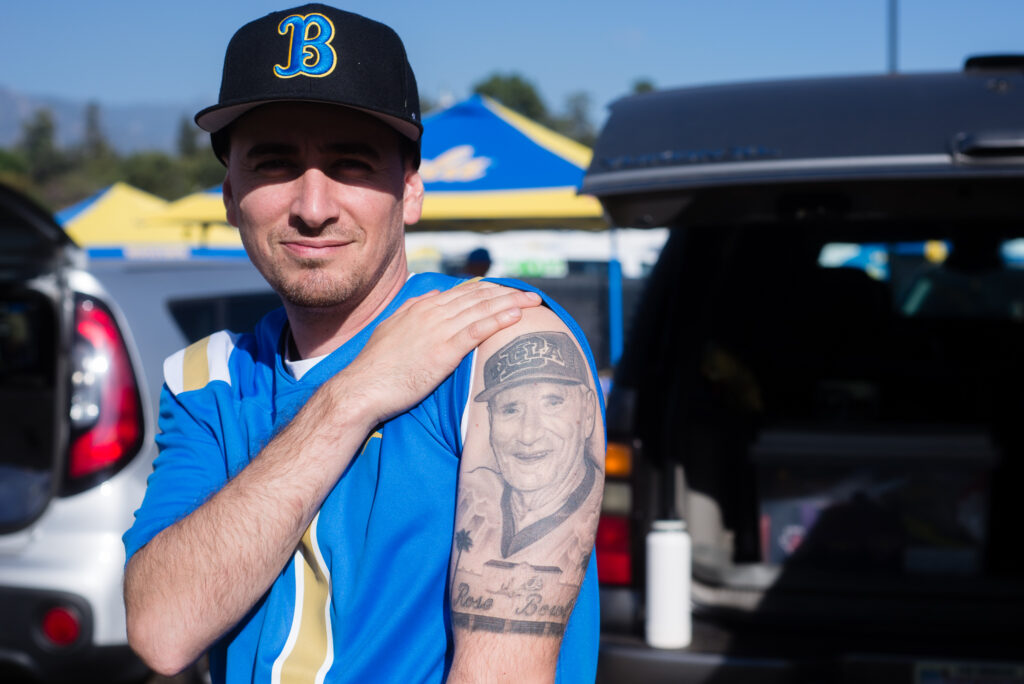
Across the way from the Kappa Sigma tailgate was a row of 10 Bruin tents, each with different decorations, food offerings and cultural makeup. According to Desarie Martinez, host for one of the tents, this was a blended family that’s been coming together to tailgate at the same location for over 32 years. They shared food, played games and laughed out loud over drinks. It began with Oscar McCullar and his wife around 35 years ago, and the trail of tailgate tents only grew. Despite many of them not having graduated from UCLA, their love for the school is undeniable. Oscar’s 36-year-old grandson, Rich McCullar Jr., has been tailgating with the family since he was four and even sports an intricate tattoo of his grandfather, Oscar, wearing a Rose Bowl shirt on his left arm. His father Rick McCullar summed up their dedication, “It’s all about love and family. That’s why we come here year after year no matter how the Bruins are doing.”

Situated next to the Alumni Band, there’s a group of Bruins who specialize in the food served at their tailgates. On this day, they were frying up a pair of steaks on the grill paired with some good wine from Strasburg, France. Other days, depending upon the time of the game, they’ve served paella, gourmet pizza and tamales for breakfast. Ed Alvarez ʼ70, Anna Magini ʼ74, M.N. ʼ77, Gary Phillips, Cert. ʼ91, and his wife Nancy, have been tailgating since 1988, a tradition that began with Danny Gant who was with the Santa Clarita Bruins. They’ve traveled to away games, attended tailgates at other schools, and they’re convinced there’s no better place than the party at the Rose Bowl. Gary said, “You can’t beat the weather, the gorgeous mountains in the background, the grass under your feet and the band playing next to you. What’s not to love?”
The love for UCLA is apparent at every Rose Bowl tailgate. Generations of Bruins, whether by degree or fandom, showcase the rich diversity of the Bruin community, bringing with them the spirit of friendship and sharing of food and drink and good times. With music blaring, drinks flowing, flat screens showing the day’s football highlights, and tailgate games like foosball, cornhole and beer pong underway, these parties are a Bruin tradition like no other.


Recent Articles
- The Fire Within: Leo Rochman’s Story of Resilience
- UC Inspires Honors UCLA Alumni
- UCLA AAP Alumni Spotlight - Adrianos Facchetti ’01, J.D.
- The Story Behind Jackie Robinson’s 1946 Reintegration of Organized Baseball
- UCLA Prytanean Celebrates Its Centennial
- Building Community: UCLA Disability Alumni Network Focuses on Belonging and Visibility
Bruin Creative Writing Stories

L
ast September, we announced a creative writing assignment with a simple premise: In less than 500 words, tell us a story that begins with "I found a hidden door in Kerckhoff and it took me..." Several Bruin creatives had fun with it and submitted these stories that capture the imagination. Can you guess which was generated by A.I.?
Shoshi Buge, M.A. ʼ02
I found a hidden door in Kerckhoff and it took me...deep below campus to a dream world of memories. But I didn't know that when I asked a passing student for directions to the nearest bathroom. “Around the corner and down the hall.” Following her suggestion, I turned and saw a simple wooden door glimmering in the shadows of a dark hall. I walked forward, grabbing the handle. The door creaked but didn’t move. I tried again, putting my weight into it. Last thing I remember was stumbling forward and down, down, down.
I landed in a concrete tunnel, damp and chill. 1960s protest graffiti was scrawled across the walls and exposed pipes covered in stickers for punk bands ran along the ceiling. “This must be one of the tunnels that runs under campus.” I’d heard the stories, but I thought they’d all been sealed shut. As my eyes adjusted to the gloom, I made out a wooden bookshelf up against the far wall. I gasped as I realized that the shelves stretched down the tunnel and as far as I could see, filled with books of all shapes and sizes.
Books are made to be opened so I grabbed one at random, a slim book with a black cloth cover. I opened it and was startled by the sound of a math lecture. The next book held nothing but the wind whispering through the trees and a scent of ocean breeze, interrupted suddenly by the sudden roar of something large and angry. I slammed it shut. A blue and gold book held the voice of Coach Wooden, “Never allow anyone else to define your success.” A basketball bounced in the background.
I kept going, opening books to sounds of a conversation, a protest or a study session. I wandered from book to book, overwhelmed. Some books made me angry, some made me cry. It dawned on me slowly, “Memories. This is where they keep the memories.” The sounds of water dripping in the tunnel turned into tapping, it got louder and closer. I blinked - opening my eyes to light streaming through my dorm room windows.
The tapping turned to knocking. “Hey. Are you in there?”
I rubbed the sleep from my eyes, “I’ll be right there.” Shaking off the groggy feeling, I reassured myself it was all just a very vivid dream. As I started getting ready for the day I noticed a small green book perched on my desk that hadn’t been there before. I cracked it open and read the first line, “I found a hidden door in Kerckhoff.”
Aletta Cooke ʼ19
I found a hidden door in Kerckhoff, and it led me to an abandoned room. The shelves were haphazardly lined with news clippings, memorabilia and awards. A spinning, smoke-colored orb catches my eye. Its mystical aura obviously out of place, I reach out to touch it and the walls of the room ripple like quicksand, folding in on themselves.
The floor disappears underneath me and I plummet into a void, falling so fast that I can only scream, until... SMACK!
The ground of a green tennis court meets me, and the roar of a crowd fills my ears. Scrambling to my feet, I feel the cool grip of a racket being thrust into my hand. A lean, athletic man exuding distinct grace, smiles down at me. "You're... Arthur Ashe?" I gasp.
He chuckles. "Last time I checked, I was. You ready to return the serve?"
“Me? Uh, I’m not a tennis player,” I stammer.
He grins, already getting into position. Feeling inspired, I toss the ball up. Just as I bring the racket down, the court's sunlight dims theatrically.
A single spotlight flares to life, illuminating a figure with fiery red hair, poised on stage. She effortlessly delivers one comedic line after another, receiving escalating laughter and applause. "You there! Fancy being part of the fun?" It’s the unmistakably gifted Carol Burnett, and I’ve just been invited to be a part of her act. Nervous, I stand on shaky legs, encouraged by the claps and cheers of the crowd, and slowly walk forward.
“Have a seat, kid,” she says, gesturing to a chair. As I sit, my chair shakes violently, hurtling me through a green light as the crowd becomes pixelated, one by one.
A team clusters around an early computer, green lights casting an eerie glow. Amidst the soft hum and key taps, a commanding voice stands out. When he turns, I recognize it’s Leonard Kleinrock. A nudge from behind. "We're sending the message," comes an excited whisper. Kleinrock locks eyes with me, smiles, and nods. "Press send." Trembling, I comply. Cheers erupt. Overwhelmed, I sink into the chair, realizing I've just aided in the birth of the internet. The computer's bright light dissolves, plunging me back into the abandoned room. My heart hammers with the reality that a time portal exists hidden in Kerckhoff! A resounding crack breaks the silence, and an ancient leather-bound book launches out of thin air, landing at my feet with a thud. Its title gleams in worn gold leaf: “The Ghosts of Royce Hall.” Coldness grips the room, and as I lunge for the book, a ghostly hand snatches it away, hissing, “You tread where only ghosts should dwell!” Sinister shadows yank me backwards with unearthly strength, forcing me out of the room. The door slams shut with finality, its handle vanishing before my eyes. As modern-day Kerckhoff Hall reappears before me once more, I know that this is only the beginning.
Dulcinea del Toboso, M.A. ʼ98
I found a hidden door in Kerckhoff. Before I opened it, I was a naive, nerdy girl who wandered the campus in awe. After going through that door, I became a married woman, to my high school sweetheart. Years later, none of the sweet heart remained. How could a UCLA graduate end up in a relationship like this one? Toxic and abusive. Well, it happened gradually.
It was a subtle journey, masked in hopes and dreams. He went to war, was diagnosed with PTSD. He was often angry. His frustration made sense. He was so smart and the world was a mess. Incompetence, ignorance and bureaucracy exasperated him. He went out less, isolated himself more. I felt my duty was to be a supportive, understanding wife. Always and forever, right? In sickness and in health, I promised. Years went by then somehow, I became the trigger. How could I feed that to our children?! Black skulls drawn with sharpies appeared on our milk carton. Strawberries would make our children gay, he claimed. Why would we watch those dumb shows?! No more Disney or Sponge Bob. We were forced to watch obscure documentaries that talked of conspiracy theories designed to brainwash us. He was our self-proclaimed savior.
How could I be so stupid as to believe in religion?! All priests were pedophiles! Why did I call that number so many times?! Was I having an affair?! Why did I question his financial decisions regarding our money?! Didn’t I trust him?! Why was I emasculating him?! Belligerent woman, he called me. It was my fault he was unfaithful. It was my fault his career was over. It was my fault our daughter wore crop tops and our son wasn’t an alpha male. How ungrateful I was! To not appreciate all that he did for us?! Broken glass, dirty words, splattered vitriol, shattered dreams. There was no physical violence, it couldn’t be that bad I told myself. I was loyal and idealistic. Why not run toward the door? Because it happened gradually. Because it made my head spin. Because it paralyzed me. I was in a house of mirrors, there were doors everywhere, but they seemed out of reach.
People judged me for staying. But they did not live my life. He’s not the only one to call me stupid. I saw it in everyone’s eyes–their frustration, their pity. He’s just the only one to say it out loud. I went through the Domestic Abuse Door. Never would I have expected to find that door in Kerckhoff. Education was supposed to protect me. Don’t be fooled! You can run into a door like that anywhere! It took me years, but I was able to find my way out. Before I went through the door, and unbeknownst to me, I had acquired what it took to survive what awaited me. Education was what grounded me, helped me develop a strategy and an exit plan. Education was the key that eventually got me out.
Darlene Gaston, MBA ʼ82
I found a hidden door in Kerckhoff and it took me to a long dark corridor that stretched 25 feet until it met a down staircase. A faraway dim light below illuminated the outlines of the stairs. Muffled voices floated up from the light. What is this place? Why had I never seen it before?
Is that laughter I hear? First a chuckle, then titters and now belly laughs. Should I see what’s going on? There was only one answer to that question. I crept closer, clutching the side of the wall, waiting for my eyes to adjust to the dim pen light while I tiptoed in that direction.
“What topic should we select for our public argument this year?” said a voice.
“I don’t know. Why can’t we use the same topic, “Which school is better?” said another.
“That’s the same discussion that we always use.”
“I know. Because it works. Okay, what about which school has the better NIL, Name, Image and Likeness program?”
The first voice sounded like Joe Bruin, but who was the second voice? I inched closer and I was close enough now to see a large room bathed in light. At the door jam, I edged my head around the corner. One eye had an obstructed view of the room, but I could see most of the room’s occupants.
It was arranged like a banquet hall with food laden tables reminiscent of Thanksgiving. Several people sat at the tables. I saw Joe Bruin, his sister Josephine, Josie and a couple of toddler Bruins chasing each other around the room. No one noticed me.
“Is that… no, it can’t be. It is. That’s Tommy Trojan. What’s he doing here?
“Uncle Joe, can we ride Traveler?” said the toddler girl Bruin.”
“Ask your dad,” Joe Bruin bristled.
“Dad, can we?”
Who is their dad, I thought? I looked around the room. Why was everyone looking at Tommy Trojan? Holy Cow! Was he their father? Wait, who was their mother?
“Kids, remember what your dad and I discussed with you?” said Josie Bruin. “You’re too young for Traveler now.”
My head is going to explode. Tommy Trojan and Josie Bruin are married, with toddler Bruins? How does no one know about this?
“Alright, let’s pack up everyone,” said Joe Bruin.
“Traveler and I have on our Bruin costume disguises, so we’ll leave first. Next month, let’s meet at Kerckhoff Hall at USC. Good night,” said Tommy Trojan. “Let’s go kids.”
“I want to ride Traveler.”
Charlene Gupta, J.D. ʼ96
I found a hidden door in Kerckhoff, and it took me on an unexpected journey through time and space. It all started on a drizzly afternoon at UCLA, when I was exploring the labyrinthine corridors of Kerckhoff Hall, that venerable, ivy-covered building on campus known for its mysterious passageways and hidden secrets.
I had always been a curious soul, so when I stumbled upon a peculiar, ornate door tucked away in a dimly lit corner of the basement, I couldn't resist the urge to turn the ancient brass knob. To my amazement, it creaked open, revealing a swirling vortex of colors that seemed to defy the laws of physics. My heart raced, and with an exhilarating mix of trepidation and excitement, I stepped through.
The instant I crossed the threshold, I was transported to a bustling 1920s jazz club, the air thick with the sultry sounds of a saxophone. I was dressed in a dapper pinstripe suit and flapper dancers twirled around me, their beaded dresses shimmering. The club's name, "The Time Slip Lounge," was emblazoned in neon lights. People sipped Prohibition-era cocktails, and I found myself chatting with a charismatic, fedora-wearing bartender who spoke in witty, rapid-fire banter.
As the night progressed, I learned that this was no ordinary speakeasy; it was a place where time travelers from all eras convened to share stories of their journeys through history. I listened in awe as a Victorian explorer recounted his encounters with dinosaurs and pirates, while a space traveler from the distant future described the wonders of distant galaxies.
Eventually, I met a mysterious woman named Isabella, who claimed to be from a time yet to come. She had an air of enigmatic knowledge about her and possessed a small device that allowed her to navigate through time. With her guidance, I embarked on a series of adventures that took us from ancient Egypt to the moon landing, all the while learning the intricacies of time travel.
However, our escapades were not without peril. We narrowly escaped being trapped in the French Revolution, and during a detour to a post-apocalyptic future, we encountered a fierce robot uprising. Each adventure was a thrill, an exploration of different times and cultures.
As my journeys through time and space continued, I grew more attached to Isabella, and the connection between us deepened. We witnessed historical events and significant moments together, but the price of time travel became evident. Paradoxes threatened the fabric of reality, and the responsibility of preserving the timeline weighed heavily on our shoulders.
One fateful day, as we ventured to the distant past, we encountered a paradox so monumental that it threatened to unravel all of history. To set things right, Isabella had to make an unimaginable sacrifice, erasing herself from existence to mend the rift. With tears in her eyes, she whispered a heartfelt goodbye and vanished before my eyes.
I returned through the hidden door in Kerckhoff, alone and profoundly changed by my extraordinary journey. The world I had known would never be the same, and my heart was filled with a mixture of gratitude and grief.
I often visited that enigmatic door, but it remained sealed, an eternal testament to the adventures that awaited me on the other side. My life had been transformed by the hidden door in Kerckhoff, an experience that showed me the boundless wonders of time and space, and the profound impact of human connection.
Hon Hoang ʼ14
I found a hidden door in Kerckhoff and as I passed through the corridor it took me a moment to realize there was a man writing on the chalkboard. He appeared to be a young professor or perhaps a grad student. I couldn’t tell, but from his outfit, demeanor and the age of his face or at least what I can see with his back turned, he wasn’t an undergrad like me. “Please have a seat anywhere,” he said without missing a beat, his chalk continued rhythmically on the board.
“I’m sorry, do you have a class in a bit? I was just looking for a quiet place to study,” I said sheepishly as to minimize my intrusion.
“Please have a seat anywhere,” he said again as if my words had evaporated throughout the lecture hall before it reached his ears. I found a spot in one of the hundreds of available seats. As I began unpacking, I realized that I was in a lecture hall within Kerckhoff. I didn’t realize the building even had a lecture hall let alone one of this scale. I tried to retrace my steps as to which hallway and staircase brought me here, but I couldn’t really recall. It’s as if in a daze or the distractions of my everyday life drifted me here.
I look up to ask the chalk-dusted man, but before a word can leave my lips, “Why are you here?” he asked, clearly vexed by my presence.
“If you want an honest answer, I don’t know.” I said.
“That’s not really an answer, let alone an honest one now is it?” he responded without missing a stroke of smooth scratching. I was silent for a time as I realized he had taken up most of the board with his scribbles. I couldn’t make out what he had written, it was what might’ve been a strange mix of chemical formulas and a foreign language for all I knew. I was never quite good at anything academic and I was surprised that I ever found myself here, at a place like this with other people who seem to be better than the person I am.
The man cleared his throat to help gather my scattered attention, “How did you get here?”
Unsure of how to answer without repeating myself, I simply said “I don’t know.”
This, this, repetition is what made him break his chalky cadence. He calmly set his chalk down, dusted off his hands, straightened his two piece attire, adjusted his rolled up sleeves, and calmly started walking over to me. He kept the same pace as he walked up about 50 steps to the row I was sitting in, keeping the same steady and stern pace as he kept his eyes locked on my position for the entire duration. With each step echoing through the empty lecture hall, he eventually reached my row and as he towered over me, he asked, “What do you know?”
Anthony Izaguirre ʼ73
I found a hidden door in Kerckhoff, and it took me on a journey beyond the boundaries of reality. My two-decade tenure as a professor at the University of California, Los Angeles had been marked by routine, predictability and the monotony of academic life. However, on this particular day, reality itself seemed to warp and shift.
Kerckhoff Hall had always been an enigmatic place, filled with the echoes of countless lectures and discussions. Yet, it was a sunlit afternoon, and as I wandered its timeless corridors, something peculiar tugged at my curiosity. A dimly lit passageway, overlooked for years, beckoned me with a peculiar aura. The light filtering through the aged windows painted strange patterns on the floor, and a subtle, otherworldly hum filled the air.
At the end of the corridor, I encountered an ornate wooden panel that appeared strangely out of place. Its intricate carvings hinted at a forgotten history. With a sense of déjà vu, I gave the panel a gentle push, and it swung open, revealing a passage that defied the laws of space and time.
I crossed the threshold into a chamber that existed at the intersection of dream and reality. The room was frozen in a surreal moment, with dusty relics from a past era scattered haphazardly. Old, forgotten books lined the shelves, pages of forgotten knowledge fluttering like the wings of phantom birds. Antique furniture whispered secrets of long-lost conversations, and a chalkboard bore equations and musings that danced between the rational and the inexplicable.
As I ventured further into this uncanny realm, I began to feel an inexplicable connection to the echoes of past scholars. Conversations of yesteryears lingered in the air, as if time had folded upon itself. The very essence of Kerckhoff Hall had transcended the boundaries of perception.
The surreal discovery of this hidden room was a portal to an alternate dimension, where the boundaries between past and present blurred. My journey into the hidden door became an exploration of the ineffable mysteries of existence, reminding me that even within the confines of the known world, there remained a vast universe of enigma waiting to be uncovered.
Delia Mizrahi, First Year Student
I found a hidden door in Kerckhoff and it took me… to Boelter Hall. There's a lot that I don’t understand about this passage, and a lot that I don’t know if I ever will understand. But let me tell you how I came across this odd passageway.
I started at UCLA two weeks ago; living on The Hill, taking classes at South Campus, and going to In-N-Out in Westwood. I grew up not far from here, so I worried that I wouldn’t feel the college life feeling, but I definitely do. It is hitting in every way possible. Most notably, my sleep schedule. I used to get nine hours every night, but now I find myself with less than a handful of hours. It’s been a rough transition, and one that has made me realize that I am in need of a supplement; coffee. I was never a coffee drinker, but now, it carries my day along, and a day without it is a hard one.
However, I didn’t realize this until too late. The first time I walked into Kerchoff my feet were dragging, I had large eye bags, and no clue where to go. I spent 15 minutes wandering the halls until I came across an ominous unnamed wooden door on the second floor. There was nowhere else to go. I pulled on the handle and it opened easily to a dimly lit hallway. I stepped forward. The door closed slowly behind me. I kept walking. After 20 steps I reached a door at the end of the hall. I turned the cold knob and stepped out into a blinding hallway. Where could I be? I walked out and began searching for signs. It was quiet here, no one in sight. There was a sign at the end of the hall that read “Boelter Hall Exit.” How was that possible?
For the next week I would enter a door at Kerckhoff and exit another at Boelter. I wanted to understand it. To explain it. I’d enter the door facing south, but I’d exit facing north. I confirmed that the hallway was straight by running my hands along the walls in case there was any slight curve. I tried the passage at different hours of the day, but all of them led to the first floor. I tried staying in the hallway for hours, waiting for the magic to run out, but it never did.
After weeks of exploring, I grew tired, the coffee was no longer a strong enough supplement. I was falling behind in my classes, and anyways, I ran out of new methods to try. So instead, I used the door to my favor. I would walk Kerckhoff each morning, enter the door, and cut six minutes off my walk. And after my whole first year, all that I could say was that maybe someone gifted this little magic trick to the STEM majors that need some help getting to their 8 A.M.’s.
Deborah Rapaport Ishida, M.D. ʼ69
I found a hidden door in Kerckhoff, and it took me to a platform that was elevated above the ground. All the noise I had experienced inside the hall completely vanished, and the silence was deafening. I decided that I didn’t want to be here, but when I looked at the door, there was no handle to let me back inside. I beat furiously against the door, and screamed at the top of my lungs, but nobody came to my assistance. I was petrified, sweat poured down my face, and under my armpits. Terror engulfed my whole being.
Suddenly a whooshing sound startled me, and a strong wind blew at my hair and clothes. I looked up, and saw a shiny saucer like entity bearing down onto the platform. Myriad lights flashed multiple colors, red, blue and yellow. They were not operating in a random manner, but seemed coordinated, like some kind of speech, or music rhythm.
I tried to run, to get away, but my feet were fixed to the platform. My heart beat out of my chest, I was petrified, my whole life flashed before my eyes.
A door opened in the unidentified flying object, and I felt a force pulling me towards it. I tried to resist, but it was of no help.
My feet, previously glued to the ground, lifted off of the platform, and I was sucked into the vessel, kicking and screaming. The door closed; I was doomed.
I heard a sound like a fierce tornado, and then we were airborne in a split second.
Where was I going? Would I be harmed? Why me?
All those questions were to be answered very soon.
Nick Todd ʼ85, M.A. ʼ87
I found a hidden door in Kerckhoff and it took me a few moments to even recognize it as such, because it was disguised as part of a mural in the storage room behind the Baskin Robbins counter. This door, typically obscured by shelves, had finally become accessible as the space underwent reconfiguration.
My connection to this corner of Kerckhoff was twofold: as an ice cream enthusiast and later as an employee, striving to fund my way through college during the academic year of 1984-85, when tuition had skyrocketed to an unthinkable $455 per quarter. This enigmatic door seemed incongruous – too small for a closet, yet too insignificant to lead anywhere substantial.
Upon discovery, I attempted to open it, but a sturdy padlock thwarted my curiosity. An attached brass plate bore the inscription, "Do not open until 1970. For access, contact Chair, Department of History."
Determined to unearth the door's secrets, I embarked on an investigative journey to Bunche Hall, where I hoped to uncover why the history department was linked to a previously hidden artifact in Kerckhoff. Alas, the trail went cold, and my pursuit necessitated further detective work. The accommodating staff offered a list of history department chairs dating back to the 1950s, alongside their contact information.
A fortuitous call connected me with Dr. Bruce Pederson, a history professor who had chaired the department from 1960 to 1962. His revelation was astonishing – the door and its contents were components of an experiment initiated in 1960. Pederson had tasked his students with predicting the state of the world in 1970 for a time capsule he intended to bury at UCLA. The second part of his experiment was determining how long it would take for someone to attempt to unlock the door and contact him for the combination. He had begun to lose hope that this would occur in his lifetime.
Since he had never reviewed the predictions submitted by his students, his excitement was palpable. In his late seventies and ailing, he entrusted me with the task of opening the door and retrieving the time capsule's contents.
The next day, armed with the combination (32-39-42), I successfully unlocked the door. Inside, I found a tall metal box filled with hundreds of sheets of paper. After a restless night, I brought this trove to Pederson's home, and we eagerly delved into the predictions made by Bruins from a bygone era.
The forecasts were a mix of fun and foreboding. Mickey Mantle, who would have been 38 during the 1970 baseball season, was, by one baseball fan, projected to be closing in on Babe Ruth’s cherished record of 714 career homeruns (Mantle retired after the 1968 season with 536). A few thought Elvis Presley, newly released from the military, would reestablish his dominance of the record charts. Rock and roll would still be popular, but not as popular as Frank Sinatra and Bobby Darin, one student opined.
Some students anticipated a world ravaged by World War III, while many expected flying cars and videophones by 1970.
As we explored these fascinating insights, Pederson instructed me to retrieve the last sheet, which bore his name and a visionary proclamation: "I, Bruce Pederson, predict that this time capsule of predictions will eventually be found, that the world will have moved beyond the differences threatening our very existence in 1960, that as we learn more about ourselves, we will become more tolerant, and that the next century will usher in an era free from war, poverty and disease – a new age of enlightenment."
Submitted for your consideration, to quote “The Twilight Zone,” with no further comment necessary.
CLICK TO LEARN WHICH STORY WAS A.I. GENERATED
Charlene Gupta aka Chat GPT
Anthony Izaguirre aka A.I.
Recent Articles
- The Fire Within: Leo Rochman’s Story of Resilience
- UC Inspires Honors UCLA Alumni
- UCLA AAP Alumni Spotlight - Adrianos Facchetti ’01, J.D.
- The Story Behind Jackie Robinson’s 1946 Reintegration of Organized Baseball
- UCLA Prytanean Celebrates Its Centennial
- Building Community: UCLA Disability Alumni Network Focuses on Belonging and Visibility
Bruins for Life: A Gathering of Bruin Football Alumni From All Eras
A
certain camaraderie is forged through competition.
Through victories, defeats, home games, road games and practices, memories among coaches and teammates are formed on and off the playing field each season, and last long after the stadium lights shut off. Given UCLA’s storied history of success in athletics, it comes as no surprise that Bruins from each of its 25 varsity programs have built and maintained friendships over the years.
Last September, generations of coaches and players from UCLA’s football program had a chance to reunite and reinforce their camaraderie at an inaugural reunion hosted by the Bruin Varsity Club aptly titled Bruins for Life: A Gathering of Bruin Football Alumni From All Eras.

“Kenny Easley and his desire to reunite UCLA football players, not just his teammates, but all players, was the impetus for this event,” said Bruins for Life Committee event organizer, two-time Emmy Award-winning television producer, and former Bruin standout linebacker Raymond Bell ʼ78. “This reunion was about Bruins, friendship, sweat and grit from players of all eras. We’re brothers, and when Kenny expressed the desire for us to put this event on, we went for it.”
Kenny Easley was regarded as one of the nation's best defenders, playing free safety for the Bruins from 1977 to 1980. His No. 5 jersey is one of nine Bruin retired numbers. Following a prolific career in the NFL, Easley was the sixth Bruin to be inducted into the Pro Football Hall of Fame in 2017. In 1991, he was inducted into the UCLA Athletics Hall of Fame and the National Football Foundation Hall of Fame (College Hall of Fame).
After nearly three months of planning thanks largely to a committee led by Easley, Bell, John Sciarra ʼ76, Frank Stephens ʼ84 and others, with the assistance of Bruin Varsity Club Director, Sam Glick, UCLA football players of all generations made their way back to Westwood and Pasadena for a time of reunion and reflection.
The two-day event began the morning of Friday, Sept. 15, with UCLA football alumni guests attending that day’s football practice at the Wasserman Football Center. Here, football alumni had the opportunity to introduce themselves to the team and connect with the current generation of Bruin athletes.

That evening, 200 attendees enjoyed a cocktail reception and dinner banquet inside the Centennial Ballroom at the UCLA Luskin Conference Center. It featured a UCLA Football highlight reel and guest speakers such as former Bruin Head Coach Dick Vermeil and Nicole Donahue ianni, daughter of the late Terry Donohue ʼ67, M.S. ʼ77, UCLA’s winningest football coach.
“A reunion like this means that the time invested in these young people was worth it. They’ve developed into great, mature people today,” said Coach Vermeil. “We had the turnout that we did because our players care about each other and care about the program.”
From 1974 to 1975, Vermeil compiled an overall record of 15-5-3 and led the Bruins to their first Pac-8 Championship in a decade. His time in Westwood was highlighted by UCLA’s 1976 Rose Bowl Game appearance where the Bruins upset No. 1-ranked Ohio State 23-10, a universally held crowd-favorite memory for many in attendance at the reunion.
Echoing Vermeil’s sentiment, former UCLA running back Jonathan Franklin ʼ12 commented, “It’s great to be back together. We’re a brotherhood, and if we can get a chance to be together and support the program, especially with all it's done for us, we need to take it.”
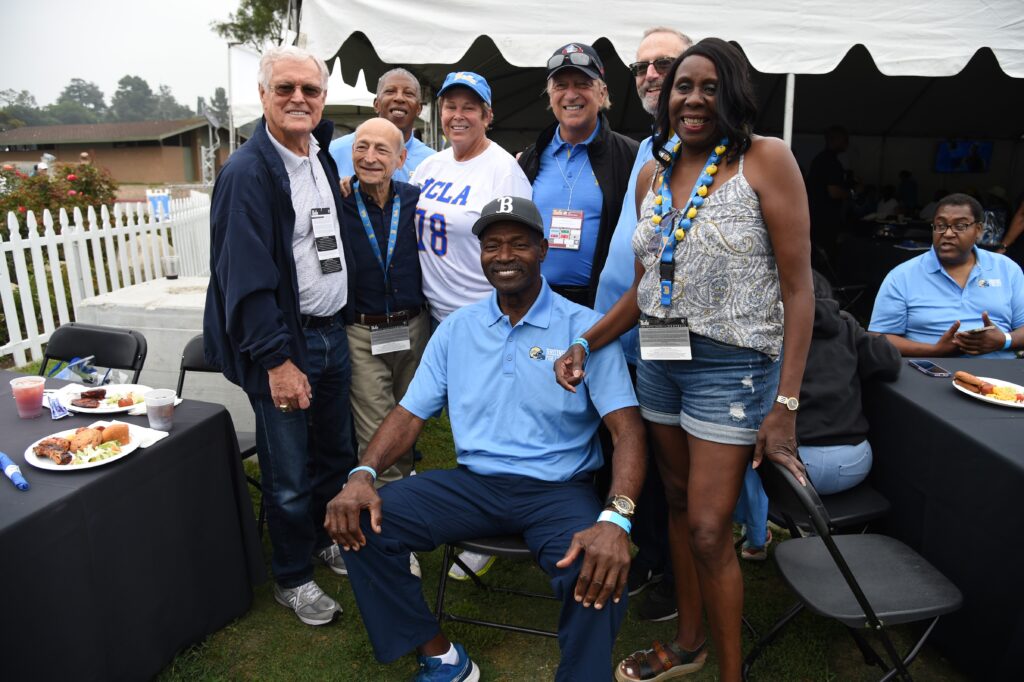
Franklin played for the Bruins for four years, setting a school record for career rushing yards (4,403) along the way. Since his time in Westwood, Franklin had a brief professional playing career with the Green Bay Packers and now works for the Los Angeles Rams in community and external relations.
The next day, UCLA football alumni were invited to watch the UCLA vs. North Carolina Central football game at the Rose Bowl. Attendees toured the newly-opened California High School Hall of Fame and the 1922 Locker Room at the stadium, attended the Wooden Athletic Fund’s Then Now Forever Pregame Tailgate and sat with other participants to watch the Bruins cruise to a 59-7 victory over the Eagles. Notably, UCLA football alumni were recognized on the field at the end of the first quarter and were even personally greeted by Coach Chip Kelly and members of the coaching staff.
“Having the opportunity sit on the committee and see this weekend come together is really rewarding,” said Frank Stephens. “This was a big opportunity to come back and share what everyone has been doing. It’s like reuniting with long-lost brothers. We were on the field battling with each other and to come back has been special.”
In only three seasons with the Bruins, Stephens' tenacious play has still ranked him 10th overall in career tackles (313), 12th in career sacks (19) and 20th in career tackles for a loss (31). Since his time in Westwood, he’s enjoyed playing football professionally, working for UCLA Athletics in both administrative and coaching positions for over 16 years, coaching at the high school and collegiate levels, and other opportunities within restaurant management.

The event’s youngest-attending alumnus, Paco Perez ’19, saw the weekend as a great opportunity to connect with Bruin greats from all generations and see what his future holds after football.
“I was inspired to attend to get inside the heads of UCLA legends and see what life could look like ahead of me. I’ve already been able to take a lot of my lessons learned at UCLA and use them in my career.” Since graduating, Perez has enjoyed careers in both HVAC and aerospace.
Looking ahead, organizers look to continue this reunion, build support for the football program through its alumni and strengthen their gridiron-based camaraderie for years to come.
“To have a Bruins for Life event encompassing all eras is pretty magnificent,” said Bruin quarterback great John Sciarra ʼ76. “I think the next event that we do, we’ll have over 400 participants, and we’ll probably be back within two years. To be able to catch up with teammates and meet players from all generations is a remarkable opportunity.”
John Sciarra was an All-America quarterback and an award-winning scholar while at UCLA from 1972 to 1975. After graduation, he played two years for the British Columbia team in the CFL, then six years in the NFL (1978-1983) for the Philadelphia Eagles, leading the league in punt returns in 1979. Sciarra was inducted into the UCLA Athletics Hall of Fame in 1994. Following his football career, he enjoyed a career in business and retirement services.
Raymond Bell is optimistic for future reunions. “We’re thankful that UCLA came on board to help get this event off the ground. Everyone came forward to get this thing going and move it forward, and we look forward to seeing it grow in the coming years.”
While it is yet to be determined when the next reunion will take place, the alumni of UCLA’s football program will continue to hold on to the memories and friendships made both on and on the field. After all, they are Bruins for life.
***
All UCLA football alumni are welcome to attend practice at the Wasserman Football Center and receive two (2) complimentary tickets to every UCLA Football game at the Rose Bowl. Tickets can be claimed at Will Call outside Gate B at the Rose Bowl. Visit the Bruin Varsity Club for more information.
Recent Articles
- The Fire Within: Leo Rochman’s Story of Resilience
- UC Inspires Honors UCLA Alumni
- UCLA AAP Alumni Spotlight - Adrianos Facchetti ’01, J.D.
- The Story Behind Jackie Robinson’s 1946 Reintegration of Organized Baseball
- UCLA Prytanean Celebrates Its Centennial
- Building Community: UCLA Disability Alumni Network Focuses on Belonging and Visibility
Pilipino Bruins
P
ilipino Bruins have played an essential role in cultivating a vibrant and diverse UCLA community since the University's earliest days. Students, staff and faculty have championed, educated and celebrated the Pilipino experience to create a more inclusive and welcoming environment.
(Note: Pilipino and Filipino are used interchangeably in this article and mean the same thing. Philippine locals use Pilipino because there is no phonetic equivalent to the letter "F" in the Philippine Islands’ indigenous languages.)
Trailblazers
In 1898, America claimed the Philippines as a colony following the Spanish American War. Pilipinos became American nationals who could migrate freely, but were excluded from citizenship. Students who excelled academically were encouraged to become pensionados and study at U.S. universities with the understanding they would return to the Philippines to teach or work in government. In UCLA’s 1927 yearbook, you can find their photos as members of the Filipino Students Association.
Pilipino Americans face unique challenges. The community has developed its own ways of supporting younger generations and ensuring their success. At UCLA, this support takes the form of mentorship, advocacy and sharing the importance of family, food and music.

One early UCLA student, Helen Agcaoili Summers Brown ʼ37, M.A. ’38, was born in Manila and moved with her family to Pasadena. Brown had a 30-year career as a Los Angeles Unified School District teacher and counselor, where she advocated for cultural diversity awareness. With no resources available, she began documenting and preserving Pilipino American stories, building a library of books, pamphlets, newsletters and newspaper clippings. Affectionately called “Auntie Helen," when she retired, she brought her library to the community. The Pilipino American Reading Room and Library (PARRAL) opened in 1985 as the first library in the United States to focus on the Pilipino American experience.
In the early 1900s, many Pilipinos left their homeland in search of better economic opportunities and settled in California’s Central Valley and the Pacific Northwest where they worked in agriculture and faced widespread racism. Flora Arca Mata ʼ40 was an early Bruin who broke barriers as Stockton’s first Asian American full-time teacher. She attended UCLA with the financial help of an older sister who worked as a farmworker. Unable to find a teaching job in California, she and her husband moved to the Philippines. Mata recalled in an interview, “Why is it that America would educate the minority and not give them an opportunity to use this education?” Returning to Stockton after WWII, she was hired as a substitute and then a full-time teacher. Her experience and tenacity paved the way for future generations.
During the turbulent Sixties, a student movement emerged at UCLA as activists envisioned an education that would reflect their cultures and experiences. Off campus, the 1965 Delano Grape Strike revolutionized the farm labor movement in America. At great personal risk, the strike started with 800 Pilipino farmworkers affiliated with the Agricultural Workers Organizing Committee. They were joined by Cesar Chavez and the National Farmworkers Association who called for a grape boycott and what began as a labor dispute became a five-year struggle for civil rights. It wasn’t until 2013 that Governor Jerry Brown signed Assembly Bill 123, requiring the State curriculum to include the contributions of Pilipino Americans to the labor movement.
A generation later, John Delloro ’94, M.A. ’96, taught popular UCLA courses on Asian American and Pacific Islander labor organizing and leadership. A well-known student leader and activist at UCLA, he worked to save Tagalog language classes and was part of the campaign for Pilipino American studies that led to the establishment of the current Pilipino studies minor. He made a profound impact as a co-founder of the Pilipino Workers Center in Los Angeles and became one of the youngest presidents of the Asian Pacific American Labor Alliance, AFL-CIO.
Often you may find family connections among UCLA Pilipino students. Melissa Jamero ʼ11, M.A. ʼ15, is the granddaughter of Herb Jamero and grandniece of Peter Jamero. She is Senior Fund Manager at UCLA Rolfe/Campbell Humanities Group. Peter Jamero, M.S.W. ’57, and Herb Jamero, M.S.W. ʼ58, were trailblazers in higher education, earning master's of social work degrees from the Luskin School of Public Affairs. Peter was raised on a Filipino farmworker camp operated by his parents. He wrote “Growing Up Brown: Memoirs of a Filipino American” and “Vanishing Filipino Americans: The Bridge Generation.”
Meg Thornton received the 2012 UCLA Pilipino Alumni Association Royal Morales Community Achievement Award. She is the student and community engagement coordinator for the Asian American Studies Center. She says, “Folks like Uncle Pete were instrumental in building a social services network of Asian Americans to do advocacy work at the local state and the national level. They educated the policymakers and organized for more funding.”
Student Advocacy
Student activists transformed higher education, demanding courses that would reflect the experiences of underrecognized communities. Inspired by the student strike at San Francisco State in 1968 that won the first College of Ethnic Studies in the U.S., UCLA students advocated for the establishment of the Asian American Studies Center in 1969, along with the Bunche Center, Chicano Studies Research Center and American Indian Studies Center. The Asian American Studies Center is one of the longest-running research centers of its kind in the country.
In commemoration of its 50th anniversary, the Center is recording oral histories with some of its 50 community founders. The Collective Memories Project will serve as a major resource and historical document. Jesse Quinsaat, J.D. ʼ76, was a student activist who compiled the groundbreaking “Letters in Exile; An Introductory Reader on the History of Pilipinos in America,” the result of a need among UCLA Pilipino students to investigate their little-known history.

This era also saw the founding of UCLA’s Mother Organizations in response to the underrepresentation of students from historically marginalized communities. Samahang Pilipino was founded in 1972 to focus on the needs of Pilipino students. Florante Peter Ibanez, M.L.I.S., M.A. ʼ06, helped establish the group while working at the UCLA Asian American Studies Center. Ibanez is a member of the “Bridge generation” that followed the early immigrants, called Manongs. Samahang Pilipino’s song “One Family” celebrates the bonds between generations.
Samahang Pilipino began advocating for more Pilipino representation at UCLA. Casimiro U. Tolentino ʼ72, J.D. ʼ75, was a law school student and one of Samahang’s founding members. In his efforts to learn more about Pilipino history, he created and taught a class called “The Pilipino American Experience in California.”
Samahang Pilipino Cultural Night (SPCN) has shared the cultural experiences of Pilipino and Pilipino Americans since 1978. Using dance and dramatic role play, the event has also been an opportunity to address the importance of Pilipino representation on campus. In a landmark accomplishment that paved the way for others, SPCN was the first student-run cultural night to perform at UCLA's Royce Hall.
Students formed the Pilipino Recruitment and Enrichment Project (PREP) in 1979 to address barriers to higher education. UCLA students use their own experiences and insight to better equip young people for college success.
Breaking Barriers in Athletics
Raymond Townsend ʼ78 overcame stereotypes to become the first Pilipino American in the NBA. Part of legendary Coach John Wooden's 1975 UCLA national championship basketball team, he was a first-round pick by the Golden State Warriors in the 1978 NBA draft, where he helped establish the NBA’s Pilipino Heritage Night, which continues to be celebrated today.

Decades later, Kyla Ross ʼ21 served as an undergraduate assistant coach for UCLA gymnastics. Ross made history as the first female gymnast ever to win an Olympic, World and NCAA Championship and the only gymnast in UCLA history to win all four individual NCAA event titles. A member of the 2012 "Fierce Five" Olympic team, she has received 22 perfect 10s.
Today’s Pilipino students are using their success to make a difference and continuing the tradition of lifting up the next generation. Devon Mallory ʼ21 broke barriers for underrepresented dancers as the first male member of the UCLA Dance Team. A first-generation Pilipino Black American, Mallory is now teaching others as the coordinator and lead instructor for the Las Vegas Raiderettes.
Educating the Youth
An engaging and illuminating account of Pilipino American history was shared in the popular "Pilipino American Experience" course by community scholar and activist Royal Morales from 1983 to 1996. Affectionately known as "Uncle Roy," he turned his classes into events as he brought history to life through stories, music and popular weekend field trips.
Morales addressed problems among Pilipino youth and co-founded Search to Involve Pilipino Americans (SIPA). UCLA Pilipino alumni pay tribute to his legacy with the annual Royal Morales Community Achievement Award, presented to those who contribute to improving the UCLA Pilipino community.

Around this time in 1985, Helen Brown was opening her library and establishing the Pamana Foundation, a nonprofit designed to support the library and its activities. Among the incorporators were Brown, Tania Azores, M.A., Ph.D. ’87, the first at UCLA to teach the Tagalog language in 1992, and Brad Bagasao ʼ73 and Dr. Herminia Meñez Coben, who taught Pilipino Folklore and Society.
Tagalog classes were scheduled to be discontinued in the late 1990s until students stepped in to advocate for their importance. UCLA now offers both lower and upper division classes and a minor in Asian languages. The efforts of students, staff and faculty have been vital to many milestones, including the 2009 addition of the Pilipino studies concentration.
Outreach, Retention and Support
In 1988, in a setback for the UCLA Pilipino community, the University determined that Pilipinos had achieved “parity,” with the rate of incoming freshmen matching the public high school graduation rate. This decision to exclude Pilipinos from affirmative action had a lasting impact and resulted in a 31 percent drop in enrollment.
Dismayed by the University’s decision, UCLA’s Pilipino community responded by creating their own outreach and retention programs. Samahang Pilipino Education and Retention (SPEAR) emphasized the need for “bayanihan,” students supporting other students. In 2000, as enrollment among Pilipino students continued to decrease, Samahang Pilipino Advancing Community Empowerment (SPACE) was established to promote access to higher education through peer tutoring, internships, conferences and field trips. In 2009, the Pilipino Council of Mabuhay Collective at UCLA brought the many organizations together.
To strengthen the bonds formed in college, UCLA’s Pilipino alumni, led by Corky Pasquil ’91, formed the UCLA Pilipino Alumni Association (PAA). Pilipino alumni have built a community of Bruins to encourage academic and professional development and support students through mentorship, scholarship and networking.
To invest in Pilipino students, the UCLA Pilipino Alumni Association awards the Lovell Sevilla Scholarship to a current Bruin who is working to improve the lives of others. PAA established more than a $200,000 scholarship endowment fund for deserving UCLA students. The scholarship honors Lovell Sevilla ʼ89, a counselor at the UCLA Honors program for over two decades and UCLA PAA Scholarship Director from 1995 to 2000, where she grew the program from one $500 scholarship a year to 10 or more scholarships totaling over $10,000 annually.
PAA also hosts career panels, networking mixers, mentoring opportunities and social events to make an investment in professional development and personal growth. Through engaging with students, staff, faculty and alumni, they are building connections to create lasting change.

A.R. Mateo '07 is a UCLA Pilipino Alumni Association Board member, currently serving as their scholarship director. As a student, he participated in Spring Sing, UCLA Madrigals, UCLA Chorale and the Graduate Mentor Program. Last year, A.R. helped organize the first ever UCLA Basketball Pilipino Heritage Night. He says, “There's a sense of family and generations within the community. When you have representation it means a lot.” A portion of every ticket sold went to the UCLA Pilipino Alumni Association for scholarship support.
His brother, Derek Mateo ʼ96, M.A. ʼ99, is a double Bruin and was among the first to graduate with an Asian American studies major. He co-founded the LCC Theatre Company with Randall Park ʼ97 and David Lee in 1995; more than 20 years later, it is the largest Asian American college theater group in the country. Derek, an active member of PAA, says, “We are one of the largest non-white communities in California, and we are an at-risk community. We are trying to support our students so that they can succeed.”
Pilipinos in Politics
Although there are more than four million Filipino Americans in the United States and 1.6 million in California, they have been underrepresented in politics, both local and national. Mark Pulido ʼ95 was the first Pilipino American to be elected student body president. With a bachelor's degree in history and Asian American studies, the former president of Samahang Pilipino went on to be elected the first Pilipino American mayor of Cerritos, California, in 2014.

In 2004, Ben Cayetano '68 became governor of Hawaii, the first Pilipino American to hold that title in any U.S. state. As lieutenant governor and then governor, Cayetano improved Hawaii’s educational system, including establishing a first-of-its-kind after-school program for elementary school latchkey children, based on his own childhood experience.
Jenny Punsalan Delwood ʼ06 once served as UCLA’s student body president and led a successful effort to incorporate holistic review into UCLA admissions policies. She currently serves as the deputy chief of staff for Los Angeles Mayor Karen Bass, where she oversees constituent services, strategy, budget and more.
The Stories Continue
The Department of Asian American Studies at UCLA was founded in 2004 and has become a national leader in promoting the study of the diverse experiences of Asian and Pacific Islander Americans. The department is the largest of its kind in the country with more than 100 majors and minors, and offers over 70 Asian American studies courses.
The Asian American Studies Center is creating an open-access, comprehensive record of the Asian American and Pacific Islander experience. The AAPI Multimedia Textbook recently received a $10 million grant from the California Legislature. UCLA historian, Jean-Paul R. Contreras deGuzman, M.A. ʼ07, Ph.D. ʼ14, is among those working on the project. A past recipient of the UCLA Distinguished Teaching Award, he founded the Tuna Canyon Detention Station Coalition to preserve the history of World War II incarceration of Japanese immigrants.
Building on a century of Pilipino experience and advocacy at UCLA, the Asian American Studies department launched the Pilipino studies minor in 2020. Lucy Mae San Pablo Burns, associate professor of Asian American studies, has been advocating for its creation and is holding informational sessions on the new program. Burns told UCLA, “We have yet to imagine the community that the minor will bring together. I’m excited to see how students are going to transform the minor and what they are going to do in it.”
***
While this is the first Connect article on the contributions of Pilipino Bruins, it will not be the last. Share your thoughts or recommendations of other Pilipino Bruins or organizations making a difference to connectfeedback@alumni.ucla.edu.
For more information on the Pilipino Alumni Association or to support their scholarship efforts, visit https://alumni.ucla.edu/pilipino-alumni-association.
Special thanks to A.R. Mateo, Derek Mateo, Justine Ramos ‘20 and Meg Thornton for their time in sharing their knowledge with us for this article.
Recent Articles
- The Fire Within: Leo Rochman’s Story of Resilience
- UC Inspires Honors UCLA Alumni
- UCLA AAP Alumni Spotlight - Adrianos Facchetti ’01, J.D.
- The Story Behind Jackie Robinson’s 1946 Reintegration of Organized Baseball
- UCLA Prytanean Celebrates Its Centennial
- Building Community: UCLA Disability Alumni Network Focuses on Belonging and Visibility
Gen Z in the Workforce Part I

Part I: Understanding Gen Z Philosophies
Last summer, I had the privilege to teach a career management course for the Class of 2023, called The Classroom. The Classroom is a six-week program to help our most recent grads from UCLA transition from the classroom to the workforce. The sessions addressed the benefits of:
- Returning to the office
- Managing the stress of finding a job
- Building resilience after rejection
- Job search preparation
As any teacher will tell you, I learned a lot from my students. In this three-part series, I will share my observations, experiences and research of Generation Z (ages 26 and under) to help us better understand their impact and how they are impacted by today’s workforce.
I started off skeptical and was pleasantly surprised to find a talented, thoughtful and passionate group of young professionals with trepidation about their future. But while this generation has inspiring intentions, their philosophies may not favor them in the short run.
So why does Gen Z get such a bad rap from the generations that came before them? I suspect it is because their activism and philosophies are often misinterpreted. More often than not, they are not afraid to speak their mind and fight for institutional and societal changes. Whether it’s the proliferation of cancel culture as their weapon of choice to protest bad behavior, or their demand for work-life balance despite having limited work or life experience to balance, or being quick to admonish a company they perceive as toxic or that condones hustle culture, many seem to lack the patience and understanding that every job and every company will have some unpleasantries that come with the territory.
When cancel culture is applied to the workplace, its intent is to hold to account bad behavior. Yet, the tactic has been known to be administered arbitrarily, impulsively and recklessly, sometimes destroying someone's livelihood. There is no grace for contrition, no opportunity to apologize and be forgiven, no chance for redemption or understanding that, at some point, every single one of us has made mistakes and errors in judgment. By creating unattainable standards of perfection, the culture of the workplace is transformed from one of free expression to fear of expression and extreme caution. It’s inevitable that the next generation after Gen Z will also hold them accountable for any transgressions.
There is no doubt that the pandemic forever changed how companies operate, and it completely changed the way we work. The preferred choice for Gen Z is to work remotely. However, unlike previous generations, Gen Z has not had the benefit of experience and tenure to understand how to pivot and manage expectations and deliverables. Most of Gen Z has been deprived of at least two years of in-person work experience and have fallen behind in some of the necessary skills to adapt and succeed in the workplace. That is what makes their stance problematic. Some have yet to attain the credibility and credentials to continue working remotely.
Gen Z's call for improved work-life balance has had both positive and negative reactions. Working remotely during the lockdown has actually improved work-life balance and resulted in additional benefits, like the reprieve from brutal commutes and hurried weekends, cost savings and more family/personal time. On the flip side, starting a new job takes much energy, especially in the first year. One has little control over their workload, directly impacting their work-life balance. We typically learn by osmosis and by modeling the behaviors of those around us, which would be a challenge if one was exclusively working from home. Inevitably, one must spend significant time learning the job, vernacular, databases, names of colleagues, products and the employer's services. These skills are needed to master one's craft and manage one's workload and, more importantly, the boss' expectations. Previous generations have referred to this as “paying your dues” in the workforce before being able to reap some of the benefits, such as more work-life balance.
This generation has also been known to throw in the towel when the expectations of their employers become too much. In all fairness, they may have seen their Gen X parents pay the price of climbing the corporate ladder; even if it came at their expense. They are not wrong for wanting a healthy and productive environment in which to thrive. Every company strives to provide that environment, but more often than not, they fall short of those ideals. Reasons for dysfunction could be various things, like reorganizations, changes in leadership or even difficult employees that corrupt the environment. The lesson is not to cancel or “quiet quit” your job but to persist through adversity and become a stronger, wiser, more employable person from this experience.
Overall, Gen Z is on to something. We should all strive to create a healthier work environment with flexibility, autonomy and accountability. Most of what they aspire to change will come to pass, but it will require patience, time and diplomacy to get it done. While well-meaning, they are still learning to diplomatically voice their concerns and work through the hierarchy that slows change.
There is more to come. In part II of this series, we will take a deep dive into the well-being of Gen Z. Post-pandemic, there has been a 25% increase in reported cases of depression and anxiety among college-age youth. Moreover, that has directly impacted their confidence, interpersonal relationships, and ability to function personally and professionally. Finally, in part III, we will discuss why this generation is so important and why we should invest our time and energy into their personal and professional development.
How can you help Gen Z? One way is to utilize UCLA ONE, short for Opportunity, Network and Experience. It is the professional networking platform for Bruins. It is a vital resource for Gen Z Bruins to find jobs and internships. You can post vacancies in your organization and offer guidance as an alumni mentor or industry expert. It’s a place where Bruins can help Bruins thrive.
The Career Engineering series features the expert advice of Amy Rueda, a 25-year veteran of executive search, who has placed CEOs and C-suite executives across multiple industries and functional areas. Her passion for leading diversity initiatives that focus on change management and employee engagement is reflected in her portfolio of accomplishments. Amy studied political science and was born and raised in Los Angeles.
Email your career questions to connectfeedback@alumni.ucla.edu and Amy will try and answer them in next month’s issue of Career Engineering.
Career Engineering Articles
-
Navigating Job Loss and Rebuilding Your Career
The recent wave of federal layoffs has left thousands of professionals, many seasoned, accomplished and deeply valued in their organizations, suddenly without work. The abrupt loss has been more than a career disruption for UCLA alumni and others in similar positions — it has been a shock to the system. Job loss, particularly when it’s…
-
Career Anxiety and How Parents Can Help
As a 25-year veteran executive recruiter, I had the opportunity this summer to teach a career management course to UCLA recent graduates. It opened my eyes to some startling trends. A phenomenon that surprised me was the rise of "snowplow parenting." This is defined as a parenting style that seeks to remove obstacles from a…
-
Gen Z in the Workforce Part III
Part III: Shaping the Future Generation Z has emerged as a formidable force for positive change across various facets of society. They are having a transformative impact on the economy, artificial intelligence (AI), sustainability and social justice. As this generation enters the professional sphere, they bring with them a unique set of values, skills and…
-
Gen Z in the Workforce Part II
Part II: A Mental Health Discovery If you work with them, you may have noticed that the newest generation entering today’s workforce has some unique characteristics. In our last article about Gen Z in the Workforce, we discussed the business philosophies predominant among 22- to 26-year-olds, citing their application of cancel culture, preference for remote…
-
Gen Z in the Workforce Part I
Part I: Understanding Gen Z Philosophies Last summer, I had the privilege to teach a career management course for the Class of 2023, called The Classroom. The Classroom is a six-week program to help our most recent grads from UCLA transition from the classroom to the workforce. The sessions addressed the benefits of: As any…
-
Interview Strategies for Success
Landing a job, particularly your first, is nothing short of intimidating. The most challenging part of the process is the pressure to execute a stellar interview. This undertaking is not limited to those entering the workforce for the first time; it applies to everyone at all levels. Let's face it, interviewing is nerve-racking, especially when…
-
What to Know About Recruiters
Being contacted by a recruiter is one of the best feelings you can experience, personally and professionally. The experience of being acknowledged as a possible candidate often comes with feelings of accomplishment, recognition and pride. But are all calls from recruiters the same? Not necessarily. What varies are the types of recruiters that reach out…
-
What Steps to Take to Land Your Next Job
It's that time of year again when we revisit resolutions we've made for 2023. For those who have stuck with their goals, congratulations! Unfortunately, some of us didn't and feel guilty about breaking our promise. But the good news is that it's never too late to restart. For example, if one of your resolutions was…
-
Where to Work
After two and a half years into this pandemic, the workforce is redefining what constitutes the optimal workplace. For individuals seeking a greater work-life balance, the flexibility to work from home offers several health, financial and productivity benefits. For others, returning to the office offers distinct advantages in relationship-building and access to key resources. As…
-
Why References Matter
When a company begins to evaluate a final candidate for a position, they often do a thorough background check prior to extending an offer. Unfortunately, some candidates overstate their experience and don't realize they are putting their candidacy and reputation at risk. This is why references matter. Because they help validate the candidate’s achievements. But…
-
When a Job Search Feels Wrong
It was hard not to get excited when a recruiter called with a once-in-a-lifetime opportunity. She was looking for a corporate leader to oversee talent management for a global pharmaceutical company. The job description had my name written all over it. My experience and credentials aligned perfectly with the role's requirements. And the best part…
-
Selling Yourself
Congratulations! You've applied for your dream job and made it to the interview stage of the process. However, preparing for the job interview can be stressful and dominate your attention when thinking through every possible scenario that could come up during your face-to-face interaction with the executive recruiter or hiring manager. The key is to…
-
Who Gets Hired and Why?
The ideal executive candidate is the sum of multiple variables. Yes, we expect the résumé to shine and the interview to be stellar, but what is the DNA of the ideal candidate? Integrity is in the genetic code of an honest, sincere and principled leader. It is an ever-present code of conduct that is noble…
Diversity Digest Spotlight - Bruins in Sustainability: The Intersectional Environmentalism of Nisha Bansal '20
Cory Rosas ’16, Director for UCLA Alumni Diversity Programs & Initiatives (DPI) connected with recent graduate and featured speaker for DPI’s upcoming program Mixin’ It Up: Empowering Communities for a Sustainable Tomorrow, a program that will bring alumni and students together to engage in conversation around intersectionality and sustainability inspired by the 2023-24 UCLA Common Experience selection “Intersectional Environmentalist,” to learn more about her experience at UCLA and how intersectionality has impacted her work in, and passion for, sustainability.
N
isha Bansal is a recent graduate who majored in environmental science and public affairs at UCLA where she worked for UCLA Housing’s sustainability team as a sustainability associate on The Hill and was involved with the Undergraduate Students Association Council (USAC) facilities commission focused on underutilized campus spaces. Following graduation, Bansal began working as an environmental science consultant with a private company and has recently transitioned to working with Partnership for Growth LA (PFGLA), an intersectional community development corporation that seeks to address issues such as food access, job and economic security, primary education support, and workforce development in a manner that builds community ownership.

Bansal credits her South Asian background as inspiration for her investment and interest in environmental issues from a young age, “My parents shaped a lot of my early environmental and conservationist thinking. They immigrated to the United States from India with very little, which instilled in me the importance of making the best use of our resources. Culturally, we don’t always think of it as being environmentally conscious, it’s more so about embodying a way of living that happens to be more connected to nature. As a kid, my mom was always growing fruits and vegetables in our backyard, and family road trips to national parks were a summer staple.”
Seeing connections between her own South Asian culture, particularly as it relates to food and the community built around food, and her coursework at UCLA drove her to seek out professional opportunities in sustainable food systems. As the program manager for Freedom Farms, a program tasked with creating a network of local urban farms to offer more food access and healthy food focused education to Los Angeles community members, particularly South and West LA community members experiencing food insecurity, Bansal has been able to fulfill her passion for sustainable food systems while supporting local communities.
"The goal of Freedom Farms is to establish 37 urban farms or community gardens in the city of LA in the next 3 years. I am interested in how we can make our food systems more local and community-centric, so that we can engage the folks in our city who have historically lacked access to fresh produce and to equitable, sustainable spaces like this.”
A recent demographic profile conducted by the City of Los Angeles Department of City Planning tells us that South LA is a multicultural community with 64 percent of residents identifying as Hispanic or Latino and 25 percent identifying as Black or African American. South LA is also a known food desert, places where there is a lack of access to fresh foods and a lack of supermarkets available to serve the surrounding population, making the work of Freedom Farms critical in providing access to fresh produce.
“My goal is to establish a program that is self-sustaining and can be replicated across other cities. I’m looking forward to the impact that this program will have, not just in terms of improving food access, but also in shifting perspectives around food sovereignty and what it means to be connected to what’s on your plate.”
Bansal will be a featured speaker for UCLA Alumni Diversity Programs & Initiatives’ upcoming program Mixin’ It Up: Empowering Communities for a Sustainable Tomorrow, a program that will bring alumni and students together to engage in conversation around intersectionality and sustainability inspired by the 2023-24 UCLA Common Experience selection “Intersectional Environmentalist.”
You can learn more about Mixin’ It Up and other Diversity Programs & Initiatives signature programs by visiting our website.
Recent Articles
- The Fire Within: Leo Rochman’s Story of Resilience
- UC Inspires Honors UCLA Alumni
- UCLA AAP Alumni Spotlight - Adrianos Facchetti ’01, J.D.
- The Story Behind Jackie Robinson’s 1946 Reintegration of Organized Baseball
- UCLA Prytanean Celebrates Its Centennial
Our Proud Partners


